

“L’Origine du Monde on Instagram,” Kelly S. Williams
Artists Talk is an ongoing series that gives artists a platform to describe a particular artwork.
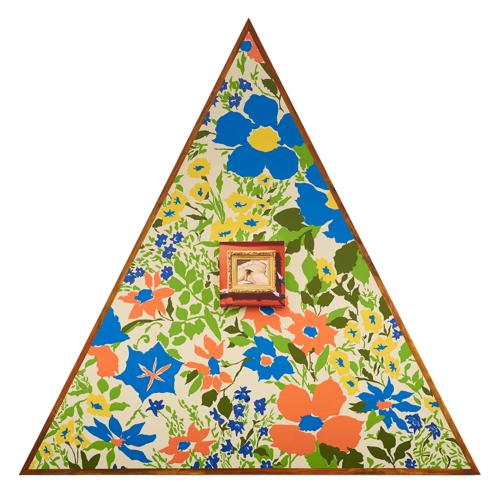
“L’Origine du Monde” is a painting made by French artist Gustave Courbet in 1866. “L’Origine du Monde on Instagram” is a reverent devotion to that painting, its legacy, and the role it’s played in artist Kelly S. Williams’ life. The Nashville native spoke with the Scene about her painting and the Courbet painting that inspired it.
“That piece has quickly become one of the favorites,” Williams says. “I follow the Musée d’Orsay on Instagram, and about four years ago I was, you know, casually scrolling through, and I saw these posts. This image is based on a screenshot I took, because I was sure they would be taken down, but also because the images themselves were just mind-blowing to me.
“First of all, the gloves of the art handlers. They’re not actually serving any purpose — if you look at the photos carefully, you can tell that they’re staged. The hands are not even touching or supporting the painting, they’re just around it. And the hands had this really creepy kind of unnecessary vibe, like maybe mimicking the way they would touch the body. Or maybe they were trying to showcase and frame this work in a way that, to me, was just totally absurd. And also the red wall that it’s on — I’ve actually seen this painting in person at the Musée d’Orsay, but I didn’t remember it being on that red wall. But of course it’s on a red wall in France — it’s just too good.
“And then also it’s just so fascinating — the scandal of the painting, how and why it came to be made, and the legacy of it, is almost as amazing as the work itself. One of the things that I really love is that it was a commission — it was painted for this Ottoman diplomat, and he kept it in his closet behind a curtain. The way he displayed it is that he’d have people over for dinner, and then bring them into his private chamber and then pull back these curtains, and there’s the painting. The idea of all that going on behind the scenes is so interesting to me, and it folds in nicely with the pure, raw realness of the image. And this was in the 1860s! It’s incredible that the painting, today, is still shocking. The idea of it being made to be kept in someone’s private room, and the way that it was shown, the curtains — all of it is just yes.
“So it’s not only the history of the painting, but the way it was displayed, and how it’s treated now. For me, the vision of it behind curtains, shown in that original way, kind of led me to this framing of the painting with the triangle. There’s this on-display feel, and I’m pushing that further. The framing with the faux wood was just my way of creating an altar, a showpiece, a viewing room. Giving it all those things that I think it also originally had. It’s a deeply appreciative devotional altar to that painting.
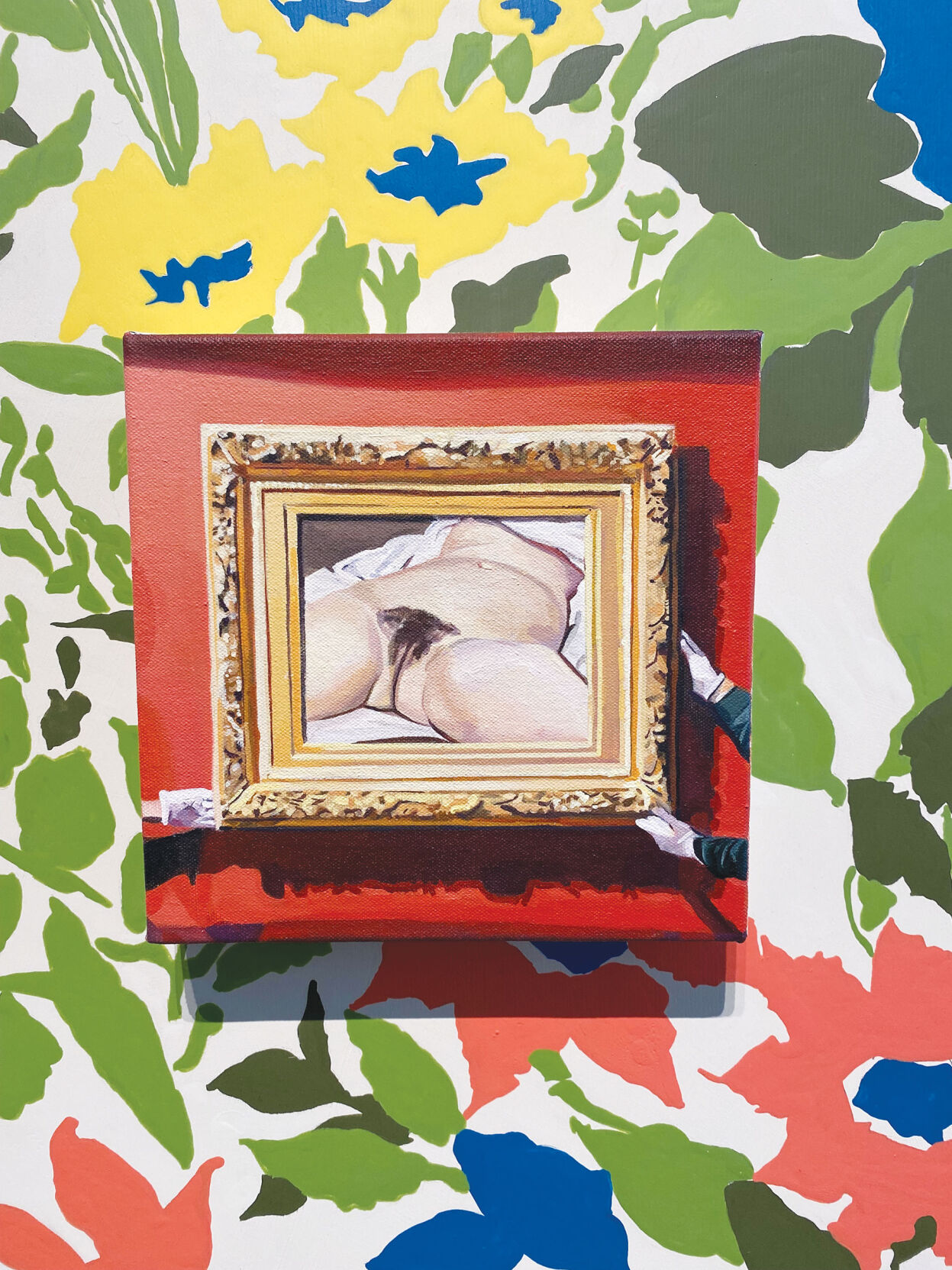
Detail from“L’Origine du Monde on Instagram,” Kelly S. Williams
“The floral pattern is based on a folding screen that I found in a junk store in Belle Meade probably 25 years ago. It came with that contact-paper pattern on it — I think it was like a drawer-lining paper but they used it kind of like a wallpaper. So that screen, that object, I carried it with me to grad school, and I’ve had it with me forever in the studio because it functions as another wall, another way to look at paintings. So I’ll set it up sometimes while I’m working on something else, and hang things that I’ve been working on on it, and look at them, just visually put it in my eyesight. It’s an easy way to make a movable wall. So that screen has been with me, and that pattern has been with me, it’s been imprinted in me for so long.
“That pattern also evokes in me this kind of 1960s and 1970s kind of feeling of horror. When I think of the scariest movies that I’ve ever seen, they’ve been made in that timeframe. These early movies that I saw, they scared the shit out of me. So that pattern brings that to the forefront. There’s something Picnic at Hanging Rock about it that has this ominous feel to me. And I was trying to get to that place.
“I mean, this has been a fucking weird time! Everything’s become more horrifying. I think this show is a direct result of really being alone in the studio for a while, and just working through some of that.
“But I have always loved ‘L’Origine du Monde.’ I mean, it’s been one of the paintings that I can look back at and see how it’s been formative for me. And just because I’ve had this formal art education, and even growing up here, I was able to indulge in Courbet and Manet. Realism, for me, was it. Discovering it was the moment when I found works of art that I wanted to make. So for me, that painting has always been meaningful to me.”