
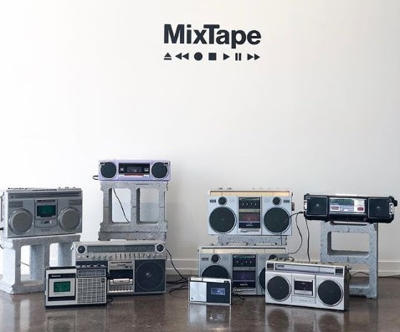


Artists often communicate the ideas of social movements to the wider world, transmitting their ideals and strategies in the moment while codifying symbols and creating documentation for future generations. That's why in times of political flux and social anxiety it can be helpful to look back at resistance movements through the lens of art. Nashville-based artist Vesna Pavlović offers a chance to do just that with MixTape, a photography installation on view at Zeitgeist through Oct. 27.
Pavlović is one of Nashville’s most internationally-known artists. Her work is a sort of cultural anthropology, often dealing with national identity in both an historical and diaristic sense. With MixTape, she’s curated her own photography from 1990s Serbia during the collapse of Yugoslavia — a time of political upheaval, civil war and hardship. Pavlović was an early photographer for the music magazine Ritam in Serbia's capital city Belgrade. She created an archive of concert photos, which she displays beside photos of student protests, street performances and demonstrations of peace groups like Women in Black.
On Saturday, Oct. 13, the gallery will celebrate MixTape with a heady combo: Vladimir Jerić Vlidi will be on hand to discuss Pavlović’s exhibition in the context of Serbian history. And Nashville musicians will play their own translations of songs by bands from the former Yugoslavia. Pavlović selected the songs and collaborated with Loney John Hutchins — music director of Cleftmusic — to select Nashville musicians, such as Dumbsigns, Lambda Celsius, The Mute Group, Lylas, Patrick Damphier, The Robe, Sehr Modern, The Altered Statesman, The Styrofoam Winos and Sugar Sk*-*lls. Pavlović and Hutchins provided musicians with translations of the lyrics along with the phonetic transcriptions. (The songs are performed by Nashville musicians in Serbian.) According to Pavlović, the results aren’t so much covers as they are translations that bring the music into the context of contemporary Nashville. The resulting mix tape is produced by Hutchins and available on SoundCloud, with cassette tapes soon to come.
In the exhibition, Pavlović set up old-school boomboxes around the gallery that play the mix tape. There are few things as nostalgic to Gen Xers as mix tapes. The act of making one is so much more personal than dragging and dropping songs onto a playlist. Listening to every song as you recorded, handwriting the playlist in tiny block letters on the tape’s jacket, making a mix tape was an occasion to think deeply about the tape’s recipient and to freeze that personal, cultural moment in time. Now, mix tapes act as relics of an obsolete technology, which is a preoccupation throughout Pavlović’s work. But it’s a mistake to think of MixTape as only personal, just as it’s a mistake to think it’s only political.
Pavlović is a careful observer, both in her keen documentation and in her ability to curate her own archives so well. The exhibition sheds light on the value of public space when it’s animated by protest and by art. Don’t miss Vlidi’s lecture, and stay to see Nashville musicians blow the roof off Zeitgeist. Check out Lylas' translation of "Kenozoik" by Serbian new wave band Idoli, below.



