
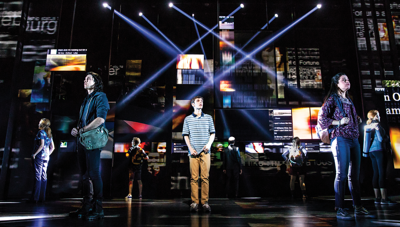


Dear Evan Hansen
Have you ever been caught in a secret that took on a life of its own? Meet Evan Hansen, the teenager at the center of Dear Evan Hansen, the six-time Tony Award-winning Broadway musical kicking off TPAC’s season Sept. 10-15.
Evan, a socially anxious misfit navigating the travails of high school and a complex relationship with his single mother, inadvertently finds himself the center of attention after the suicide of a bullying classmate, Conner. Thrust into the spotlight thanks to a misunderstanding that’s fueled by social media and his own duplicity, Evan must grapple with his newfound fame, the strain it causes on those he loves and an unexpected connection with Conner’s family. Exploring themes of isolation, popularity, grief, family dynamics and the pressure to curate the perfect public persona, Dear Evan Hansen is an emotionally charged, universally appealing tale about the desire to fit in and the need to do good, regardless of age.
“I think that it’s so brilliantly written to mirror the experiences that we are all having, whether that be a teenager or a parent of someone, or even just somebody who tries to lead a well-curated life online,” says Christiane Noll, who plays the role of Conner’s mother, Cynthia Murphy, in the national tour. “It is very much a commentary on where we are right now as a culture on so many different levels — that there is somebody on that stage that is dealing with the idea of wanting to be seen, wanting to be heard, wanting to belong, to be loved, to feel they are good enough. Everybody is going through their version of that.”
Dear Evan Hansen debuted in Washington, D.C., in 2015, followed by a two-month off-Broadway run in 2016, before landing on Broadway in December of that year. The book was written by Steven Levenson (The Unavoidable Disappearance of Tom Durnin, If I Forget) with music and lyrics by Benj Pasek and Justin Paul, the dynamic musical powerhouses behind La La Land and The Greatest Showman. The conflict hinges on a letter that Evan writes to himself, a daily pick-me-up exercise suggested by his therapist. Conner discovers the letter — which mentions his sister Zoe, Evan’s crush — on a printer at school and, after tormenting Evan about it, pockets it. When Conner takes his own life later that day, his parents mistake the letter for a suicide note and Evan for a close friend. Conner’s family reaches out to Evan in hopes of gaining a better understanding of the son they’ve just lost, and Evan’s inability and unwillingness to tell the truth — propelled by his compassion, his interest in Zoe and his social awkwardness — sets off a chain reaction of deceit, confusion and secrecy. Caught in a maelstrom of sudden social media celebrity and conflicted about his growing fondness for Conner’s family, Evan is forced to confront his deception and the toll it’s taking on him.
The emotionally wrought storyline is leavened with touches of humor and the pop-driven soundtrack, which — like all of Pasek and Paul’s work — is likely to be stuck on repeat in the minds of audience members for days following the performance. But the catchy melodies aren’t all that will stay with the audience. The emotional resonance lingers on, as well.
“Yes, it is an emotional piece, but it really takes you through the gamut of many levels of emotional expression,” Noll says. “So by the end of it you are put through the wringer, but in a wonderful way. It’s quite something. I’ve never experienced anything quite as profound as the emotional reaction that audiences have to this piece.”
Tackling everyone’s innate need to be loved and the lengths people will go to for acceptance, Dear Evan Hansen shines a poignant, thought-provoking if somewhat harsh light on our modern social-media-driven culture and the threats it poses to kids and adults alike. But while the plot and setting are very of-the-moment, the deeper questions this show asks of its viewers transcend time and technology.
“There are people [in the audience] that are doing some major healing and acknowledgement of the troubles that they’ve gone through in their lives or that they’ve overcome,” says Noll. “And we are all struggling and striving to come out the other side together, as it were. You’re not alone, and that’s, I think, the main message.”



