
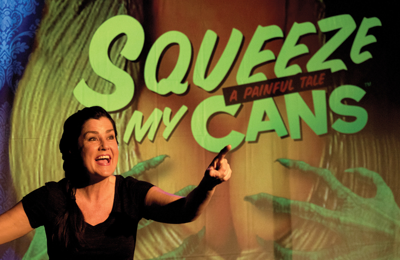


For nearly two decades, Cathy Schenkelberg’s entire life was tied up in Scientology. She’s shared a burger with John Travolta and had coffee with Kirstie Alley. She never did like Tom Cruise, Scientology’s most famous member, but that didn’t keep her from abandoning her burgeoning career as an actress to meet all of the church’s shocking demands while raising her daughter and handing over her money.
Now, after escaping the organization she calls a cult, she’s telling her story — mistakes and all — in a one-woman show titled Squeeze My Cans. The title is a play on words, inspired by the church’s “auditing” process, wherein church members grasp metal, can-like tubes that are hooked up to an “E-meter,” while recalling some of the most personal and/or traumatic moments in their lives. Some have accused the Church of Scientology of using this private information as a means of extortion against people who try to leave the church, but Schenkelberg shamelessly puts everything on the table herself — how she first fell into it, why she went along with it for as long as she did, and how she finally got out.
On a recent visit to Nashville, Schenkelberg sat down with the Scene to talk about her experiences and give more insight as to why she’s now sharing her story with the world, instead of running far away without ever looking back.
I want to start with the show. Can you give us a brief synopsis? The show evolved from spoken-word pieces — I started writing these seven-minute, eight-minute spoken-word pieces. I’d always wanted to do a solo show, but I had no idea I would be doing it about getting out of Scientology. I started to take these pieces and go, “Oh, I could actually do a whole show.” I wanted to include the audience in on the ride of how a Catholic girl from Nebraska, family of 10, gets into a cult. I take you on that journey. As a Scientologist, you get counseling or auditing with an electronic device, an E-meter. I was able to take the audience back to what happened in my life and in my childhood through this auditing.
The auditing is the process of recalling any sort of trauma or experiences you’ve had in your life, right? Right. They like to take you to a moment and go earlier, earlier. Now, in the beginning it’s fun. You do these courses, and you feel like you belong to a group. I was looking to belong somewhere, and I met a Scientologist, an actress, that I really liked in Chicago. That’s how I stepped in.
Obviously, the topic of Scientology is very provocative, and it’s something a lot of people want to know about, but the church is also infamously litigious. Have you heard from them? Are you expecting to? No, not too much. It’s my story. I had lawyer friends come see [the show] and say, “It’s your story, it happened to you.” Also, I have no money. I kept every invoice, every document of everything I ever did in Scientology. I got every commendation letter, I kept every invoice of money I donated. I made copies and I archived them into a safe space, because I’m paranoid. The church says your folder, your counseling session is confidential. Guess what. It’s confidential until you step out and speak out. In my show, I basically lay out everything that they would’ve pulled out of my folder anyway.
Were you ready to share everything from the very beginning, or did it take some psyching up? It was hard when my mom saw it, because I didn’t want to embarrass her. I didn’t want to hurt her or make her feel uncomfortable. It was moving for her to see it — I get choked up — because she lived a lot of it. There was a paper that interviewed her after and said, “Barb, was this pretty much the truth here?” My mom says, “Oh my gosh, she left stuff out.” I’m not being mean, I’m only telling my story.
My goal is to hit the vulnerable 20-something before they get involved in a cult. When people go, “How could you be so stupid? It’s all out there.” It wasn’t. Once I got in, you realized if you looked at the internet, when it was just starting up, or read the newspaper or listened to someone’s black PR about the church, it would cost you more money in your counseling session, because you listened to someone saying something bad about the church. They’re suppressive.
Have you found that the internet and social media have made it easier to connect with people outside the church, to make that transition of getting out easier? I just got two calls from two active Scientologists that are leaving the church — I couldn’t divulge their name — who have been reading about me. I had 10 people show up at my show — all under the radar, they go under different names on social media — who have family members connected to the church, so they cannot leave because they’ll risk losing their mother or their daughter. There’s a couple people that if they reached out to me, I would forgive them. People still owe me money. I don’t care, because I don’t want to spend any more of my time, which is the biggest loss for me, more than the money.
Is this a cathartic thing for you, then? That is the operative word, “cathartic.” In the show, it’s funny, but it’s also emotional. Someone said after they saw the show, “Aren’t you exhausted?” I’m exhausted, yes. I’m exhilarated, but also I get emails through my website or through Twitter or somebody writes a private message that I don’t even know, and they tell me they were in a cult. It was a job cult. “I was in a job I hated, your show reminded me of that.” “I was in a 17-year relationship with an abusive man.” This woman who is a Mormon, she lost her family because she left the Mormon church. That’s the beauty of the show, and that’s what heals me, because I don’t have money to go off and get therapy.
Ex-Scientologists have written books, made documentaries. Why’d you choose stage as a way to tell your story? I graduated with a degree in musical theater. I was a working actress in Chicago. I was young, I got involved in the church, and they kept saying, “Do this first, and then you can get back to your career.” Every level I finished, I was like, “I want to go to New York and audition. I’m a singer.” What happens is, you open up this can of worms and they say, “Oh, if you don’t move on to the next level, you could get sick and die.” Like, what?
Wait, they would tell you that you would die? Yeah, you could physically pull in illness, disease or even death. I got indoctrinated. I’m doing the fun stuff, and all of a sudden I open up this can of worms, and I’m like, “Fuck.” Two decades are gone. Just under two decades, and I’m now middle-aged.
You use comedy as a way to cope with these things, these experiences that can be very traumatic. It’s therapy for my soul, because having your daughter crawl into bed when you are just about to jump off the deep end, and put her young little 12-, 13-year-old arms around you and go, “I would be so F’d up if you left me.” That was a point where I was trying to get out. I had already decided I didn’t want to do it anymore, but I was so invested in it. I had my agent, my manager, my tax guy — they were all Scientologists. My dentist, my doctor, my dermatologist all shunned me. I still don’t have an on-camera agent.
A lot of people want to see Scientology end. Do you see it ending? It would only end if there was a revoke of the tax status. They own billions of dollars in property. That’s why they buy property, because they have to put their money into something because they’re not-for-profit.
Do you care if it ends at this point? I’d love it to end, but here, look at this way: There’s offshoots of everything. Since the beginning of time. It’s going to be a pyramid scheme of another kind.
It sounds like whether or not Scientology continues, you’re ending it in your own way. That’s maybe the important part. A lot of people that got out don’t want to talk about Scientology. That’s their choice. Other people want to speak out, that’s their choice. You find your route and — just like a couple that’s married and raised their kids and now they’re empty nesters — you have to reinvent yourself. I don’t love growing old, but it’s inevitable. Why not make it the most fun and do something good that helps others? I can’t take the church down, nor do I want to, but if I can keep one or two people from joining? It’s the same thing. My story’s no different than half-a-million people, it’s just that their scenario’s different. What they experienced is probably similar, because it’s that feeling of, “I’ve got to get out of this.” I remember at one point I said, “This would be a tough religion to leave.” I said it to the woman who got me in, and she goes, “Why do you say that?” I go, “Because they hold your family over your head.” The church says it doesn’t, but it does.



