

In the documentary about the artists that screens in two separate locations at the Frist's 30 Americans exhibit, collector Mera Rubell — whose conviction and shaded granny glasses bring to mind Yoko Ono — asks artist Mickalene Thomas to relay a story about the time she spent as a security guard at the Brooklyn Museum. Thomas was a student at Pratt during the controversial Sensation exhibit, and as part of the school's programming she was charged with guarding Chris Ofili's "The Holy Virgin Mary" — the piece that was demonized by then-Mayor Rudy Giuliani for its depiction of religious iconography using elephant dung and images of female genitalia lifted from porn mags. "That was an important time to be there because that was the first time we were able to see this art in person," Thomas recalls, speaking of the multitude of Young British Artists whose work she and many others had been reading about but never had seen up close or felt a personal, tangible connection to. Could 30 Americans — with its canvases by Jean-Michel Basquiat and large-scale silhouette by Kara Walker — be to Nashville what Sensation was to Brooklyn back in 1999? Perhaps.
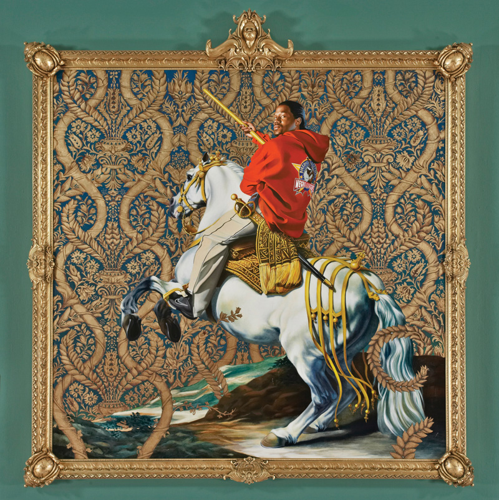
The Rubells — Mera and husband Don, the contemporary art collectors from whom the exhibition is drawn — have amassed a collection that is certainly in line with the Saatchi Collection that yielded Sensation. Encompassing more than 75 pieces from 31 artists, 30 Americans was the first major survey of work by two generations of contemporaryAfrican-American artists when it was organized in 2007. And though nothing in 30 Americans is as incendiary as Ofili's "Virgin Mary" or Andres Serrano's "Piss Christ," bodily fluids make an appearance — namely in Kehinde Wiley's "Equestrian Portrait of the Count-Duke Olivares." Look closely at the larger-than-life painting and you'll see more than a young black man in a red hoodie and a fresh pair of Nikes brandishing a saber — dozens of tiny squiggly sperms, their tails wrapped around the ornamental wallpaper motif like impish tricksters begging you to pay attention to your dirty mind and see them for what they are. Such a symbol of virility undoubtedly would have been incorporated in the deeply symbolic paintings from which Wiley takes his inspiration, had Velasquez and Gainsborough had access to microscopic technology. But the sperm imagery in the painting — as well as in its elaborate gilded frame — is most definitely the product of an artist who grew up knee-deep in the immersive visual culture of the 1980s. It underscores Wiley's artistic intention, which he states with thoughtful determination in the documentary: to "take a stance in opposition to history."
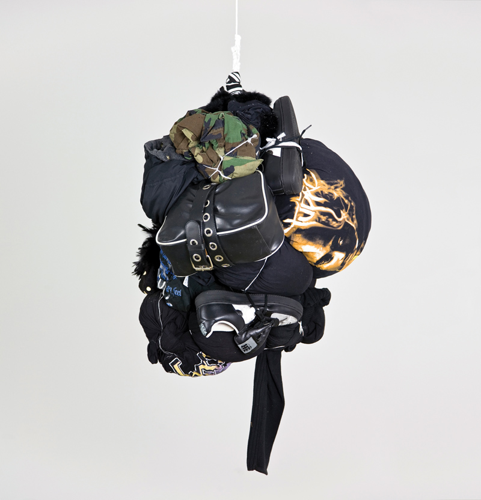
Shinique Smith might be one of the lesser-known artists in the exhibition, and she was only a few years out of graduate school when the exhibition was organized. But the two pieces on display at the Frist are some of the exhibit's most complex and beautiful — "A Bull, a Rose, a Tempest" is a tight bundle of soft materials tied together with rope and suspended from the gallery ceiling. Among the materials are several well-worn Tupac Shakur T-shirts, as well as a pair of high-tops with his image screen-printed on the toe panel. A black feather boa gives the piece the texture of a wild thing, and a scrap of camouflage recalls the idea of black American youth as soldiers in a war — an idea entwined with gangsta rap and the Black Panther movement, both of which Shakur was deeply connected to. The glittery paint of the T-shirts, the cloven-clawed hand that holds Shakur's face in its palm, and the spotlight that shows the shadow of the piece as it swings ominously from its rope are all so heavy with symbolism that it's easy to overlook just how beautiful and sculptural the piece is. Add to that the information that Smith and Shakur both went to Baltimore School of the Arts — Shakur began the same year Smith left — and you're faced with an intimately autobiographical bricolage of American culture.
Deeper into the exhibit is Rodney McMillian's untitled piece from 2005, an enormous swath of dirty carpet the artist took from his grandmother's apartment. The carpet extends from the wall onto the Frist Center floor like a monster reaching out its tentacles, threatening to get into the viewer's space. In an exhibit filled with powerful imagery, McMillian's is the most divisive — there is nothing beautiful to see here, but the artist purposefully includes the detail that this carpet was once in his grandmother's house. This ugliness is close to his heart. Its scale and placement — this is an entire room tacked up onto the wall — forces you to recognize the floor plan of a space that is so different from the gallery it might as well be a parallel universe, and yet this is where at least one of our artists came from.
Nashville-based poet Stephanie Pruitt, in her series of poems written in response to the exhibit, 30x30x30, talks about how repulsed she was by this particular piece, and how suddenly, almost subliminally, she arrived at her understanding of it. "I bristled when I turned the corner," she explains in a video narration she recorded along with the poem. "I almost held my breath because I imagined it would smell, I didn't get too close to it. Then to look around and see all the works surrounding it and the company it kept, I wondered, 'How did you get here? What collector decided you belonged here?' " She then pauses a moment to explain that, if you replace the word "carpet" with something — or someone — else, the piece takes on a different, racially charged meaning. Her poem concludes with: "What gall, what nerve, what very big hairy stained balls you have, dirty nig — I mean dirty carpet."
The Rubells, a white couple who've steadily been building their contemporary art collection since the mid-1960s, certainly have gall, nerve, big hairy stained balls. And thank God for that. How else would we be able to have a conversation about American history in front of a monumental bale of cotton, as in Leonardo Drew's "Number 25," or a circle of Klansman hoods surrounding a noose, as in Gary Simmons' "Duck, Duck, Noose"? How else could we see Glenn Ligon's massive text paintings, Nick Cave's sound suits and Kerry James Marshall's beautiful comic canvases, and be able to bring our children through the galleries to discuss all the ways contemporary art is perfectly suited to discuss complex issues like race, and to see that influence spill over onto the work of our poets and writers, informing the conversation we have about identity in America for years to come? This is an unforgettable exhibit, and its importance should not be underestimated.
Email arts@nashvillescene.com.



