
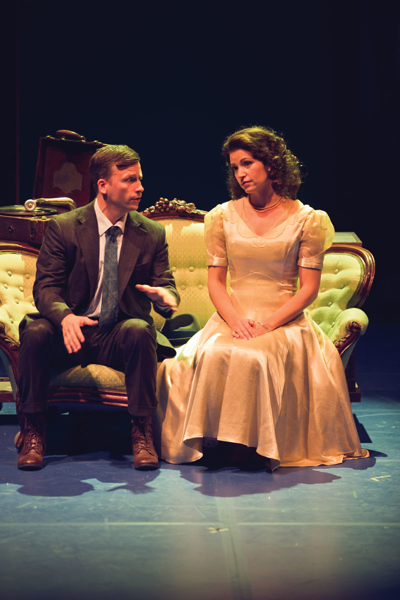
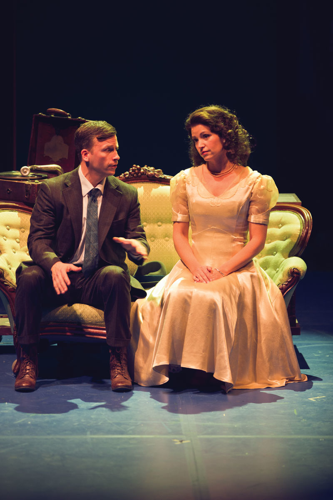
A stage version of Frank Capra's It's a Wonderful Life? It seems almost sacrilegious. Yet there have been various adaptations of the famous screenplay for live theater, including a radio drama by Joe Landry, which was successfully mounted by Nashville Rep in 2007. There have been musical versions as well, including one by Sheldon Harnick and Joe Raposo. Then there is the 1993 straight-up stage adaptation by James W. Rodgers, performed nowadays by regional and community theaters eager to provide something slightly different in their holiday fare.
But therein lies a problem. How can a troupe put its own stamp on a holiday favorite that's as much a part of Christmas as eggnog? And even if it does, will audiences spend the entire time wondering why it isn't more like the Hollywood version they can practically recite from memory?
Studio Tenn's new production of the Rodgers script qualifies as a game effort, with director Matt Logan assembling a superior cast and introducing clever and festive design elements into his staging. If there are people who've never seen the original, they may better appreciate this outing strictly on its own merits — you know, once they've brushed off the dust from their cave dwelling of the past six decades.
But here's the crux of the matter: It would be difficult to satisfy anyone who reveres the Capra film — a harrowing, ultimately elating fantasy about an ordinary man given the chance to see his extraordinary impact on others — with Rodgers' CliffsNotes reworking. The script insufficiently evokes the original's richness of detail, incident and character, and it proceeds through the movie's plot as if by checklist, lessening the catharsis that makes it so memorable.
It's not just the little things that may frustrate purists: the essential replacement of Annie, the Baileys' African-American housekeeper, with a mate for Uncle Billy, or a xylophone substituted for a piano during George Bailey's meltdown. It's the way the script truncates or eliminates some of the film's key scenes, like the Pottersville nightmare montage — whose less eventful handling here reminds us the film is as incident-packed as it is verbally keen — or most of the suicide attempt, which is talked out rather than enacted.
It is unfair to fault a stage production of a classic film for not reproducing all its cinematic elements. (Don't come expecting a swimming-pool scene.) But Rodgers' busy adaptation leaves little more than quickly sketched outlines of familiar moments. The pivotal bank run doesn't last long enough to build the requisite dramatic desperation; even Uncle Billy's misadventures with the $8,000 are not deftly done. To quote Mr. Potter: "Do I paint a correct picture, or do I exaggerate?"
The Capra original hopscotches the line between abject bleakness and mirthful corn. To be fair, some of that tension emerges from Logan's staging. Big issues about community, the effects of economic hardship and the importance of a single life remain resonant, and the characters show occasional pulses of emotion. But sustaining them becomes the show's major challenge — too often not met.
The cast is studded with major local talent, including Nan Gurley, Denice Hicks, Corey Caldwell and Nat McIntyre. And there's admirable work on display. In a clever switch-up, Erin Parker handles two roles filled by men in the original: Mr. Potter's rent collector and the uptight bank examiner who wants to "spend Christmas in Elmira." Parker's ever the pro with both these roles, and also in her turn as the nagging Mrs. Hatch.
But the leads, Brent Maddox and Shannon Hoppe, show how hard it is for even skilled players to compete with actors made iconic by decades of reruns. Maddox and Hoppe are personable, accomplished performers whose casting appears sharp on the surface. Yet they never really jell as a team, which makes it hard for them to dislodge our memories of James Stewart and Donna Reed.
Matthew Carlton's Clarence the Angel is fine, but he does a lot of standing off to the side waiting for his next line — leaving time to wonder if anyone other than Henry Travers could ever really do Clarence justice. Carlton's got it easier than Derek Whittaker, who must portray Uncle Billy in the shadow of master character actor Thomas Mitchell. His performance offers an object lesson on the fine distinction between comic genius and buffoonery. Chip Arnold makes Mr. Potter a mean ol' guy, but his sting seems blunted.
The show's set serves in part as a collection of reference points from the film, e.g., the "George Lassos the Moon" sampler and even the font stenciled on the doors of the Bailey Building & Loan. Logan's costume designs signal precise work as well, noticeably the dresses worn by Ellie Sikes, who portrays Mary Hatch's rival Violet and brother Harry's wife Ruth.
Yet even these details show the strain of competing with a work so deeply embedded in the collective memory. Studio Tenn's task was mighty: to respect an American movie classic and its beloved themes and characters, yet also relate its story freshly based on a wobbly adaptation. While it sounds the expected bells, alas, the angel never quite achieves liftoff.
Email arts@nashvillescene.com



