
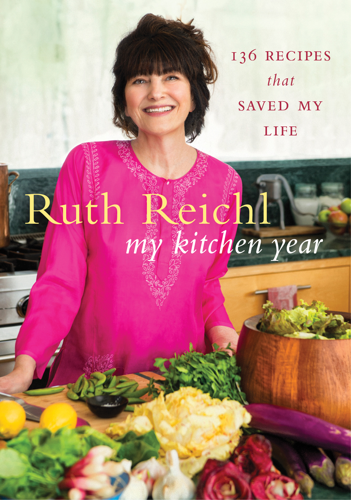

Cook, restaurant reviewer, food-magazine editor, broadcast personality — there's hardly a food-royalty title that Ruth Reichl hasn't held: restaurant reviewer at The Los Angeles Times and The New York Times, author of numerous books, and finally editor of Gourmet magazine. Then, in 2009, when Reichl was at the top of her game, the magazine was shuttered. Where does a food writer go when there's nowhere to go? To the kitchen, as it turns out. Reichl kept a journal of seasons and senses, occasions and obsessions, as she rediscovered daily cooking. That journal became My Kitchen Year: 136 Recipes That Saved My Life.
The recipes are inspired by fresh produce, regional finds, occasion and sometimes emotional need. Photos are unfussy candids and prep shots, outdoor snaps and barely styled plates. Sprinkled throughout are Reichl's impressionistic thoughts, superimposed on the scenery like motivational posters or emotional check-ins. This distinctive style suits Twitter perfectly, and Reichl has become "Twitter famous," as they say, to a whole new generation of cooks.
Prior to her appearance at the Nashville Public Library in conversation with novelist Ann Patchett, Reichl recently answered questions via email:
A funny paradox often happens to food writers — you get so busy with your food career that you don't have time to cook. How frequently did you cook when you were writing about food? Infrequently enough to lose your chops? When I was a restaurant critic, I almost never had the opportunity to cook. I was eating out 12 times a week. And at the L.A. Times, I was both the restaurant critic and the editor of the food section, which meant (ironically) that the only meals I really cooked were the big holiday feasts. (I've always insisted on inviting lots of people for Thanksgiving, Christmas and Fourth of July meals.) When I was at Gourmet, I cooked family meals most nights, but since I rarely left the office before 7, they were mostly quickly thrown-together affairs. And, sadly, you do lose your sense of ease when you cook infrequently. Now that I'm cooking all the time again, I'm much more comfortable in the kitchen.
All that "fast and easy" cooking in the 1990s — it seemed this next generation wouldn't have cooking skills. Have you been surprised by the revival of fairly esoteric skills: handpies and homemade noodles, preserves and fermenting? Not at all. I think the interest in these artisanal, hands-on skills is a direct reaction to the fact that this generation spends so much time in the virtual world. They're eager for a real experience that cannot be reproduced online. They want to taste food, touch it, smell it. And they want to gather around a table and have real meals, with real people.
If I wrote the cookbook of my own life and times, it too would include apricot pie, ma po tofu, lemon-pudding cake, Vietnamese caramelized pork, pasta with bottarga and breadcrumbs. It says something about the period from the 1970s to the 1990s. What exactly does it say about that period from the '70s to the '90s? Two things, I think. Apricot pie is a direct reflection of the growth of farmers' markets. I don't think I'd ever tasted a fresh apricot until the '70s — they were too fragile for supermarkets — and they were a revelation to me. But the Asian dishes, and the bottarga, speak to the fact that it in the mid-'70s we finally broke out of our slavish devotion to French food and began looking to the wider world for inspiration.
What's the cooking trend that's meant the most to you? Home entertaining. One of the things I found very distressing is the way we began spending so much of our private time in public spaces. We met people for dinner in restaurants instead of inviting them over. That's playing it safe. There's a kind of risk in inviting people into your home, and a great generosity in cooking for them. I love that people (and especially young people) are starting to do that again; I think it bodes well for the future.
In your experience, is a restaurant review answering the question, "Does the food taste good?" Or is it answering, "Is the food made properly?" Neither. I don't think a really great restaurant review is about passing judgment. A good review puts the restaurant in context, gives readers a sense of what the restaurant feels, smells and tastes like, and offers them tools to enhance their own experience when they go out to eat.
Do you ever have the sense that you can taste whether a cook really loves to cook — is an artist at work — or whether he or she's more of a technician? Absolutely! Although they're not mutually exclusive. There are artists and technicians who are also passionate about cooking — and that's when you experience true greatness.
You've been very open in My Kitchen Year and other books about your tendency toward melancholy. Which is more therapeutic for that: cooking or dining out? This one's easy: cooking! In a restaurant you just have noise, food and conversation. In a kitchen you have all the sensual aspects of cooking, and it becomes a kind of meditation.
For more local book coverage, please visit Chapter16.org, an online publication of Humanities Tennessee.
Email arts@nashvillescene.com



