


Poet Allen Ginsberg and composer Philip Glass were apparently on to something. In the late 1980s, these noted artists decided to collaborate on an opera, one that tackled what they saw as the pressing issues of the late 20th century. Their work, Hydrogen Jukebox, explored such concerns as drug abuse, gay rights, the very real possibility of nuclear annihilation, and the seemingly endless and senseless conflict between Islam and the West.
On Friday night, Nashville Opera unveiled its new production of Hydrogen Jukebox at the Noah Liff Opera Center. The performance, skillfully staged and terrifically sung, seemed frighteningly prophetic, given the horrific acts of terrorism that occurred Friday in Paris.
Early in the first part, the opera’s six vocalists, accompanied by wild percussion music, launch into a frenetic rendition of “Jahweh and Allah Battle,” a song about the perpetual war in the Middle East. A video screen behind the performers showed clips of smart bombs obliterating targets. Where will this all lead? Hopefully not to the scene in the second part, where soprano Hannah Brammer dons a pair of black wings, making her look like an angel of death for the song “Nagasaki Days.”
John Hoomes, Nashville Opera’s artistic director, is presenting a Hydrogen Jukebox that’s about as close to the work’s original intent as one can get. The opera is being staged in its entirety — all 20 numbers contained in two parts — without cuts and, most importantly, without censorship.
Probably the biggest challenge this opera posed to the audience on Friday was its lack of a linear story. In that respect, Hydrogen Jukebox is more like a song cycle than an opera, a sort of beatnik Winterreise with a chugging, churning minimalistic soundtrack. Ginsberg’s various poems, however, do have interconnecting and overlapping themes, and Hoomes made the most of them.
When the opera was originally staged at the Spoleto Festival in 1990, the six vocalists were dressed as archetypal American characters – waitress, policeman, businessman, cheerleader, priest and mechanic. Hoomes wisely avoided this hackneyed approach, which, among other things, would make the opera’s cast look a little bit too much like the Village People.
Instead, he dressed all three male and three female vocalists the same way, in a jacket, tie and tan slacks, a sort of 1950s Leave It to Beaver look that prevailed when Ginsberg first began publishing his hyperemotional and often explicit verse. Speaking of explicit writing, Hoomes noted that this production would confront all of this opera’s adult themes head on, and it did. However, his treatment of such motifs as gay rights and sexual liberation were artistic and highly stylized.
In the second part’s “The Green Automobile,” for example, the vocalists mime various sexual acts, but they do so only briefly and fully clothed. Admittedly, at the end of the opera, the singers do strip down to their underwear. But they then proceed to sing “Father Death Blues,” an a cappella choral number that’s so immediate and emotional that one is entirely focused on the beauty of the music, not on the singers.
Glass’ music, by the way, occasionally suffers from a certain sameness, from those all-too-familiar arpeggio sequences and oscillating chord patterns. But in this opera Glass thankfully expanded his musical palette, creating tunes with richer harmonies and melodies. The score also includes some raucous saxophone playing that calls to mind the wild jazz scenes in Jack Kerouac’s On the Road.
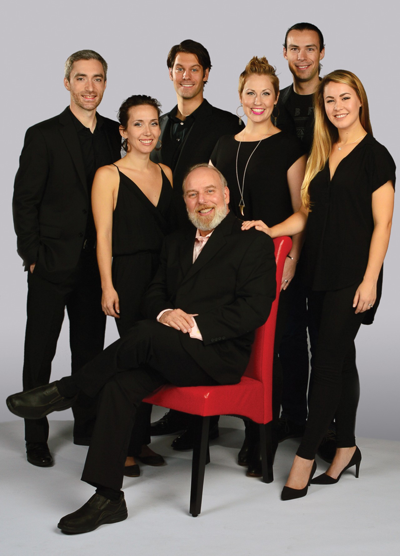
The vocalists — sopranos Hannah Brammer and Rachele Schmiege, mezzo-soprano Caitlin McKechney, tenor Stefan Barner, baritone Patrick McNally and bass-baritone Peter Johnson — sang these melodies with style and sensitivity. Conductor Dean Williamson, making his debut as Nashville Opera’s new music director, led his small ensemble of winds, synthesizers and percussion with polish and precision.
Special mention goes to the actor Henry Haggard, who plays the role of the Poet in this production. Admittedly, Haggard looks more like George Carlin than Allen Ginsberg. Nevertheless, he expertly channeled the emotions of Ginsberg’s poems. And in this opera’s best number, “Wichita Vortex Sutra,” Haggard performed with a level of drama that rivaled (even surpassed) Ginsberg’s best readings.
Hydrogen Jukebox repeats Saturday night and Sunday afternoon. Opera fans who aren’t afraid to venture beyond their usual comfort zones would do well to attend.



