
Vanderbilt University is celebrating the relocation of its fine arts gallery to the rejuvenated Cohen Memorial Hall with an exhibit of selections from the school's permanent collection. The show's title, Eye & Mind, references the philosopher Maurice Merleau-Ponty's essay on Cézanne, which emphasizes the importance of achieving a personal perception of a piece of art while at once comprehending its historical context.
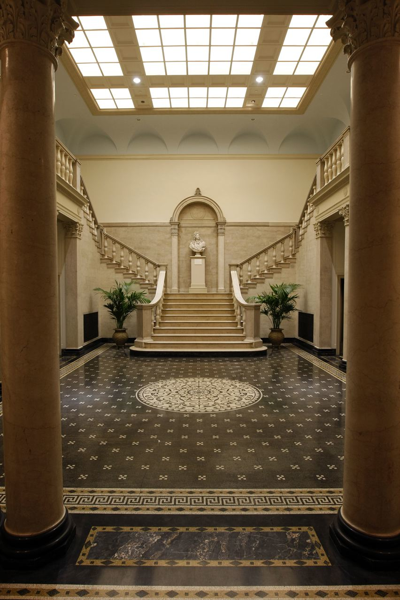
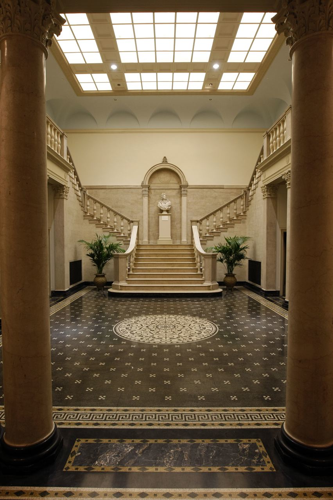
That philosophical approach is just as applicable to the building itself as it is to the artworks on display. Cohen Memorial Hall's tasteful renovation last year is the latest episode in the building's long and colorful history. In 1926, Mrs. George Etta Brinkley Cohen made a generous contribution to the George Peabody College for Teachers, and the very next year the design contract for the structure was awarded to McKim, Mead and White — arguably the foremost architectural firm in New York at that time. The building was to be a fine arts museum focused on deepening the aesthetic tastes of future art teachers through direct exposure to the art world's finest works.
Mrs. Cohen's gift carried a few stipulations, such as the construction of an apartment for herself on the east side of the third floor, where she lived from the time of the building's completion in 1928 until her death in 1930. Undoubtedly her finest proviso was the single grand staircase that curves up the building's three stories. A marvelous photograph of Mrs. Cohen in full regalia posing at the bottom of the stairs hangs on a wall near the marble banister. In 1979 Peabody College merged with Vanderbilt University, and the studio art program resided on the first floor of Cohen Hall until the 2005 opening of the E. Bronson Ingram Studio Arts Center. The 2009 overhaul elegantly furnished the 80-year-old facility, at 1220 21st Ave. S., to house the Vanderbilt University Fine Arts Gallery, the Department of History of Art, and the Department of Classical Studies. With roughly 6,000 pieces in the university's collection, the application of the gallery to the curriculum is once again the central function of the Fine Arts Gallery.
Eye & Mind draws together an assortment of pieces from the collection that, though eclectic, shed considerable light on one another. The amber watercolor-like etchings and mezzotint landscapes of Joseph Mallord William Turner hang across from Childe Hassam's "The Skyscraper Window," a painting of a woman from the American leisure class, the caretakers of culture. She marvels at the expanding modern city without, but the stylish simplicity of her earthy room and timeless dress robes make her seem nostalgic for the naked land beneath the spires of the new world. Though Turner's and Hassam's works are separated by more than 100 years, they are both verses in an ongoing dialogue. Just as the rusty crags of Mount Saint Gothard await a sunrise of undreamed color, so does Hassam's cultured lady, in her blue room, long for the dark golden earth.
The sentimental threads running through the exhibit are tempered by William Hogarth's utterly political pair of etchings, "Beer Street" and "Gin Lane." Because beer was a product of England, it is depicted as stimulating the people toward joyful industry. In "Beer Street," lively fishmongers drink to their health as diligent masons erect scaffolding in the distance. But gin was a product of France, and according to "Gin Lane," leads to miserable debauchery and bedlam. A man and a dog chew on opposite ends of a bone. A cadaver cradles his jug of sweet poison. A madwoman funnels liquor into her baby's mouth. Most of the children in the image are not so lucky. One falls, neglected, from its mother's breast. Another is skewered on a pike while the murderer marches through the wreckage brandishing the pole like a baton. Instead of the shining scaffolds, the skyline sports collapsing buildings with fallen walls that reveal an occupant dead at the end of a rope.
To put the spectrum of the exhibit into perspective, the gallery is capped by Vanderbilt's Samuel H. Kress Collection of Renaissance paintings. A number of sculptures are on display to complement the collection. These include one of the finest pieces in the show, "The Crucifixion," a tiny ivory work made by an anonymous Northern French artist circa 1320-1340. Looking at the detail of the mourners' miniscule hands as they kneel at the feet of Christ, you might wonder if the artist ever considered training a mouse to use a hammer and chisel.
On the opposite end from the Kress Collection hangs a large serigraph on stainless steel by Robert Rauschenberg. The other works in the gallery are visible in the piece's reflective surface, and are as much a part of the piece as the images that are printed directly upon it. This master of modern art understands that while the urge of the artist is to cross into uncharted roads, the only way to sustain the journey is to acknowledge where we've been.
Email art@nashvillescene.com.



