
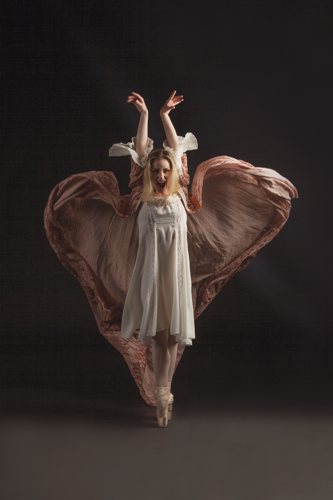
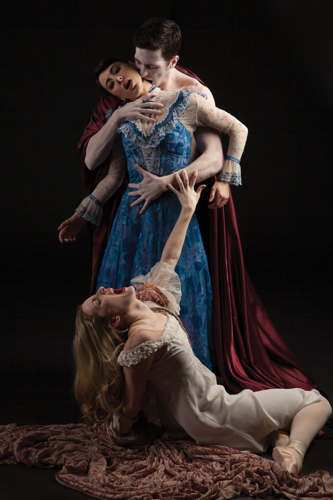

Over the years, Nashville Ballet artistic director Paul Vasterling has created numerous contemporary dances. But like an avid art collector who's run out of wall space to display his treasures, Music City's most prolific choreographer has been unable to showcase many of his favorite contemporary works.
"We only have one contemporary dance program a year, and that's our Attitude program in February," Vasterling tells the Scene. "So a lot of my contemporary work has had to sit on the sidelines. And that's a problem, because the emergence of OZ Arts Nashville and [the dance company] New Dialect has proven that there's an appetite for modern dance in Nashville."
This weekend, Nashville Ballet will attempt to satisfy this demand with the debut of its new Fall Contemporary Series at TPAC's Polk Theater. The inaugural program will include one of Vasterling's most popular contemporary works, his seldom-seen Dracula. Two of the late choreographer Salvatore Aiello's finest dances, Afternoon of a Faun and Satto, are also on the bill.
First staged in 1999, Dracula was an obvious choice for Vasterling, a Gothic enthusiast who — like noted vampire chronicler Anne Rice — is a native of New Orleans. Bram Stoker's 1897 Gothic horror novel has inspired a number of American choreographers to create ballets. More often than not, these dances have been literal adaptations of the novel. Vasterling, however, rejected this linear approach, preferring instead to focus on the essence of the story.
"I see Dracula as an inner conflict between good and evil," says Vasterling. "I also see it as an inherently Gothic story, which is all about heightened emotions, about descriptions and other story elements that are over-decorated. This kind of Gothic exaggeration is what informs our production."
Vasterling's interpretation looks at Dracula as an especially twisted kind of Byronic hero, a dark and alluring romantic character who is at the mercy of his own self-destructive forces. Like any good 19th century Romantic hero, Dracula is obsessed with finding his immortal beloved, a woman who will love him as much he loves her. But such intimacy proves to be a chimera for the hideous bloodsucker.
"Dracula searches for love but defiles every woman he touches, turning them into vampires like himself," says Vasterling.
Humans and vampires are clearly distinguished in the choreography. Vasterling sees humans as creatures of air and light, so he uses classical ballet techniques (dancing on toes in pointe shoes) to suggest the land of the living. Vampires are creatures of the earth, of soil. So they dance, in accordance with modern techniques, without shoes, with their feet planted firmly on the ground.
"I dance Dracula with strong, powerful and direct movements," says Jon Upleger, who dances the title role this weekend. "There's a lot of tension in the arms and legs, which is very different from the elegant, effortless flow of ballet."
The transformation from human to vampire, and from ballet to modern dance, is seen most dramatically in the dancing of Lucy, Dracula's first victim. "As Lucy begins her transformation into a vampire, we see her dancing first with just one shoe on, and then finally barefoot," says Vasterling.
In Dracula, Lucy represents the erotic animal side of human nature. "There's definitely no reserve in Lucy," says Upleger. The character of Mina Harker, in contrast, is the archetype of humanity's rational and chaste side. Mina's fiancé, Jonathan Harker, is as submissive as Dracula is dominant. Aside from being an infinitely creepy and entertaining figure, the madman Renfield serves primarily a practical purpose. "A vampire can't enter a home without permission," says Vasterling. "Renfield provides Dracula with access to Mina."
The music in Dracula deserves special mention. Vasterling set his dance to some of the chamber music of 20th century Czech composer Bohuslav Martin. The composer's Pastorales and Nocturnes for cello and piano, which cellist Matt Walker and pianist Melissa Rose will perform live, provide the vampire with a darkly romantic soundtrack.
"Martin composed some of this music under the shadow of the Nazis, so it's appropriately dark," says Vasterling. The production will also feature a number of sound effects: wind and breathing, interrupted by moments of eerie silence.
The aforementioned Salvatore Aiello, the late artistic director of North Carolina Dance Theater, is represented on the program by one of his most celebrated works, Afternoon of a Faun. Aiello used Nijinsky's original 1912 choreography as his starting point, seamlessly mixing ballet and modern dance. Pianist Rose and flutist Philip Dikeman will perform a chamber arrangement of Debussy's famous orchestral score. Aiello's expressive, gymnastic Satto (Wind Dance) will be performed to recorded music.
Email Arts@nashvillescene.com



