
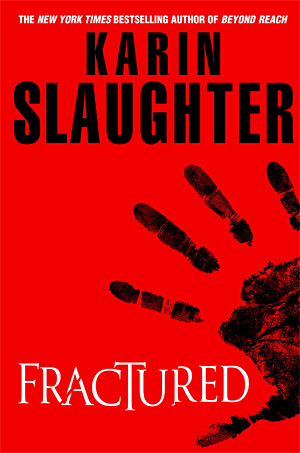


In 2006, Karin Slaughter departed from her popular series of crime novels set in fictional Grant County, Ga., with The New York Times best-selling Triptych, a gritty, realistic thriller set in Atlanta. The book introduced Will Trent, a brilliant dyslexic who manages to hide the fact that he is functionally illiterate as he rises to the rank of detective in the Georgia Bureau of Investigation. Now Slaughter has brought Trent back as the hero of Fractured, which opens with a pair of brutal murders in a fashionable Atlanta suburb.
Although the crimes should be investigated by the local police department, the political connections of one victim's family force an unhappy marriage between the Atlanta PD and the GBI, pairing Trent with police detective Faith Mitchell, a single mom with hidden baggage of her own and a good reason to hate him. As the pair pursue clues that take the case from murder to kidnapping to sexual abuse, inevitable sparks fly and inevitable bonds are formed, creating a memorable detecting duo that seems destined for future outings.
One way to tell just how well Slaughter measures up to her crime-writing competition is with a ruler. Take, for example, this summer's biggest detective novel, Fearless Fourteen, by Janet Evanovich, number guess-what in the comic Stephanie Plum series. Remove the splashy dust jackets, and both books look the same: 9 by 6 inches, about an inch thick. But crack them open, and Slaughter allows barely a half-inch of white space in the margins, while Evanovich's are more than an inch wide. The lines of Fractured are closer together, printed in a slightly smaller font, and the paper is thinner too, adding up to nearly 400 pages next to Evanovich's 300.
There are, in short, a lot more words in Fractured.
This is a good thing. While most American crime fiction tends toward the quick—and quickly forgotten—read, Slaughter's literary depth allows complex characters to probe ugly, brutally realistic crimes in a manner more akin to the PBS series Mystery than to, say, CSI: Miami. The richness of the worlds she creates may be one reason that her novels are enormously popular in England and much of Europe. Slaughter writes crime thrillers for well-read grownups.
Maybe they aren't even crime novels, at least not exclusively. "To Kill a Mockingbird—that's crime fiction," Slaughter said in a 2005 interview in Time magazine. "That's a murder story. Snow Falling on Cedars. Oliver Twist. What's more violent than a bludgeoned prostitute? A lot of novels use crime as a stepping stone to talk about greater issues. So I just think of myself as a writer."
Here is Slaughter the writer describing—in an almost Dickensian display of the physical details—the body of an intruder, killed by a wealthy housewife who surprised the man moments after he had apparently murdered her 17-year-old daughter. "[T]he smell of lavender air freshener and Leo's sweaty, nicotine stench competed alongside the metallic tinge of violent death. At the bottom of the stairs lay the source of the most dominant of all the odors. The man lay on his back with his hands palms up near his head as if in surrender. A medium-sized kitchen knife with a wooden handle and a jagged edge was a few feet from his hand, lying in a nest of broken glass. His black jeans looked soiled, the skin of his neck bruised red from strangulation. The smattering of a mustache under his nose made his lip look dirty. Acne spotted his sideburns. One of his sneakers had come untied, the laces stiff with dried blood. Incongruously, the killer's T-shirt had a dancing cherry on it, the stem cocked at a jaunty angle. The shirt was dark red, so it was hard to tell if the darker parts were blood, sweat, urine of a combination of all three."
The length and chilling realism of her thrillers does not keep Slaughter from allowing Evanovich-like moments of levity from time to time. Late in the book, for example, when the wealthy housewife is trying to restore her shattered family by avoiding the sensational press about them, Slaughter notes:
There were so many wet bags of newsprint at the end of the driveway that the woman from the neighborhood association had left a letter in their mailbox.
"I regret your misfortunes, but Druid Hills is an historical district, and as such, there are rules."
" 'An historical district,' " Abigail had mimicked, thinking the woman had an historic stick up her ass.
The combination of witty and insightful social observation, fully realized characters, rising suspense and sudden violence makes Fractured difficult to put down—even if it does take a bit longer to read than some of its shorter cousins.



