
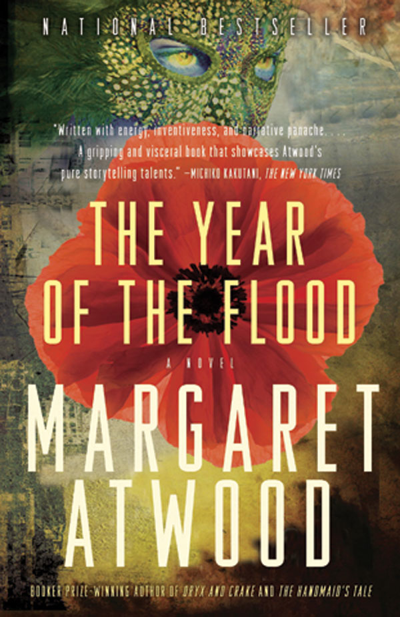

One of the most popular and prolific authors in the world, Margaret Atwood is also among the most gifted writers of her generation. She has written more than 40 prize-winning books of poetry, fiction and critical essays, and she is a writer with the rare ability to create great literature shaped by a powerful social and political conscience. Her new novel, The Year of the Flood, is set in a post-apocalyptic world in which much of humanity has been wiped out by a bio-engineered virus. It is a continuation of her 2003 novel Oryx and Crake. Atwood recently spoke by phone from her home in Toronto.
In both The Year of the Flood and The Handmaid's Tale, people are punished pretty severely for their arrogance, but I take it you don't believe in any sort of karmic justice.
There are always going to be people willing to step forward — in fact, eager to step forward — and say, "Look what God is going to do to you because of your bad behavior." Do I believe in that? No. Do I believe that as the world warms, the winds get stronger? Yes, and warmth creates more evaporation, and what goes up must come down in the form of rain. I do believe that, [but] is some form of karmic justice being worked out? No. Have choices that we have made created a different sort of climate than the one we've been used to for the past couple of hundred years? Yes. Is that going to have bad effects on some people? It's already having them. Is it their fault? No. Fault means they have the moral responsibility, that they've been bad.
Do you think there is any moral responsibility?
In your individual life, absolutely. And once you know that there's a problem, presumably you have some kind of moral responsibility to do something about it. But the problem with the problem that we have today is that nobody quite knows what to do. So I don't think it's a question of telling everybody that they're bad. That's not going to have any positive result anyway. They'll just say, "OK, so I'm bad. So I need to pay my mortgage. What are you suggesting I do? Let my family freeze to death?"
You've used your book tour for The Year of the Flood to promote environmental activism through a traveling theatrical interpretation of the story.
It happened because one of the outfits I am involved with called BirdLife International said, essentially, "How do we move outside the circle we're already inside, and get other people to understand what it is we're doing, and why it's important?" And I said, "Through the arts." At which point they all looked at me.
That was as good as volunteering?
I'm afraid so. I should have said, "Well, you could do it through the Miner's Association; go to them."
Do you plan to continue this environmental activism?
Am I going to set up an office, start fundraising, hire a staff and become a full-time activist? No, other people are doing that. I can support what they're doing, but there's not much point in my duplicating it. Jonathan Franzen — a couple of years ago he set up an initiative among writers, he and Jonathan Safran Foer, that said we would each give one of our reading fees to an initiative called Air/Land/Sea, and that consisted of three American conservation organizations — they were American Bird Conservancy, Farm Forward and Oceana. I'm not going to duplicate what they're doing. I'm going to support what they're doing.
You're not going to do any more theatrical tours?
I think it would kill me, frankly. I'm not 35 anymore.
What will your next novel be about?
It's the third one of the Oryx and Crake [series]. The number three is so much more stable than the number two.
Do you see that as the end of a trilogy?
I never foresee any end to anything, but I would assume that it's the end. I would not predict that it's the end.
To read an uncut version of this interview, please visit Chapter 16 at http://www.chapter16.org/content/imagining-future-not-predicting-it.
Email arts@nashvillescene.com.



