

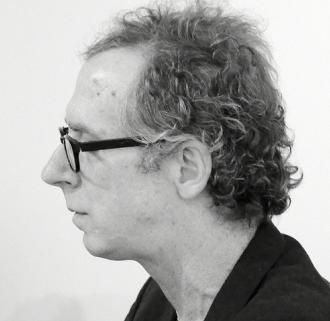
Lane Relyea was the latest visitor at Vanderbilt's StudioVU lecture series, and even with a sparse audience — Colin Powell was also giving a lecture on the other side of campus — Relyea stirred controversy and provided moments of enlightenment for those who had the mental capacity to follow along with his extremely abstract thought process.
From my Critic's Pick:
Northwestern University professor and Art Journal editor Lane Relyea knows a lot about the ways the art world has altered to reflect the cultural sea change of the past 25 years — namely, the post-studio movement and the proliferation of social networks and DIY culture in all arenas of life — and he’ll be at Vanderbilt tonight to share his knowledge in the most recent lecture from the university’s stellar StudioVU series.
"In moments of progress, ruins tend to accumulate in art as in elsewhere."
Relyea told his audience that he was going to try to put what he called "junk art" into context. It was a perfectly thought-provoking beginning to an overall positive, if at times infuriating, lecture. The examples he gave of the wake progress leaves behind — the shadow of its absence, in a way — set the tone for an hour of abstract thoughts that were dense with implications. Today, Relyea proffered, fewer people are actually participating in a nuclear family unit, and yet we're constantly bombarded with the notion of family values. It was one of those instances where a lecturer says something that sounds so simple but carries with it so many possible connections that I got lost for a few minutes thinking of other examples of the same "absence-leaves-behind-an-empty-vessel" situation.
Relyea came up with one for me, and I snapped back to attention: D.I.Y. culture proliferates in the wake of globalism. It's this, Relyea posits, that is the impetus for the relational aesthetic movement — "intimate connections set against an international backdrop." So, as opposed to the 1980s where fragmented work by artists like David Salle was considered a reaction to flipping channels and being in several places at once, today's art treats our constant flux as a positive — more empowering than burdensome.
To match our constantly changing attentions, the exhibition spaces that are being created now consistently avoid closed spaces, opting instead for open-air feelings of outdoor market. And artists, particularly sculptors, are creating work that puts the ruins of old social structures on display.
The questions asked at the end of the lecture were interesting simply because they were so reticent to accept Relyea's perspective. One man seemed almost angry when he asked how Relyea could be so kind to these "new bricolage" artists without considering their skill level. Relyea said that the artist's skill and intention is not really his concern — as a critic he rarely waits for an artist to tell him what the work is about; in most cases Relyea will instead let the artist know what he or she has just made. That gives artists an awful lot of leeway, and gives critics perhaps more power than they deserve. But in the right hands — like Relyea's, which seem capable and trustworthy — this power is enlightening.



