
Art follows stylistic trends that vary from season to season, year to year, decade to decade — schools are established and rebels overturn old orders before becoming the next to topple from the mountain. But the art world is mostly driven by business trends — the moves made by collectors and dealers have much bigger impacts on the state of art than the messy business of aesthetic concerns, which are mostly sorted out in the aftermath of a shift in the culture or, more importantly, the market.
One of the best art books I read this year was the new edition of Abstract Expressionism by David Anfam. The slim volume speaks to the influence that abstract expressionism continues to have on American painting. Abstract expressionism came of age after World War II, but its influence on painting was so enduring that emerging 1980s painters like Julian Schnabel and Jean-Michel Basquiat were labeled neo-expressionists, and Basquiat emulated the tortured, self-destructive clichés of abstract expressionism's enfant terrible, Jackson Pollock. Pollock's legend looms so large that he was eulogized with a biopic feature film as recently as 2000, and the Dallas Museum of Art is currently hosting its "once in a lifetime" exhibition, Jackson Pollock: Blind Spots — a survey of the artist's black paintings.
A quick flip through any recent edition of New American Paintings reveals that the medium is being pushed in countless directions in the U.S., but mega-dealers Jeffrey Deitch and Larry Gagosian's recent Unreal figurative painting extravaganza at Miami's Art Basel may signal that the market is moving on, even if artists still feel the sway of those midcentury trends.
The ideas that abstract expressionism brought to American canvases are in full effect at Josh Elrod's new show at Coop Gallery. In the 2000 Pollock biopic, Jeffrey Tambor plays art critic Clement Greenberg, saying, "Paint is paint. Surface is surface." Looking back on abstract expressionism with his Modernist Painting radio broadcast for the Voice of America in 1960, Greenberg said:
Modernism used art to call attention to art. The limitations that constitute the medium of painting — the flat surface, the shape of the support, the properties of the pigment — came to be regarded as positive factors, and were acknowledged openly.
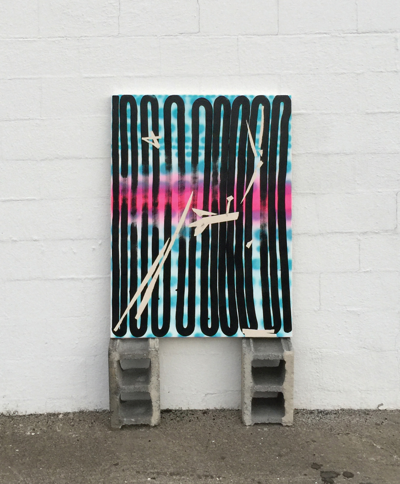
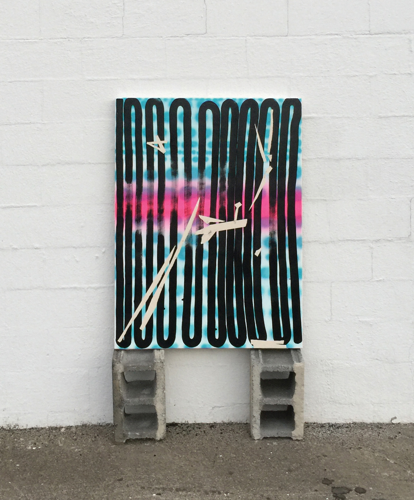
Elrod's One Liners is an exhibition of single, mostly unbroken black lines painted against colorful backgrounds. In his artist's statement, Elrod writes, "the lines are executed in a single sitting, as if they were recorded 'takes,' " and, "Painting a straight line — which could be a very precise and deliberate act — could also become a dialogue with the line itself." Elrod's lines don't represent anything or point to anything. The subject of these very Greenbergian paintings is painting.
The backgrounds of the four paintings in this show — two larger canvases and two smaller ones — are all just lightly kissed with what looks like pastel spray paint. Blues, pinks, grays and purples conspire cloudlike formations and the luminous strata of setting suns. The candy colors and the cheap, stinky medium mesh perfectly with the irreverence of Elrod's punning title, and they're in keeping with traditions established by those American painters of the 1940s and 1950s: "Full Fathom Five," one of Pollock's earliest so-called drip paintings, featured cigarette butts, coins and keys embedded in the surface, which was covered in cheap house paint. Pollock eventually graduated to the kind of industrial gloss enamel paints that were used on cars.
But if Gagosian and Deitch have their way, and the market for painting in America makes a hard turn toward the figure, Elrod is ready for that too: The show includes a scene-stealing display of colorful drawings on paper that offer a cartoonish counterpoint to his canvases. Much more expressionistic than the unilinear pieces, these chromatic, chaotic renderings bring loads of energy to their legal-size trappings, which made me wonder what they might look like on large canvases of their own. These are still mostly abstract affairs, but they feature enough skulls, faces, torsos and limbs to satisfy even the most nervous investors looking to buy in to tomorrow's trends today.
Pendulums swing in creative media and in markets, and in the next 10 years we might see a continued trend away from abstraction. And in a world that seems progressively unreal, I could see a comfortable realism making a comeback: In an unseen tomorrow marked by global warming, endless war, displaced populations, racial tension, total surveillance, random-seeming terrorism and ceaseless financial strain, the most exotic thing in the world might be a painting of laborers breaking a stone, or white sheep dotting a green hillside.
Email arts@nashvillescene.com