
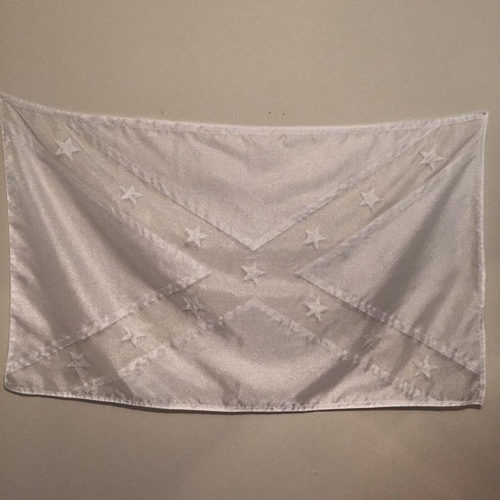
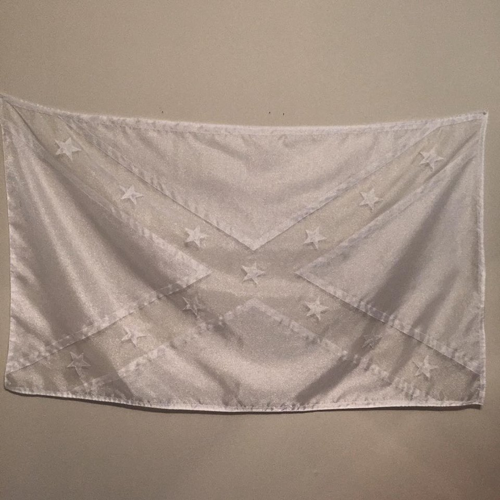

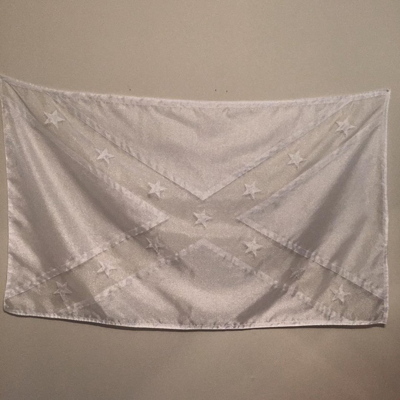

"White Flag," Jessica Wohl
The Confederate flag may have been removed from the South Carolina state house, and Nashville's art scene may have hosted an overwhelmingly positive discussion about Confederate imagery at White Avenue Studio last Friday, but the idea of the rebel flag and its place in art is still up for debate. The first work I've seen from a Nashville-based artist that directly addresses the Confederate flag and its meaning is Jessica Wohl's "White Flag." Wohl is an artist and professor at Sewanee University, and I spoke with her about the piece via email. Here's what she had to say about it.
I started thinking about this piece back in March, but couldn't act on it because I had to finish the show at Zeitgeist — so it's just been stewing, waiting for me to have some free time.
It was heavily influenced by my interpretation of the race relations here at the university after I moderated a really positive discussion about race. Our student body, motivated by the SAE bus chant at the University of Oklahoma, organized a panel discussion on race where students were invited to anonymously write questions on notecards, and I read some of the questions aloud to the audience. These questions were then answered by a panel of students that included the Presidents of the InterFraternity and Sorority Councils, Posse Scholars, and other student leaders (white, black, Latino and mixed-race, if I remember correctly). In reading these questions, and hearing the testaments of the students on the panel, it became apparent to me that our students were experiencing, and/or witnessing a number of racially charged incidents and/or "micro-aggresions," but little was being done about it, or even discussed — but the desire to do so was there. And what was really amazing was that students, faculty and administrators filled Convocation Hall — people were even sitting on the floor. There were easily 200 people there, and there were more questions than we could answer- many from whom I assumed to be white students who just didn't understand the plight of their fellow minority students, or who did, but didn't know how to help. They were afraid of getting involved, saying or doing the wrong thing. I realized how much people care about this, and how few people feel confident speaking about it.This of course struck a chord with me, because of my interest in the discrepancies between how we present ourselves versus how we actually are. Our campus, which is really a microcosm for the South, and even our country as a whole, is really living with this invisible ghost of the past that is simultaneously here and not here. Seen and not seen. For some it's ever-present, and for others it's invisible. To imagine the Confederate flag in translucent whites, for me, was a physical manifestation of that ghost, and that thing that lingers in the walls of buildings and in the history books of many institutions, despite all the recent positive efforts to progress.
I also like the metaphor of a white flag for surrendering, and the obvious whiteness associated with those who have traditionally supported this flag. I think of white as a peaceful color, so perhaps the fading of the reds and blues to whites may be somewhat hopeful. Maybe it's a memorial — again, like a ghost. I don't know if I've fully comprehended it all yet.



