
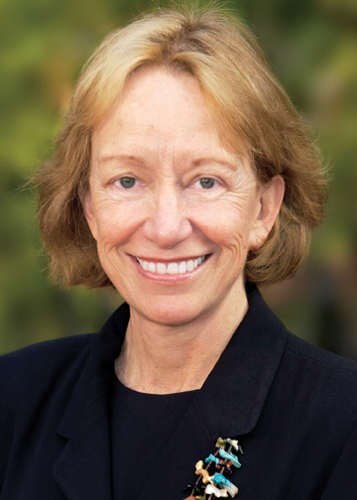


Last year, when Barack Obama appointed his chief Democratic rival, Hillary Clinton, as secretary of state, the media widely reported that his decision had been influenced by reading Team of Rivals, a Pulitzer Prize-winning biography of Abraham Lincoln that emphasized the way Lincoln led by drawing together his opponents. But the book's author, best-selling historian Doris Kearns Goodwin, has been influencing political leaders with her knowledge of the past for years. She was an assistant to President Lyndon Johnson during his final year in office and helped him in the preparation of his memoirs. She taught a Harvard course on the American presidency and has been a widely sought-after speaker to business and political groups. More recently she has become a frequent television commentator on politics, history and current affairs.
Kearns is the author of three other widely acclaimed histories as well as an autobiography (which explains that her love of history was kindled by her childhood as a rabid baseball fan). She will be in Nashville this weekend to receive the Nashville Public Library Literary Award; previous recipients have included novelists John Updike, John Irving and Ann Patchett, and nonfiction writers David McCullough and David Halberstam. Kearns will discuss her career in history and public life in a lecture at the auditorium of the downtown Nashville Public Library Saturday, Nov. 7, at 10 a.m. The event is free and open to the public.
The historian who sets out to examine great American presidents must cover ground that many others have trod. How do you carve out your own space in such an undertaking?
When choosing historical subjects about which many books have been written, it is especially important to find an angle that can bring a fresh approach to the subject. This is perhaps the largest challenge in writing. With FDR and Eleanor, for example, since a very good book on the two of them had already been written, I decided to focus on the home front in World War II, which would allow me to bring out their relationship but in a different context. With Lincoln, about whom 14,000 books have already been written, I finally came up with the idea of focusing on his leadership style as evidenced by his willingness to put his chief rivals into his Cabinet.
In the course of research, have you ever located source material that had eluded all previous historians? If so, could you give an example, and tell us how you were able to use it?
In writing The Fitzgeralds and the Kennedys I was given access to hundreds of cartons of letters and documents belonging to Rose and Joe Kennedy that had been stored in their attic in Hyannis Port and just shipped to the Kennedy Library. They had saved everything—every dance card, report card, letters to each other and to the children, so it proved a true treasure.
In Team of Rivals, you observe that ordinary people seemed to have an almost unlimited ability to approach Lincoln personally, to shake hands and offer a word of advice or encouragement, even during the war, when assassination threats were common. Do you think the country—and democracy—has lost something now that such contact is no longer common?
For Lincoln, the chance to meet with ordinary people who lined up outside his oval office to talk with him in the mornings was critical. He said these meetings were his public opinion baths, critical for him so that he never forgot the public assemblage from which he had come. This regular contact with ordinary people is much less possible today for our presidents, given security concerns, and is a great loss.
As a public intellectual, you speak and write intelligently on broad aspects of history and the American presidency, and to a general public you trust to understand. How will the state of current academic research—which has become increasingly narrow and inaccessible to all but a few specialists—affect the role of public intellectual in years to come?
The state of academia in modern times, with its emphasis on specialization, has made it less likely that commentators on our country and our culture have the breadth and insight that public intellectuals had even 30 or 40 years ago. Too often, academic research focuses on small topics rather than addressing the large questions that need to be answered by our presidents and our country.
As someone who spends time commenting on important issues both in writing and on television, what do you think the current form of cable news debate has done for democracy and public discourse?
The problem with cable news debate is that it puts a premium on people arguing from more extreme views. The thought is that this makes better television, but it has helped to undermine the middle.
What other historians, past and present, do you most admire, and why?
My heroine is Barbara Tuchman, a first-rate narrative historian who taught me that even if you are writing about a war, you have to imagine you do not know how that war ended so you can carry your reader with you every step along the way, from beginning to middle to end.
What significance, if any, do you think the Nobel Peace Prize will have on the Obama presidency?
Hopefully the Nobel Prize will remain for President Obama a challenge of excellence in public leadership that he will try to live up to.
What are you currently working on?
I am currently working on the progressive era from 1900 to 1912 told through Theodore Roosevelt, William Howard Taft and the muckraker journalists.
Who do you like in the World Series this year? (Or are you too deep into "Wait Till Next Year" mode to care?)
After so many years of watching the Yankees beat my teams—first the Brooklyn Dodgers and then the Boston Red Sox—there is a big part of me that hopes the Phillies win!
For more local book coverage, please check chapter16.org, an online publication of Humanities Tennessee.
Email arts@nashvillescene.com.



Post a comment as anonymous
Report
Watch this discussion.
(0) comments
Welcome to the discussion.
Log In
Welcome to the discussion.
Keep it clean. Please avoid obscene, vulgar, lewd, racist or otherwise abusive language. Comments featuring hate speech or threatening or violent content will not be tolerated.
PLEASE TURN OFF YOUR CAPS LOCK.
Be truthful. Don't knowingly lie or mislead.
Be proactive. Use the “report” link on any comment that violates our comment policy.
Share with us. We'd love to hear your feedback.