
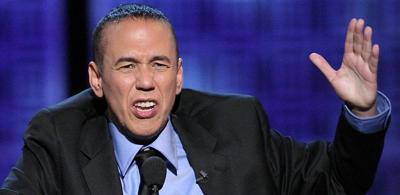
Gilbert Gottfried is the fine line between being “famous” and “infamous.” With a voice and gaze that almost make you think he's being strangled by some invisible phantom of yesteryear's decency, Gottfried has made a career out of toying with topics that are collectively deemed unspeakable. An author, veteran voice actor and stand-up comic with a body of work as lewd as it is legendary, Gottfried's the neighborhood menace every street wished it had.
In a recent phone interview to discuss his appearances May 9 and 10 at Zanies, Gottfried spoke to the Scene. Try reading his answers in any other voice but his.
First question: What the hell do you ask Gilbert Gottfried? You've been around for 45 years doing standup.
I guess the real question is, “Why the hell would you want to talk to Gilbert Gottfried?”
Well, you're sort of a “comedian's comic.” You've got this fearless ethos about you, like you can touch almost any topic. But I'm getting ahead of myself, so let's back up. In the 45 years that you've done comedy, how have audiences evolved?
I don't notice it all that much in clubs, as now there's this other weird creature — the Internet — that's created a whole different sort of audience. I still think that most people have a brain in their head, but sometimes when they get the Internet behind them that it becomes a very weird creature that's created. And it's like there's a lot of outrage on the Internet. A lot of offended people. And I think that the Internet is the new state-of-the-arts way of ringing someone's doorbell and running away.
So you think the Internet has taken over the practical joke?
Yeah, well, it's become ... not so much the practical joke as like ... people who would normally be scared to say something to you now are safe. Now they get outraged, and they'll insult you. It's a very weird thing. ... It's like in Charlie Chaplin's day doing movies, or The Beatles, or these other performers, there wasn't a chance to get in touch with, say, Humphrey Bogart and say, “I thought that Casablanca sucked.” But now there is.
You think that the audiences have become more disrespectful due to the Internet and social media?
It's very odd, because I remember growing up and there were certain columnists and commentators and movie critics and writers that you would listen to. And now everybody has that. There's no lone person you listen to. It's the whole world.
Do you think that the quality of creative works has diminished because of that?
That's a tough one to say. People always have to adapt. It does become a weird thing when ... there's so many people. There seems to be an “outrage of the day.” There seems to be a new villain each day that someone says something that the world of the Internet doesn't like. ... I think it would be harmful to any form of creativity if everyone has to second-guess what they do from now on.
You've got a May 9-10 stand in Nashville scheduled at Zanies. What can fans expect from the new set?
Oh God. That's one of those questions I never really know.
It just comes as it is?
Yeah. I mean, there's some that just comes as it is. There's of course a lot that happens over the years where you've got bits that you've been doing where you could pretty much go out and do your laundry and come back and continue doing the set. (laughs)
So when you've been doing this for as long as you have, it's sort of like being on auto-pilot for you?
Well, a lot of the bits ... that's when you know you've been doing them for too long. And I heard that from other people ... I'd heard that in interviews where dramatic actors on stage doing Shakespeare or singers really rocking the house down that while they're doing that, they're like daydreaming.
How do you keep performing standup comedy fresh?
Wow. That's one that when someone tells me, I'll be sure to give you the answer. I guess you gotta force yourself to keep creating and go out on a line every now and then.
So just taking as many creative risks as you can would sort of be a remedy for that?
Yeah. Yeah. And that's become another thing now. It used to be that you'd go into these clubs, and … you know, you'd try out a bunch of stuff. And plenty of it would bomb; that's the way you sorted out the good from the bad. Now, with the Internet, when you go out and bomb, somebody's recording it and they play it all over the place.
What should have been a “dress rehearsal” for a show for comedians is now considered a live performance, despite the fact that they're working out bugs?
Oh, yeah.
Do you consider yourself an inspiration to other people, or do you shy away from that entirely?
Hmmm … I don't know. Certainly if they want to call me that, I'll take it. I always thought “inspiration” was a nice way of saying “plagiarism.” (laughs)
Do you think that with the kind of jokes that you're telling that it has to be considered a bad thing if you're borrowing jokes that are “old enough?" In a way, aren't some of these jokes in the public domain? Some of the jokes come from an older period.
Right.
Would you say then, that someone would be a joke thief for putting a new spin on an old joke?
I've always felt that when someone creates a bit, no matter how old, it's their bit.
And people should respect the history of that joke?
Oh, yeah.
I can only assume that you've been asked this before, but are there any topics you won't touch?
Uh, no. I usually hit all of 'em. It's one of those things like I've said way too many times already. Comedy and tragedy are roommates. And wherever tragedy is, comedy's right behind him sticking his tongue out. And I feel like with nowadays the big outrage everyone gets, it used to be way before the Internet that people started exchanging jokes and stuff at the water cooler. It used to be back then that if there was a disaster or a tragedy, there would usually be about 10 jokes that would come out immediately that everybody knew, and no one knows who they heard it from. So that's changed now with the Internet. Those jokes spread, but everyone has to show that they're offended by them.
So in terms of audience evolution, audiences are becoming both more sensitive and more desensitized?
I guess. I guess so. It's hard to judge. Each audience is different. It's like one of these weird things with audiences that any performer will tell you. The difference between the first and second show could be monumental.
Let's talk about your book Rubber Balls and Liquor. I've read that you've got a Harrison Ford story?
I was on The Tonight Show. They used to call me into these little bits when I was on The Tonight Show. I was backstage and I hear someone say, “Gilbert.” And I turn around, it's Harrison Ford. Which to me was pretty amazing that the biggest star in the world not only knows who I am but wants to talk to me.
So he was telling me how much he liked me and The Aristocrats and other things, and I'm standing there and — like an idiot, rather than saying, “Thank you very much, I'm a tremendous fan of yours too," I figure I'm gonna be funny. Which is always bad, because when I'm being funny, it comes across like a really bad Gilbert Gottfried imitation.
And so I shake his hand, and I go, “Thank you. And who are you?” And he says quite seriously, “Harrison Ford.” And at that point: “Oh God … What the hell did I just do here?” It was one of those points where you could just as easily be normal, but I had to try to be funny. To this day, and it's funny, this has happened to me a lot; celebrities that I've met that I've felt that the meeting was awkward, I have a hard time watching them from then on. It brings back that memory. He was very nice, but I was a moron. (laughs)
Even with your body of work, you're saying that the pain that one gets when you mess up a punchline will never go away?
Yeah. It's like ... performers tend to remember their worst shows more than their best shows. You know, the best shows kind of fade away. You go, “Oh, I did a great show then,” and then you forget about it. The bad shows … boy, I remember jokes I've said onstage or on TV and interviews, and I still remember them and go, “Oh God, that was so awful.”
Moving on to something a tad more positive, you've also got something of a friendship with Penn Jillette?
I remember I had met him briefly a couple of times before. When I had had my burst appendix, he came to the hospital and visited and announced to me quite thrilled, “You survived what killed Houdini!” Which, coming from a magician, is quite a compliment. My appendix burst, and I guess I had peritonitis. So we've remained in touch since them.
With your Dirty Jokes DVD and CD set, why did you decide to do both? Is there an advantage for comics to diversity their content on different platforms like that?
I figured, if there's a buck to be made, and two instead of one, I'd certainly do it. I did the DVD and — I don't know, I always enjoyed dirty jokes, so I figured it was one of those things I would just try it. I don't know why I was surprised by it, but I waited a long time before reading any of the reviews when the DVD came out. After a year, I read them and they liked it. And that kind of amazed me.
I guess I'm amazed any time I get good reviews on something. I'm also one of those people who thinks — for just in showbiz in general — that one day the jig is up and they're gonna discover I have no talent. It's kind of like a party that you snuck into, and one of these they're gonna look at the guest list and go, “You're not on here.”
Last question: Is there anything you want to share with your fans in the area?
Oh, God. If you could think of something really funny, witty, and intelligent, and just attribute that to me. That would be great.



