
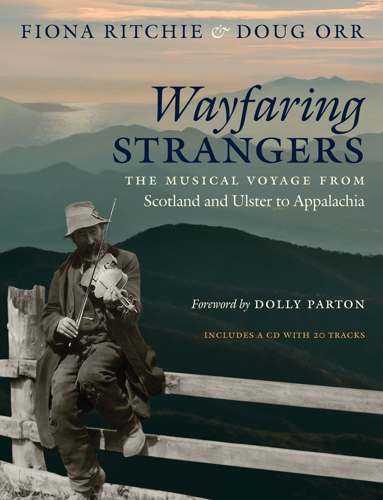
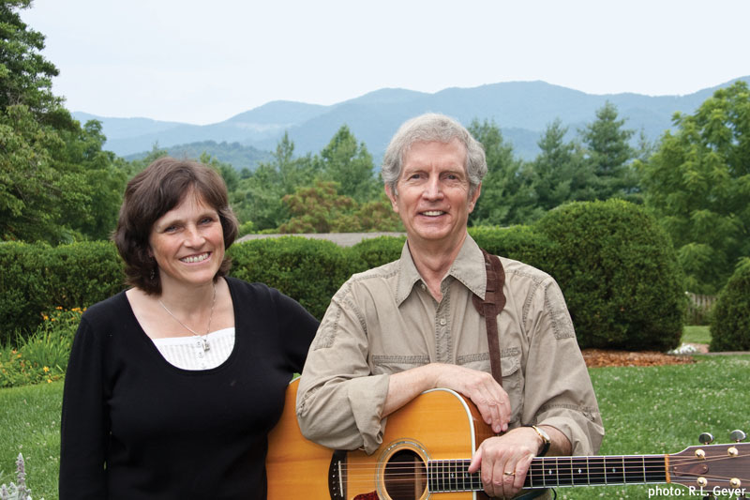

Since June 1983, Fiona Ritchie writes, she has been "officially in the business of sharing music from what we loosely called 'Celtic' roots to public-radio audiences across the United States" in her radio program The Thistle and Shamrock. The "we" to which she refers is music historian Doug Orr, who joined Ritchie to write Wayfaring Strangers: The Musical Voyage from Scotland and Ulster to Appalachia, a compendium of the music and people that in America came to be known as the "Scots-Irish." The large-format book is loaded with illustrations and contains a 20-track companion CD, but more importantly, it also contains interviews, historical accounts and source lyrics concerning many familiar — if distantly related — classic American tunes.
Wayfaring Strangers combines the expertise of Orr, founder of the Swannanoa Gathering music workshops, and Ritchie, who has spent 30 years interviewing the likes of Pete Seeger, Jean Ritchie, Doc Watson and many less celebrated but influential artists, to create a musical encyclopedia unlike any other. In advance of her appearance at the Southern Festival of Books in Nashville, Ritchie recently answered questions via email:
Early in Wayfaring Strangers, you write that the town of Gourock, Scotland, was the "backdrop to my childhood's dreamy setting." What do you recall of the music in that setting? Most of the music I heard in those early years came drifting over the airwaves. I especially recall the Scottish country dance and ceilidh music, which my mum used to play on radio while she was doing her housework. Sometimes the sound of a pipe band would drift down the street where we lived, and we would run outside to watch them march past. Also in the ferry ports of the River Clyde — like Gourock, where we lived — there were variety shows for day-trippers and holiday-makers with Scottish music-hall-type songs and sing-alongs — not really very much folk music as we think of it now. If I'm honest, probably my strongest musical memory from very early childhood was hearing The Beatles on the radio.
Your co-author, Doug Orr, is an authority on Celtic and American music, and he also played a role in the creation of The Thistle and Shamrock. What led you to collaborate on a book after so long? The book is just the natural outcome of our shared interest in both the music and the people it connects us to: some very special tradition-bearers we both have known. As we became aware that some of these voices — on both sides of the Atlantic — were fading, we felt we wanted to reach them to tell their stories of a living tradition, connecting back to the pre-media age. I was always keen on uncovering the musical connections between my native Scotland and Appalachia. Doug, on the other hand, being from North Carolina, had an abiding curiosity about the Scots-Irish origins of his family. With UNC Press as our partners, we finally got to explore it all fully.
You quote Jean Ritchie, who recently died at the age of 92, in virtually every chapter. Can you describe the significance of her place in traditional American music? This summer, I commented to Jean's son Jon Pickow that Wayfaring Strangers would be a slimmer volume if we extracted all Jean's words, songs and wisdom. Although she recorded many records and performed on radio and television (and YouTube!), Jean absorbed her musical culture before all that. It came to her directly from her family, where songs accompanied work and play as a natural part of daily life. In this way, she makes a powerful connection to her forebears, who first traveled from Scotland in the 18th century and settled in Eastern Kentucky.
In the 1950s, traveling through Scotland, Ireland and England in search of the roots of her family's songs, she returned the American cousin of the old music to its origins and seeded songs there. She also took the mountain dulcimer out to an international audience and contributed new folk songs, now considered American classics. Through her music in the 20th century, she connects us directly to the spirit of the 17th, 18th and 19th century wayfarers whose story we wanted to tell. We were so very glad to have finished the book in time to share it with her. Sadly, a number of the "Voices of Tradition" that grace our book are now quiet.
One particularly well-traveled ballad is the song known in the U.S. (among other names) as "Black-Jack Davy." How do you trace the rambling pedigree of such wayfarers? It's knowing where to start and when to stop that is the challenge in telling the story of a song like this! "The Gypsy Laddie" reaches back into antiquity. Of the top 10 ballads collected in southern Appalachia, seven were Scottish, and this was the second-most commonly sung. Then, as "Gypsy Davy" or "Black-Jack Davy," as recorded by Woody Guthrie and Bob Dylan, it came back across the ocean to the source once again. The story has no beginning and no end. It evolved as part of an ongoing, meandering trans-Atlantic dialog. More than 100 versions have been collected in Britain, Ireland and North America.
Wayfaring Strangers is illustrated with an astonishing array of paintings, woodcuts, photographs and documents that parallel the migration of Scots-Irish people and music through Appalachia. How did you decide which images to include? Doug and I always knew we wanted a richly illustrated book and had a veritable Christmas list of design requests: antique drawings, maps, woodcuts, vintage and contemporary photographs, illustrations, interesting typefaces! Darcy Orr was charged with the challenge of gathering all these images and presenting them in a way that complemented the narrative and added visual meaning. She also created original art and sourced illustrations from fellow contemporary artists in Scotland, Ireland and the U.S., which had always been a goal for the book. Darcy was supported by some great designers in the offices of our publisher, UNC Press, who did not flinch at our high hopes that this would be an abundantly illustrated and beautiful book.
Just taking a wild guess here, but how often do American listeners tell you they have fallen in love with the sound of your voice — and, through it, with the music? It does happen now and then! While I was living in the U.S., I did realize that people enjoyed hearing me talk between the music tracks, perhaps sparking curiosity for them to think about exploring the music further. Here in Scotland, I'm surrounded by people who sound like me, so it doesn't really occur to me now. Whoever does the talking, radio is an enduringly powerful way to make connections for people and introduce them to great music.
Many long-running NPR programs have ended in recent years: Piano Jazz, Car Talk and now Garrison Keillor is retiring from A Prairie Home Companion. How long can fans count on new episodes of The Thistle and Shamrock with Fiona Ritchie? Well, I'm working on one even as we speak! Does that answer your question?
For more local book coverage, please visit Chapter16.org, an online publication of Humanities Tennessee.
Email arts@nashvillescene.com



