
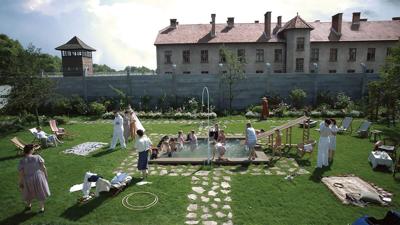
Since the end of World War II, Nazis have been a boogeyman of Western media. From Captain America comics and Indiana Jones films to Inglourious Basterds, Nazis have been depicted as purely evil — complete monsters. It’s easy to look at the atrocities committed by the Third Reich and wonder how human beings could be capable of such horror. But the reality is the people responsible for this terror weren’t monsters but merely humans, like the rest of us. This is where Jonathon Glazer’s The Zone of Interest, based on true events, focuses its story — in humanizing evil.
Outside of Auschwitz lives SS officer and concentration camp commandant Rudolf Höss (Christian Friedel) and his wife Hedwig (Sandra Hüller). The couple live a life of luxury, building a family and a garden near the extermination camp and taking advantage of all the “perks” of their station.
There’s been a vast array of Holocaust movies over the years, from Speilberg’s Schindler’s List to Polanski’s The Pianist. Most have focused on the victim’s perspective and largely followed the rules of Hollywood. Glazer challenges these conventions, throwing out the lighting and shot compositions that make movies visually appealing, aiming for something — as his director of photography Lukasz Zal has described it — less “emotionally manipulative.” The crew used a 10-camera setup and natural lighting, giving a more plain look to the film. The cameras are kept at a distance from many of the actors, who are shot in profile to keep the audience cold, unsympathetic and able to focus more on the characters’ complacency at the horrors being committed off screen.
Zone is visually distinct, but also has a very strong emphasis on sound design. The sounds in the background are just as important as the events in the foreground. The pops of gunfire and screams in the distance give us the full picture — if you watch the film outside of a cinema, unless it’s with high-end headphones, you run the risk of missing out on the dread that looms just outside the frame.
Despite its banal depiction of the lives of the oppressors and architects of the Holocaust, The Zone of Interest is still an emotionally taxing ride. It uses its approach to its characters and its unique cinematography to show these atrocities from the point of view of those responsible, and just how little they think about their actions. It’s a grave reminder that the horrors of genocide don’t begin with a blast, but rather the sound of pens scribbling on paperwork.



