
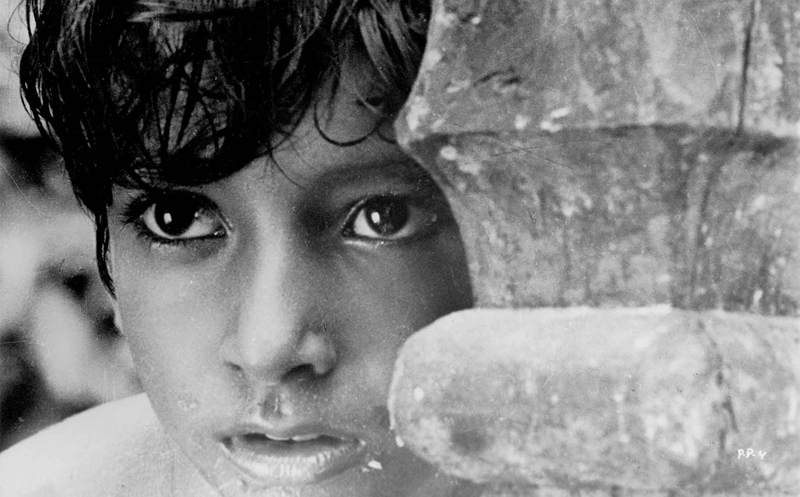
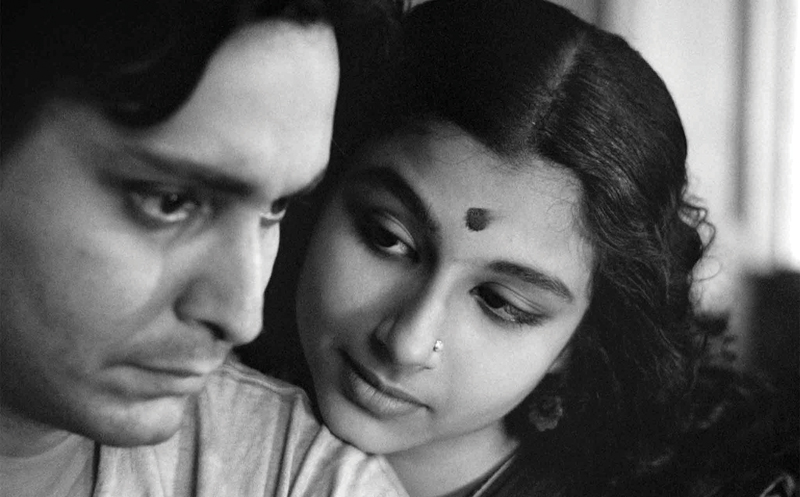
In 1955, an unknown Indian filmmaker named Satyajit Ray changed the world with the release of Pather Panchali, an extremely low-budget, hyper-realistic coming-of-age tale adapted from Bibhutibhushan Bandyopadhyay's semi-autobiographical novel of the same name. For most viewers, the film was like nothing they'd ever seen. Oh, it had familiar forebears: It combined the ground-level aesthetic and nonprofessional casting of Italian neorealism with the poetic naturalism of Jean Renoir, whose production of The River, shot in India in 1949 and '50, Ray had observed.
But there was something else to the film that felt entirely new: an immersion in, and respect for, the rhythms of daily life and nature. Gone was the melodrama of the Italians and the literate classicism of Renoir. Watching Pather Panchali, you could have sworn you were watching real life. Indeed, many viewers mistakenly thought they were. Some critics called it a "semi-documentary," even though Ray — a city boy largely unfamiliar with the rural world of his film — had cast, scripted and staged every moment in the film.
Pather Panchali looks at the life of a family in a poor Bengali village. Harihar (Kanu Banerjee), the father, is an oft-unemployed Brahmin priest, but also a dreamer and a poet, while the mother, Sarbajaya (Karuna Banerjee), is the rock that keeps the family together; an elderly relative named Indir (played by the great Chunibala Devi) also lives with them. The film is seen largely through the eyes of the young son Apu (Subir Banerjee), as he plays and occasionally fights with his vivacious older sister Durga (played by Runki Banerjee as a child, and Uma Dasgupta as a young teen).
There's no real story to speak of: We have moments of joy, or little bits of incident, and one particularly devastating moment of loss. But to watch the film is to immerse yourself in this world, one in which texture, sound and atmosphere are more important than plot — where the way the rain falls on a pond covered in lotus leaves, or where the rumble and smoke of a train disrupting the whisper of wind in a wheat field, can say more than reams of dialogue. It is this quality that contemporary viewers can experience as a meticulous restoration of Ray's landmark Apu Trilogy screens this week at The Belcourt.
Bandyopadhyay's original work encompassed two novels; Ray had taken quite a few liberties in his adaptation of the first, and he was able to follow up Pather Panchali with two sequels. At the beginning of Aparajito (1956), Apu is 10, but the film follows the family over several years as they move from town to town, and as Apu begins to conflict with his mother over what he will do with his life. By The World of Apu (1959), he's a grown man, a university graduate trying to write a novel. The film details how he comes to wed his best friend's cousin — after the girl protests on the eve of her arranged wedding to a mentally disabled man — and his subsequent disillusionment with life. If the first film was marked by the shadow of the father, and the second by the shadow of the mother, then the third film, finally, is marked by the shadow of the child — the shadow of both Apu and his own son, Kajal. The World of Apu ends with what might be the most transcendent and moving final shot of any film, ever.
A more detailed description of the events in these three films would by necessity have to give away some important matters of life and death — which, even though these are not plot-based movies, should still retain some of their surprise for the viewer. In truth, they are filled with loss and powerful emotions, but thanks to Ray's attention to detail — to the sights and sounds of village life, to the delicacies of human behavior — what we get is not manipulation, but a quietly gathering sense of grief and reflection. These movies breathe like no movies before them, and few movies since. Bandyopadhyay's novels were rooted in a deep sense of place, and heritage — they were specific to the Indian reality. Ray's films initially ground themselves in that same reality, but use it as a springboard to portray a universal coming-of-age tale, one that could easily travel across borders.
And travel it did. Pather Panchali was released all over the world to great acclaim and awards at Cannes, Berlin and New York; Aparajito won the top prize at the Venice Film Festival. Together, the films introduced the world to a kind of cinematic realism it mostly hadn't encountered before. They also introduced the West to the work of sitar virtuoso Ravi Shankar, who composed and performed the three films' scores.
At the same time, their success empowered a new kind of filmmaker. India's film industry was massive already, but Ray, at the outset of his career, was a lone wolf, an independent working far from the mainstream with an inexperienced crew. He spent three years shooting Pather Panchali, often financing the production with his own money. And his example helped fuel the emergence of other filmmakers throughout the Third World. Whether it was Ousmane Sembene in Senegal, or Yilmaz Guney in Turkey, or Glauber Rocha in Brazil, new directors in other parts of the world found inspiration in focusing on the underprivileged, on using real settings, on establishing a newfound respect for a direct discourse with reality, as opposed to fanciful re-creations. Ray's moving, patient portrait of a boy and young man's coming of age had another, more subtle influence on filmmaking — one could probably draw a direct line from it to François Truffaut's Antoine Doinel films (even though Truffaut initially showed little interest in Ray) and to Richard Linklater's recent Boyhood.
But perhaps the greatest effect these films had was to put Ray himself on the map. He would go on to have one of international cinema's most stunning and versatile careers — from expansive studies of class like 1963's Mahanagar (The Big City) to humanist chamber dramas like Charulata (The Lonely Wife, 1964), from musical fantasies like Goopy Gyne Bagha Byne (1969) to period pieces like The Home and the World (1984). Throughout this diverse body of work, he never lost the qualities that made his voice so distinctive — the patience, attentiveness and humanity that made Pather Panchali and its two follow-ups so revolutionary.
The Apu Trilogy will screen in its entirety July 19 and 23. Sarah Finklea of Janus Films, which collaborated on the film's 4K digital restoration, will introduce the 7:45 screening of Pather Panchali Friday, July 17. Jennifer Fay, director of cinema and media arts at Vanderbilt University, and Anand Taneja, Vanderbilt assistant professor of religious studies, will introduce the 6:40 p.m. screening of Aparajito Tuesday, July 21. In addition, the theater will conduct a three-day seminar for high school students on the trilogy July 20-22 featuring Fay, Taneja, Meharry Medical College director of bioinformatics Siddharth Pratap, and technologist, product manager and Indian classical musician Ram Kaushik. The $100 cost for the seminar ($75 for members) includes lunches. More information available at belcourt.org.
Email arts@nashvillescene.com



