

I get the feeling Canadian filmmaker Matthew Rankin has some unresolved issues with his homeland. With his 2019 feature film debut The Twentieth Century, he concocted an alt-history psycho-satire using the life of Canadian Prime Minister William Lyon Mackenzie King. In that film, Canada is a genderfluid (half the cast, male and female, is in drag) ice kingdom, and King is a nebbish nepo baby with mommy issues and a boot fetish.
Along with being a mad mashup of Guy Maddin, Powell and Pressburger, Kenneth Anger and the Japanese horror whatzit House, Century saw Rankin garishly addressing the repression and oppression lurking underneath all that bland but sensible Canuck cheeriness. As one character says, “Canada is one failed orgasm after another.”
If Century was Rankin calling out Canada for not letting its freak flag fly, his new film Universal Language (which was selected as the Canadian entry for this year’s Best International Feature Academy Award, though it didn’t ultimately receive a nomination) sees him literally having trouble fitting in with the place. Along with co-writing and directing, Rankin stars as … well, Matthew Rankin. For the purposes of this story, he’s a guy who returns home to Winnipeg after resigning from his government job in Quebec.
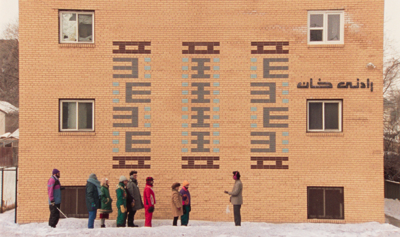
Just like Century’s cold world, this bizarro version of Canada is caked in ice. Winnipeg is both a winterland and a wasteland, complete with myriad barnyard animals scurrying about. (A turkey can even steal your glasses!) The townspeople are True Stories-level eccentric, from the tyrannical French teacher who thinks he’s cool because he has an earring to the cowboy-hat-wearing, wheelchair-riding, cheesy-commercial-making butcher. One earmuffed character (co-writer Pirouz Nemati) serves as a pitiful tour guide, dragging a group to such “landmarks” as the abandoned briefcase that still sits at the park bench where it was left.

Brady Corbet’s Golden Globe-winning film opens this week at the Belcourt (in 35 mm) and Regal and AMC locations
But this Winnipeg is also populated by Iranians. They all speak Farsi and hang out at a Tim Hortons that mainly serves tea. Once again, Rankin presents an offbeat view of the world’s second-largest country (geographically), starring an unexpected cast of characters. By dropping an Iranian cast in a setting that’s both deadpan and derelict (the movie looks like it was shot around the abandoned community center from The Brutalist), Rankin makes Language a film that evokes both Kaurismäki and Kiarostami. The subplot featuring two young girls (Rojina Esmaeili and Saba Vahedyousefi) who go on a hunt for tools that’ll unfreeze some found money suspended in ice certainly gives off Where Is the Friend’s House? energy.
The casting also makes Language an uneasy tale of a hometown boy who becomes a stranger in a strange land. For Rankin’s on-screen avatar, Winnipeg is home, but it doesn’t feel like it. With the cemetery (where his dad is buried) and other memorials placed on the sides of freeways, people literally move on from the past around these parts. The house he grew up in is now occupied by another (happier) family. Nevertheless, that family and other townsfolk welcome this awkward fella with open arms. By the time he finds out how his senile mother is being taken care of, it leads to a head-scratcher of a climax that also includes one last casting switcheroo.
With Universal Language, Rankin presents another beguiling cinematic stew bubbling over with obvious influences. The static tableau shots of what I like to call “working-class twee” will definitely have people comparing the director to both Wes Anderson and Roy Andersson. But it’s also a film that has him satirizing, criticizing and, ultimately, coming to terms with the Great White North.
In Rankin’s hands, Canada is a flawed but fascinating land. Let’s just hope it doesn’t land in the hands of a certain orange despot.



Post a comment as anonymous
Report
Watch this discussion.
(0) comments
Welcome to the discussion.
Log In
Welcome to the discussion.
Keep it clean. Please avoid obscene, vulgar, lewd, racist or otherwise abusive language. Comments featuring hate speech or threatening or violent content will not be tolerated.
PLEASE TURN OFF YOUR CAPS LOCK.
Be truthful. Don't knowingly lie or mislead.
Be proactive. Use the “report” link on any comment that violates our comment policy.
Share with us. We'd love to hear your feedback.