


How can one make a film about a country like North Korea, whose government tries to exercise tight control on all images of it? A filmmaker could go the route of fiction, like Jim Finn’s The Juche Idea, which convincingly faked a North Korean arts colony with Korean-American actors in upstate New York. Or one can acknowledge the existence of censorship and the limits placed on Western filmmakers in North Korea, as French director Marie Voignier’s International Tourism did — Voignier erased her entire soundtrack and recorded a new one once she was safely back in France. Russian director Vitaly Mansky’s Under the Sun opts for the latter strategy and goes even further than Voignier.
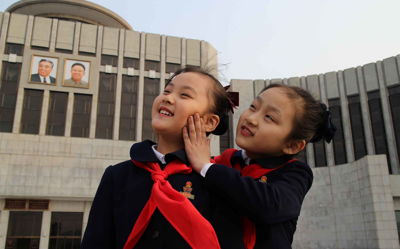
Mansky arrived in North Korea and learned that his documentary wouldn’t be a documentary at all. He was given a script — which focused on a young girl named Lee Zin-Mi and her family — and saddled with 24-hour minders. For the most part, Mansky followed the script, but he points to its phoniness in large and small ways. After leaving North Korea, Mansky added intertitles showing the script’s departures from reality. For example, Zin-Mi’s parents were given more proletarian jobs: A journalist in real life, her father is depicted as a garment factory employee. Her mother’s workplace is switched from a cafeteria to a soy-milk factory.
Mansky avoids close-ups for the most part and prefers wide shots, particularly in exteriors. Several times, children extol the beauty of North Korea, but we see little of it. Instead, Under the Sun depicts a gray urban landscape of ugly apartment blocks. The blossoming of the kimjongilia flower is a relief.
Mansky makes it quite clear that we’re not watching unmediated reality, to put it mildly. More daringly, he raises questions about who’s in charge of the film. An innocuous scene in which Zin-Mi extols the virtues of eating kimchi is shown being shot several times, from different camera angles. Is Mansky yelling “Action,” or is that the North Koreans? This same device is repeated later on, pointing out the dramatic level of fictionalization in even the most harmless-seeming scenes. There’s another staged scene in which Zin-Mi visits a friend with a “sprained ankle” in the hospital — it’s clearly a manufactured opportunity to show off the benefits of North Korean medical care.
For much of its running time, Under the Sun isn’t exactly entertaining. It has a conceptual payoff, but Mansky makes us sit through a lot of communist indoctrination to get there. (The Army vet who speaks to children about the atrocities committed by Americans during the Korean War isn’t exactly wrong, but he’s not telling the whole story; still, one can understand Mansky’s focus on Zin-Mi periodically nodding off during the lecture.) Eventually, the celebrations of Kim Il-Sung and Kim Jong-Il’s birthdays burst to spectacular life, in a Busby Berkeley-cum-Leni Riefenstahl display of color and fascist aesthetics. It may set one’s teeth on edge, but it’s a lot livelier than a lesson on the evils of landowners.
Mansky saves his most powerful punch for last: Driven to tears, Zin-Mi can only cheer herself up by reciting slogans about Kim Il-Sung and Kim Jong-Il. Under the eyes of his minders, Mansky got away with a film about the human cost of authoritarianism, as well as a postmodern lesson in the value of questioning the reality of what we watch.
Email arts@nashvillescene.com



