
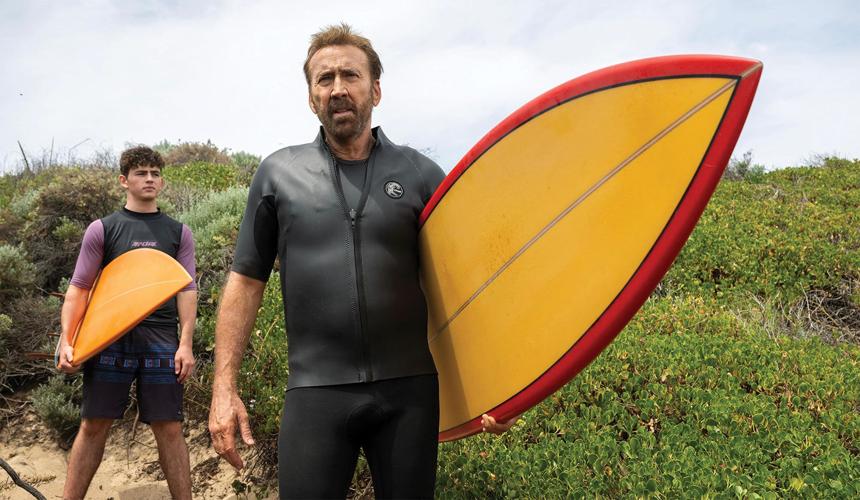
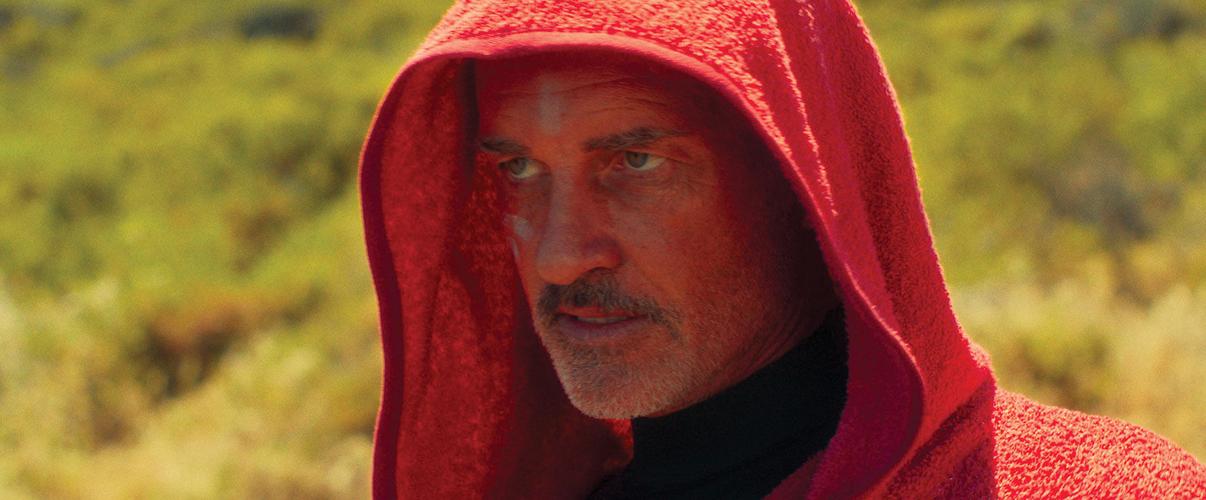

The Surfer seems like it was made for a sole purpose: to give Nicolas Cage another vehicle in which to continually crash out.
We first catch Cage’s nameless, surfboard-schlepping protagonist as he drives his teenage son (Finn Little) to an Australian beachside car park, where they’ll ride a couple waves and he can show his boy the property he’s about to buy. But even though our hero has hometown roots here, a local gang of bullying surf riders, led by an oh-so-manly svengali (Julian McMahon, looking like Omni-Man from Invincible), make it known that he and his kid aren’t welcome.
With The Surfer, Irish director Lorcan Finnegan (Vivarium) and Irish screenwriter Thomas Martin (Ripper Street) have crafted the sort of brutal, fish-out-of-water, toxic-masculinity takedown that put Australian filmmaking on the map back in the ’70s. It’s basically a sunnier, stranger Wake in Fright. (It’s a shame recently departed Canadian filmmaker Ted Kotcheff, who directed that seminal Australian New Wave thriller, isn’t here for this film’s rollout.)
Surfer is a shiny, sweeping heaping of good ol’ what-the-fuck. Finnegan and cinematographer Radek Ladczuk visually turn that parking lot Cage can’t seem to leave into a scorching purgatory (the sudsy blue waves may start calling you the same way they call Cage’s character), while composer François Tétaz comes up with grand, bombastic musical cues that sound like Ennio Morricone scoring a telenovela.
The Surfer comes out the gate fully acknowledging that there’s some weird shit going on. The movie doesn’t even reach the five-minute mark before we get some frazzling flashbacks of our lead, dirty and grungy as hell, lost in the wilderness alongside stock footage of insects, reptiles and other wild creatures. Cage fans will most likely watch The Surfer just to see how batshit the iconic actor will go in order to play a character who’s … well, clearly batshit. Since Cage spends most of the movie taking abuse from a steady stream of cartoonishly cruel beach bogans, you may become giddy anticipating just how zero-fucks Cage will be when he retaliates. (“These poor, dumb bastards,” I said to myself when the villains hassled a visibly seething Cage.)

The Surfer
Cage goes in on the mental and physical unraveling of his character, especially once the film starts taking some head-scratching turns. It isn’t long before the tormented dad is walking around in sweltering heat with no shoes on, crusty and sun-baked, drinking disgusting bathroom-sink water and fighting with a rat. One possibly improvised scene sees a babbling Cage harass other beach dwellers — some of whom seem like they don’t know they’re being filmed. (Finnegan uses a fish-eye lens to capture this madness, making it look more like a Jackass stunt than a cry for help.)
Cage dips in and out of haze-covered hallucinations that might have you thinking the whole movie is a Lost Highway-style psychotic episode from the main character. You’ll also get some Fight Club vibes with McMahon’s Tyler Durden-esque cult leader, who spouts nihilistic, supposedly profound affirmations while encouraging his male minions to embrace their inner savage.
As entertaining as it is watching Cage once again assume the role of ticking-time-bomb white guy (he has mastered the art of playing mild-mannered mooks with serious anger issues), The Surfer might leave you more perplexed than anything else. Even with minor characters giving Cage’s backstory via exposition dumps, I still had trouble getting a handle on what the hell this is all about. Is it just a dream? A dissociative fugue state? A commentary on the Manosphere?
As an intentionally baffling, patriarchy-slamming psychothriller, The Surfer comes off more flawed than fiery. But if you enjoy watching one of our most daring American actors act like he ain’t got the good sense his mama gave him, then you should take in this wild, weird ride where the star of the show actually gets — to borrow a David Lee Roth EP title — crazy from the heat.



