
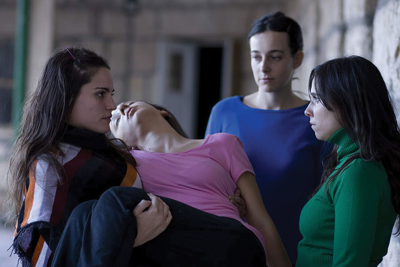


There are some things to know about writer-director Mariano Llinás’ La Flor.
Yes, it’s 13-and-a-half hours long, though it’s not a continuous experience. You can take some time in between its (six) episodes and (four) parts. (Though the parts share a cast, characters and narratives do not recur — themes, however, are another story.) If stream-and-binge culture has taught us anything, it’s that you really do have time for a narrative that’s captivating enough, and that the right wine can make that even easier. If ever an epic cinema experience has benefited from a drink with friends — or a sexy pre-film brunch — this is certainly it.
La Flor sees its U.S. theatrical engagement courtesy of Grasshopper Films, a wonderful and heroic group of people who really believe in getting weird with it, and it will be shown in four parts across three days. Part One encompasses Episode I (“My Angry Sister”), which is about the curses of mummies and class structure, as well as Episode II (“Watch Out”), a musical mystery that deals with the secret history of Argentina’s most beloved (fictional) pop-rock duo and what happens when those you rely on most start dabbling in a venom-chugging death cult.
Part Two encompasses much of Episode III (“The Universe”), which is a polyglot spy epic that digs deeply into the mentality behind international espionage. Part Three finishes up Episode III and gets deep into Episode IV (“The Spider”), a metatextual nightmare about artistic collaboration, witchcraft, authorship and the ability of human beings to be truly cooperative. Part Four finishes up Episode IV, then gives us Episodes V (“A Day in the Country,” a remake of Jean Renoir’s Partie de Campagne) and VI (“Fragments,” a captivity narrative of the Canadian wilderness shot with a camera obscura).
The end-credits sequence is about 40 minutes long, but it’s deeply captivating in that it unfolds as the cast and crew literally disassemble the set and equipment, pack everything up and scatter in their cars to the four winds. If you’ve ever been on a film set, there’s something so viscerally overwhelming in this grand benediction, wherein this 13-plus-hour beast that brought all of these people together unwinds itself, giving itself over to data, to the air and to the memory of all who have witnessed it. Every movie does that to some extent. But La Flor isn’t like every movie, or even most movies. As far as ambition and heft, it’s completely fair to put it in the realm of Out 1 or Sátántangó or Berlin Alexanderplatz. But it’s much rougher and messier than those films.
Llinás himself pops up throughout the film, holding court at a picnic bench by a rest area, letting you know where you are in things or explaining some of his narrative conceits. (The first four episodes have a beginning but no traditional ending, Episode V is a complete story with a beginning, middle and end, and Episode VI has a definite ending but no real beginning.) Llinás is a charming guide, and while he’s pleased with this magnum opus, he’s not ostentatious about it.
The four women who make up the cast (Pilar Gamboa, Elisa Carricajo, Laura Paredes and Valeria Correa) are absolute badasses. They cover all genres and bring to life all of the epic’s emotions. It’s such a varied, shifting experience that by the time everything is done, you feel like you’ve been in a whirlwind affair with cinema itself. You have the stunning highs of waves of love beaming from an adoring crowd as you rock a stage, or the existential horror that comes from the secrets that the trees keep, or the punishing betrayal that precedes the moment your throat is slashed by a formerly trusted hand. There are bureaucracies and secrets and the impermeable boundaries of The Body and The Land and The Law, and you go through it all. And here’s the shocking truth: This experience isn’t for everybody. It’s not going to realign your aesthetics or kickstart a previously dormant gland that helps art cinema carbonate your hormones. But if you’re at all inclined for this kind of an undertaking — or even better, if your curiosity is piqued — this could be the thing that changes your life.
Even if you aren’t enthralled, there’s something for you in the multifold mysteries of La Flor. My personal favorite, Episode II, is a musical drama that I could watch over and over again and never tire of; you will want a soundtrack album. Though fiction, it is the kind of juicy drama that hopefully could be made about real musical acts like Lime, Pimpinela or ABBA. To put it another way: If anyone could make a film about Fleetwood Mac during the era of Rumours, it is Mariano Llinás. He has a gift for using the structures of music as the perfect foundations for the chaos that the universe buffets us with.
You could watch just Episode II as its own film and have a totally enjoyable time at the movies. (Though, as a word of warning, there is an act of violence against an apparently real arachnid that could wreck the enjoyment of more sensitive viewers … i.e., me.) But there’s always more to be had with this teeming table of “everything,” both in the sense of what the word means literally but also in what the word means when drag queens or sophisticated teenage girls say it.
La Flor is a monster of a thing, though the denominator that everything reduces down to is the pleasure of cinema. Grungy thrills, operatic emotions, the settling of all kinds of scores, destabilizing that which is unjust, magic (as well as magick), women getting real and telling the world about itself, conquering death, maybe even finding that special love between people with incompatible secrets. La Flor demands your time and attention, but it gives you the most exquisite of dreams.



Post a comment as anonymous
Report
Watch this discussion.
(0) comments
Welcome to the discussion.
Log In
Welcome to the discussion.
Keep it clean. Please avoid obscene, vulgar, lewd, racist or otherwise abusive language. Comments featuring hate speech or threatening or violent content will not be tolerated.
PLEASE TURN OFF YOUR CAPS LOCK.
Be truthful. Don't knowingly lie or mislead.
Be proactive. Use the “report” link on any comment that violates our comment policy.
Share with us. We'd love to hear your feedback.