
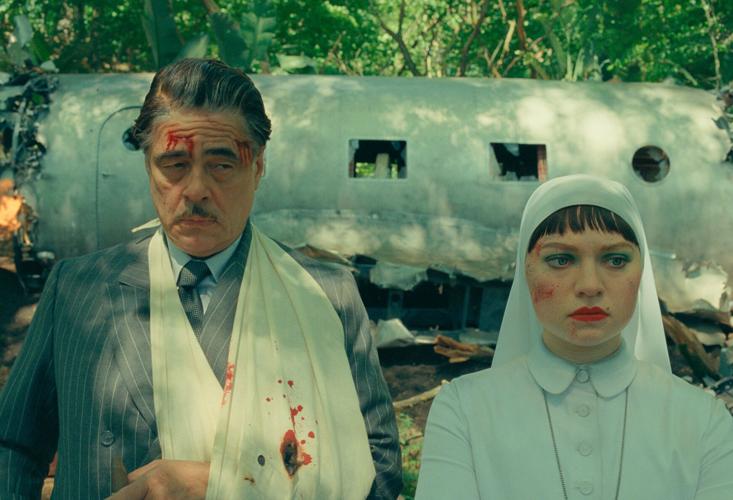
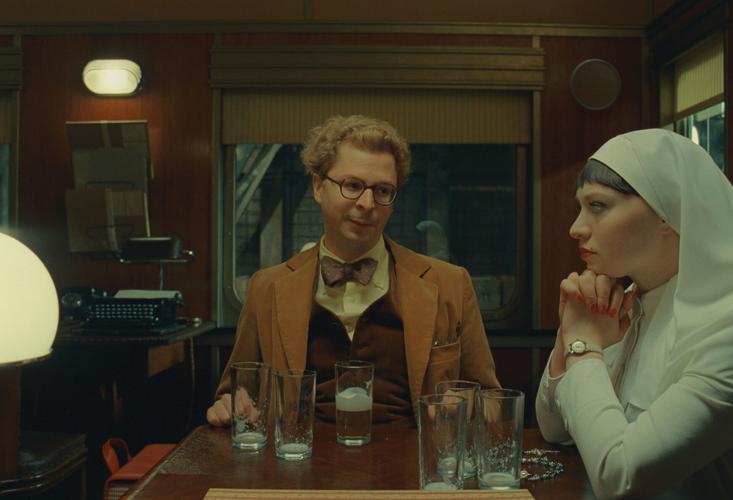

The first scene in The Phoenician Scheme, the latest from director Wes Anderson, depicts a 1950s-era plane targeted by sabotage. Shrapnel chops a passenger in half — the upper part of his body sails away into the sky.
This bit of dark-comedy gore seems to suggest that Anderson is ready to resist his reputation as the master of comforting twee filmdom.
But Wes-heads should not fear: The Phoenician Scheme has plenty of Anderson’s signature elements. The visuals are adorably absorbing. The score is classically apt (including several Stravinsky pieces, notably The Firebird). The ensemble cast is impeccable, and the plot uses absurdist humor to sweeten the dysfunctional family themes.
Anderson, who cowrote the film with Roman Coppola, has his vocal detractors — many people consider his movies to be no more than repetitive fluff — but I’m not one of them. And yet I found The Phoenician Scheme to be a lesser entry in the Anderson oeuvre. But here’s the thing: One actress helps elevate the movie sky-high.
The story revolves around shady international businessman Zsa-Zsa Korda (Benicio del Toro), operating in the fictional land of Phoenicia in the 1950s. One of his enemies, identity unknown, appears determined to assassinate him. Since Korda is obsessed with completing a grandiose project in Phoenicia, he reaches out for aid from various relatives and associates — including his estranged daughter Liesl, whom he hopes to recruit as heir to his empire. (Korda’s nine sons, who all live together in one dormitory, aren’t considered worthy.)
Liesl (Mia Threapleton) is a young and highly principled nun-in-training, which makes her seem like a less-than-ideal candidate for the job of running a big ol’ sleazy business scheme. But strangely, Korda seems to welcome her ethical objections to various aspects of his operation, including plans to utilize slave labor.

The Phoenician Scheme
Threapleton is a luminous delight. Her wide-eyed visage and firmly set mouth communicate all you need to know about Liesl — in a world of dodgy men, she takes no guff from anyone. Threapleton, the 24-year-old daughter of Kate Winslet, has created one of the best female characters in all of Anderson’s work. (Sorry, Margot Tenenbaum.) In a star-studded cast, she is by far the most memorable performer.
Some of the funniest cameos come in a twist in which Korda travels to a black-and-white realm that appears to be the gates to the afterlife. This land is populated by what the movie’s credits call “the biblical troupe,” featuring Willem Dafoe, F. Murray Abraham and Charlotte Gainsbourg, along with a certain Anderson favorite as God.
Other highlights of the cast are Michael Cera as an entomology tutor who becomes Korda’s executive assistant, Benedict Cumberbatch as a bearded family antagonist, and Richard Ayoade (The IT Crowd) as a gun-toting revolutionary. Basketball is involved, as two imperious Americans (Bryan Cranston and Tom Hanks, wearing “STANFORD” and “PEPPERDINE” sweatshirts) issue a highly unfair hoops challenge.
Will the Phoenician scheme succeed? Will arch-capitalist Korda grow a little more humane? Will Liesl figure out at least a provisional plan for her life? And what’s the deal with that wacky biblical troupe? All these questions (except perhaps the last one) will be answered, wrapped up in an admirably compact 101 minutes.
I’m at a bit of a loss as to why I, as an Anderson devotee, didn’t love it more. Perhaps I wanted the political points to be a little more barbed. After all, the fictional “Phoenicia” evokes the history of the Middle East. (“Phoenicia” is the name of an actual ancient region, where modern-day Lebanon and Syria are today.) But satire is an ephemeral thing. I wouldn’t want to be clobbered over the head with it, I suppose.
The Phoenician Scheme isn’t a perfect project, but with kickass Mia in the mix, it’s a memorable one.



Post a comment as anonymous
Report
Watch this discussion.
(0) comments
Welcome to the discussion.
Log In
Welcome to the discussion.
Keep it clean. Please avoid obscene, vulgar, lewd, racist or otherwise abusive language. Comments featuring hate speech or threatening or violent content will not be tolerated.
PLEASE TURN OFF YOUR CAPS LOCK.
Be truthful. Don't knowingly lie or mislead.
Be proactive. Use the “report” link on any comment that violates our comment policy.
Share with us. We'd love to hear your feedback.