
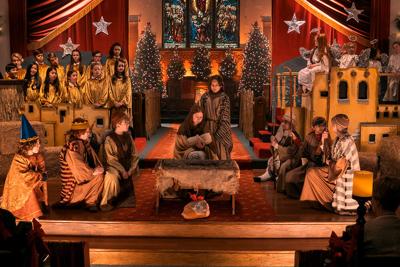

Barbara Robinson’s 1972 book The Best Christmas Pageant Ever is one of the stone classics of holiday literature. (I still have my Weekly Reader Book Club Edition from the very early ’80s.) It shares with its 1983 cinema sibling A Christmas Story a sense of whatever the late-20th-century oral tradition was, well-written and packed to the gills with turns of phrase that endure in your subconscious way down the road on which life steers you — the kind of thing you read aloud or quote because the language is clever, sharp and just a pleasure to speak and hear.
This new adaptation from director Dallas Jenkins (of the TV/theatrical phenomenon The Chosen, which my mom highly recommends), while running almost 50 minutes longer than the previous incarnation (the one with M*A*S*H’s Loretta Swit and a pre-Return to Oz Fairuza Balk), understands and respects the material in a way that is a relief.
My credentials as an arthouse weirdo cinema deviant are impeccable, so when I tell you that I jumped at the chance to review this film and was matching Imogene Herdman for tears when this thing hit its grand finale, you should know that that means something. Despite the best efforts of modern life to hunt the Christmas spirit to extinction, I’ve managed to secret away a kernel of hope and holly; it usually lasts for about a day-and-a-half, though the right baked goods and friends can extend that by a few hours. So know that this movie, on the Saturday before the election, managed to punch through the nearly incapacitating anhedonic anxiety that had been a source of social paralysis for quite a bit. As always, your mileage may vary.
It’s a simple set-up: In an indeterminate pre-cellphone era, homemaker mom Grace Brady (the always iconic Judy Greer) ends up directing the town Christmas pageant after church community pillar Mrs. Armstrong breaks both of her legs. The fact that she must do so with the main roles played by the Herdman children, a (mostly) ginger sextet of “the worst kids in the history of the world,” is a test of faith, resources and how strong the tenets of Christian fellowship are as opposed to just talking a good game.
The Best Christmas Pageant Ever is a fairly radical story about classism and how Christianity can be, and is, weaponized against The Other — and more so, how empty, self-serving platitudes are completely opposed to what is supposed to be the defining ethos of the historical Christ. This film doesn’t back down from that. It’s family-friendly, rather charming and unafraid to point out that calcified church figureheads are often the stumbling blocks keeping people from the community and fellowship that faith should offer. The Wendelkens, Armstrongs, Slocumbs and assorted families were always the villains of the piece (something that, having grown up in the UMC, I was very familiar with), and I was worried that in adapting the text for the modern era, some of Robinson’s sharpest elbows might be insulated or excised. Not so. This film understands that for a lot of people, the church is not a source of comfort or welcome, but rather a symbol of something that, to get biblical for a second, has abandoned the love it once had.
There are several additions to the novel’s narrative (a few prayers to give narrator Beth some more drive in the story, a snowball fight, a bit of character expansion for comedian Pete Holmes as the Brady patriarch, a Gilmore Girl to adjust some structure), but the one that really does something special involves the ability of books and libraries to change the course of lives. One of the Herdman kids refers to his new library card as a “book license,” and I laughed hard enough that even I was taken aback.
Greer and Beatrice Schneider (who plays eldest Herdman Imogene) are the MVPs herein. The former because she’s landing incredible feats of tonal balance, and without them, the whole thing wouldn’t work. The latter because she’s a transformative point for the film and the community. And together, they’re making the emotional center of this piece, now 52 years old, work for a whole new generation of audiences. This has the potential to be a beloved holiday classic, the kind of perennial watch that allows family traditions to build upon it. And that’s something very rare indeed.



Post a comment as anonymous
Report
Watch this discussion.
(0) comments
Welcome to the discussion.
Log In
Welcome to the discussion.
Keep it clean. Please avoid obscene, vulgar, lewd, racist or otherwise abusive language. Comments featuring hate speech or threatening or violent content will not be tolerated.
PLEASE TURN OFF YOUR CAPS LOCK.
Be truthful. Don't knowingly lie or mislead.
Be proactive. Use the “report” link on any comment that violates our comment policy.
Share with us. We'd love to hear your feedback.