
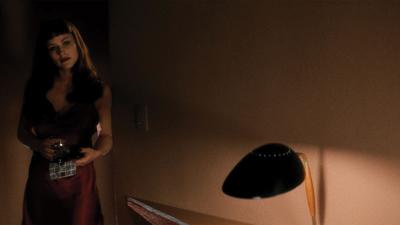

A nightmare bookended by Bowie’s “I’m Deranged,” careening into uncertainty in windshield-spanning cinemascope and never looking back, Lost Highway is the smell of wheels impelled to outrun the inescapable sense that you’ve fucked it all up. Though it’s the first of David Lynch’s psychogenic fugue trilogy (along with Mulholland Drive and Inland Empire), this film is fixated on the end of things in a way that belies its Möbius structure, unable even to embrace this preternatural other life as a means of reconciliation (Inland Empire) or a blissful, possibly aspirational fantasy for the damned of the now (Mulholland Drive).
Lost Highway, Lynch’s second collaboration with Wild at Heart author Barry Gifford, is all too conscious of doom nipping at your metaphorical heels. It’s a down-and-dirty Los Angeles noir that even James Ellroy would have to look at and say, “damn.” When asked about the film in interviews, Lynch is uncharacteristically forthcoming, explaining that it was his meditation on the O.J. Simpson murder trial, and how a mind compartmentalizes its deeds, and how people deceive themselves. And that certainly gives you a thematic framework. But in no way can it prepare you for the merciless journey that awaits.
Jazz musician Fred Madison (Bill Pullman, who’s only ever better in Zero Effect the following year) suspects that his wife Renée (Patricia Arquette, brunette, quite good) may be cheating on him. But when a stranger starts leaving videotapes filmed outside the Madison home, that initial fear is subsumed by this voyeuristic violation being waged against Fred and Renée. But things get worse: The tapes escalate in content, with whoever’s filming them eventually entering the house without setting off the security system, recording the Madisons, in bed as they sleep. And whatever began this process of documentation and pursuit will follow Fred Madison into other bodies and lives, a scourge at the heels of the condemned man.
Pete (Balthazar Getty) is a low-level 20-something fuck-up who works in an auto shop run by Richard Pryor (in his last role). Mysterious crime figure Mr. Eddy (Robert Loggia, terrifying) has a soft spot for Pete, because he does good work on cars. He has such a soft spot for Pete, in fact, that he trusts him to escort his lady, Alice (Patricia Arquette, blonde, exquisite), around town. Chemistry doing what it does, soon Pete is carrying on with Alice, always trying to stay a step ahead of Mr. Eddy and his associated henchfolk. But regardless of what comes from the process of being a David Lynch film, this is a film noir, and fists are clenching and fates are sealed long before we meet alleged murderer Robert Blake as a spatially unbound incarnation of sexual insecurity — and before the players find their way into a snuff ring, and discover the absolute best example of why one’s mother was always correct about not running around things with pointy corners.
One time, when I was hosting a midnight screening of Lost Highway, not even halfway through the first reel a couple of Belmont students stumbled into the lobby and asked, “Is this a devil movie?”
This eagerly awaited 4K restoration certainly has its work cut out for it — rendering the inky shadow and formless void that makes up so much of this movie’s visual sensibility is difficult for DCP technology and most contemporary digital projectors. Lots of films are dark, but Lost Highway feels somehow more than just that — something chthonic and obliterative lurks in these shadows, something that feels as close as any modern filmmaker has gotten to the thematic personifications that the ancient Greeks excelled at onstage. It is somehow fitting that the film was made into an opera in 2003.
But nothing — not even Slavoj Žižek’s exceptional writings on the film — gets across the visceral charge of its twists and turns. This movie has a power to it that ramps up, gradually, from the elliptical, classic arthouse domestic tableaux of its early scenes into the most hard-hitting, pedal-to-the-metal, bat-out-of-hell adrenaline rush since the last half-hour of The Texas Chain Saw Massacre. Relentless, fatalistic, immaculately soundtracked and unforgettable, a nightmare bookended by Bowie’s “I’m Deranged,” careening into uncertainty in windshield-spanning cinemascope and never looking back, Lost Highway is the smell of wheels impelled to outrun the inescapable sense that you’ve fucked it all up.



Post a comment as anonymous
Report
Watch this discussion.
(0) comments
Welcome to the discussion.
Log In
Welcome to the discussion.
Keep it clean. Please avoid obscene, vulgar, lewd, racist or otherwise abusive language. Comments featuring hate speech or threatening or violent content will not be tolerated.
PLEASE TURN OFF YOUR CAPS LOCK.
Be truthful. Don't knowingly lie or mislead.
Be proactive. Use the “report” link on any comment that violates our comment policy.
Share with us. We'd love to hear your feedback.