
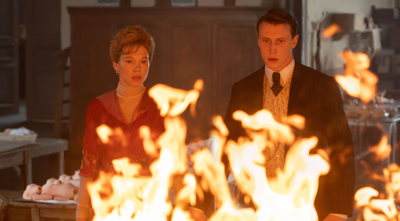

Bertrand Bonello may be the best filmmaker working at the moment, and this is his Mulholland Drive, his 2046 and his Cloud Atlas all at the same time. An all-encompassing work of adaptive unease, The Beast (loosely inspired by a 1903 Henry James novella) flouts traditional categorization and instead exults in blurring edges between genres, between lifetimes. Gabrielle (Léa Seydoux) and Louis (George MacKay) keep running into each other at different points in time, and the fingers of fate grasp all the more tightly.
In 1910, desire unmakes a marriage in the slowly drowning streets of Paris. In 2014, an aspiring actress and a sociopath meet in the aftermath of a Los Angeles earthquake. And in 2044, in a futurescape that doesn’t feel like one we’ve seen before, fauna shares deserted streets with askew humans adrift in an uncertain space — and the solution is through aggressive DNA therapy that excises past trauma and bad decisions from the brain.
How does it get better? There are a lot of philosophical movements, cults and business schools built on the idea that only by suffering can we improve ourselves, so it’s rather refreshing that this film is built upon a giant, world-deranging technological/psychological development of “How about … not?” There’s a common ancestor here with Eternal Sunshine of the Spotless Mind, but that film’s forget-technology was rooted in the now, with echoes of how dementia unmakes the past in the mind. Here the technology being used (never fully explained, which is probably for the best) works in the past, using similar principles to Terminator’s “one-way surgery on the past” theory. But instead of threats to existence across potential timelines, what’s being eliminated is the trauma of bad decisions, with the idea that they’re like recessive genes hanging around threatening to derail happy development in the future.
It’s a wild approach, and we accept it because Bonello is gifted enough that it never feels impossible. We accept these parameters because the film does, and it frees up some intense possibilities. A good portion of The Beast is built around the dialectic between forgiving and forgetting, but it’s staged with a kind of tension that makes you feel like this film may actually be changing the boundaries of reality.
Bonello has a singular gift: He doesn’t make horror films, and yet he finds a way to make a scene of such unimaginable terror that it casts a tone on the whole rest of the movie. Here it’s a scene we experience at different times, with each refraction adding a new layer of unease. If the film’s central thesis involves a technology that, by altering moments in the past can change both the present and the future, it demonstrates so with this central scene, of Léa Seydoux in a green-screen room, in the foyer of an elegant L.A. mansion, in a moment of digital transition. And it’s the scariest thing I’ve seen in ages, really engaging with tech fears and human frailty in a way that really works.
Scrawled in my notes for The Beast is the phrase, “The freedom to make bad choices,” which could honestly be a great title for a history of the past 45 years. Romance used to be a force of nature, and now it’s more like a meticulously cultivated algorithm. And the recurrent tendency of humanity is to believe our own hype. We want so passionately, with such strength that it bypasses both our internal safeguards and common sense. And despite its facility with the serrated edges of contemporary digital everything, The Beast is a film conceived with an unfathomable respect for the analog mess of human emotion. Tonally, the viewer is kept at the exact right kind of remove — we see, we evaluate, we judge. It’s not even really about feeling called-out, but much more recognizing a form of empathy completely alien to your own experience, and it is an unexpected turn.
The Beast is one of those films that watches you back.



Post a comment as anonymous
Report
Watch this discussion.
(0) comments
Welcome to the discussion.
Log In
Welcome to the discussion.
Keep it clean. Please avoid obscene, vulgar, lewd, racist or otherwise abusive language. Comments featuring hate speech or threatening or violent content will not be tolerated.
PLEASE TURN OFF YOUR CAPS LOCK.
Be truthful. Don't knowingly lie or mislead.
Be proactive. Use the “report” link on any comment that violates our comment policy.
Share with us. We'd love to hear your feedback.