
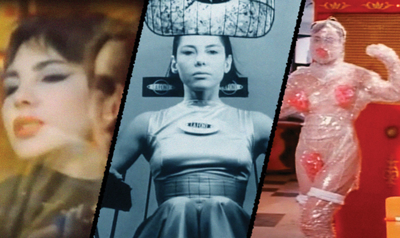


In a just world, Alyce Wittenstein would be spoken of in any conversation about ’80s sci-fi and speculative fiction. As a filmmaker, lawyer, cultural theorist, yoga instructor, mother and tennis player, she’s lived a more exciting life than most can imagine. Every frame of her work pulses with imagination, and is suffused with humor, horror, vision and ideas that carbonate the subconscious.
This month’s installment of Peripheral Visions — a screening series co-presented by the Belcourt and Third Man Records in TMR’s Blue Room — will feature Wittenstein’s Multiple Futures, a loose trilogy of three short works: “Betaville,” “No Such Thing as Gravity” and “The Deflowering.” Wittenstein will participate in a Skype Q&A following the March 29 screening. Wittenstein spoke with the Scene via email.
Did your family’s law firm help shape the socioeconomic compassion that drives your films? Social conscience and visual élan seem like defining characteristics in your work.
I think growing up with the law firm did plant that seed. This concept sprouted with my times in high school at Washington Square Park with the last vestiges of hippies and playing in a band with David Peel and the Lower East Side. It’s always been art and politics — art that is political and politics that is artistic. I wanted to be a fine artist, a painter, but my parents felt this would be a “shame” since I was so talented academically. They told me that artists cut off their ears like Vincent Van Gogh!
So I went to film school, because it was housed in the communications school, not the fine arts school. I had a minor in political science, and I viewed film as a way to mix media — writing, photography, building sets, acting. This evolved with my love of speculative fiction and imagining worlds in the future, both the way they would look and how they would be organized.
What works and artists helped shape your vision of science fiction?
Philip K. Dick, William Gibson, Margaret Atwood and my favorite author, Norman Spinrad. Andy Warhol, Salvador Dali, Magritte, Degas line drawings. TV shows like The Jetsons and Star Trek — Stanley Kubrick’s Clockwork Orange and Dr. Strangelove, Blade Runner, and I am loving the series The Handmaid’s Tale these days.
Your visions were prophetic — technology helping smooth some edges, but cultural and class divisions remaining inescapable. Do you consider your work optimistic?
I’ve always considered my work to be dystopian, but optimistic in the sense that if we can visualize the worst of what might happen, we can make changes to prevent these catastrophes. When I look at the current state of politics, I feel like I am living in one of my films — the spoiled playboy son of a tycoon wins an election against the smartest and most qualified candidate for president ever to run. His platform includes building a modern version of the Great Wall of China (despite the facts that we have planes now), and he makes dirty jokes and uses Twitter as a policy platform.
Did “Betaville” begin as a riff on Godard, or did that angle emerge from filming?
“Betaville” was developed as a sequel to Godard’s Alphaville. Instead of the Eastern Bloc communist dictatorship, it was a capitalist dictatorship — a city-state run strictly by the dictates of fashion. This was a concept that I took further in “No Such Thing as Gravity” — the idea of freedom in a capitalist culture where most people are lifelong indentured servants to their debt, as they feel they must always have the biggest television and the newest phone.
Did, and do, you feel like your reputation was limited by the concept of “underground film”? Do you consider “No Wave” a laurel or a limitation?
I did begin to feel limited by underground film. I realize now that I should have been more mindful of the lengths of the films — shorts that were short and full-length features. I think that’s what prevented me from really breaking through more than the content. The films are quite slick, not really that “underground” or “No Wave” in style, and they certainly did not push limits with explicit sexuality or violence. Underground for me was really about not having a budget for marketing and needing to be creative with publicity. I earned the moniker “Queen of the New York Underground” more for setting up film shows and tours that included the works of other independent filmmakers, and for my work with Nick Zedd.
As an artist, do you prefer working in color or monochrome? You’ve got an exceptional eye for both.
I really like both. I like using black-and-white to denote an older or darker world. For “Betaville,” I asked director of photography Richard Brooks how to get a poppy Technicolor look — assuming this was done with lighting and filters. He advised that this is not the best way to do this. It should be done with the art direction, with the sets and costumes — that was life-changing advice.
The character Zeena in “No Such Thing as Gravity” has a beautiful moment where she talks about a time when people couldn’t even imagine large, open spaces. That’s something that resonates deeply for anyone who ever lived in or loved New York City. What are your thoughts on the way the battles between public and private spaces have continued?
In New York City, we have smaller private spaces, but vast public spaces like Central Park and The Met. I’ve come to believe it’s a personal choice, one that can change over the course of a person’s life, preferring more or less social interaction. I think we are moving towards more decentralization, and I fear for the loss of the cities. Already they are losing their individual character, as more and more small stores close and are replaced with large chain stores, making cities look more and more alike. And once ordering online is perfected and our stuff arrives on drones, what will keep the cities alive? I was thinking about a resurgence in mom-and-pop stores that are more like showrooms/cafes — where there is limited stock and you can place orders. I hope something will save cities and we don’t all become like cyborgs plugged into the net for just about everything. I hope they don’t develop “phones” that are inserted permanently into our hands to add “convenience” to our lives.
The LaFont Corp. in “No Such Thing as Gravity” really should be held to the level of legendary sci-fi corporations like Alien’s Weyland-Yutani and Blade Runner’s Tyrell. I mean, they aren’t even planet-killer corporations, so that respect should be there.
We all know that corporations really run everything, but here it’s literal. And with Donald Trump as president, here’s our Andreas LaFont and his ridiculous idea that there is an “immigration problem.” There is no problem other than the horrific scapegoating and harassment of immigrants that’s going on. Meanwhile the crops in California are rotting in the fields because you can’t pay an American enough to withstand the conditions in those fields. I read an article recently about a farm that tried to use only American workers — they all quit after less than a week, most of them after the first day.
It’s overwhelming, when watching “The Deflowering,” to recall the plague years of the HIV epidemic. How has your relationship to that film changed since the time of its initial release?
Of course, AIDS was the inspiration for the film, but it’s more about how corporations profit from disease than [about] any specific disease. The analogy I see now is with cancer treatment — expensive chemotherapy with no serious research into real cures. What would happen to the pharmaceutical industry if there was no cancer? The stock market would crash.
What is your favorite plant? I’ve lived in Nashville and New York my whole life, and I’ve always adored birds-of-paradise. They’re such special flowers — and then you visit Los Angeles and they’re everywhere, on every street corner, and nobody gives a shit.
I share your love of birds-of-paradise, which I see outside only the best flower-selling delis. My favorite New York plants are azaleas — especially the huge spreads they have at the New York Botanical Garden, like giant walls of pink and red. I grew many of the flowers for “The Deflowering” myself and developed disabling allergies afterwards, which I thought was a bizarre coincidence, until I realized that I was actually reacting to all the pesticides I used, and now it’s organic or bust!
Would you like to make another film?
I am making a little film right now for my daughter’s bat mitzvah next month. I had to get a new computer and editing software to make that happen, and I’m really getting into it. This is just going to be the best bat mitzvah video ever. Then I am planning to make hundreds of YouTube informational videos about law to promote my law firm — these films might go viral as the competition is pretty darn bad. So I am getting my feet wet again; I wouldn’t rule it out.
Would you recommend yoga as a discipline for would-be filmmakers?
Yoga is so broad now — it’s become like aerobics was in the ’80s. Yoga means union, and it’s about moving with your breath — but so much of what is called “yoga” now has no relationship to its principles. The style I am trained is called kundalini yoga. It is about waking up energy — the asanas range from ones where you a completely still for 108 minutes to ones that have so much movement that you are quite quickly drenched. I think there are so many different kinds of filmmakers, too. People that like to make abstract shorts, those that like to make long serious documentaries, and everything in between and sideways. I think every individual needs to do what resonates with them.



Post a comment as anonymous
Report
Watch this discussion.
(0) comments
Welcome to the discussion.
Log In
Welcome to the discussion.
Keep it clean. Please avoid obscene, vulgar, lewd, racist or otherwise abusive language. Comments featuring hate speech or threatening or violent content will not be tolerated.
PLEASE TURN OFF YOUR CAPS LOCK.
Be truthful. Don't knowingly lie or mislead.
Be proactive. Use the “report” link on any comment that violates our comment policy.
Share with us. We'd love to hear your feedback.