

For a film with this much Guns N’ Roses in it (and there is honestly more GnR here than there really should be for a non-jukebox-musical), the fact that there’s no “Patience” is a giant pulsating question mark. Beyond the many songs, there’s also signage and a plot point involving how cool the name Axl is, so there’s some behind-the-scenes shenanigans involved, to be sure. But given how 2017’s Thor: Ragnarok fulfilled several generations’ worth of rawk fantasy with its amped-up battle cut to Led Zeppelin’s “Immigrant Song,” it makes sense that the involved players might aim for what we get here — even if an ABBA deep cut almost steals the whole film.
When last we saw Thor Odinson (Chris Hemsworth) at the end of Avengers: Endgame, he was heading off into space with the Guardians of the Galaxy, which is more or less where we find him when Love and Thunder kicks off. Christian Bale is the film’s Big Bad, though his Gorr the God Butcher only became such due to a betrayal by the divinity he worshipped that led to the death of his daughter. From there, it was just an ancient necrosword within arm’s reach that set him on the path to kill all gods, everywhere, for taking the faith of their followers for granted. This is a pretty explosive framework to build a tentpole action movie around, so director/co-writer Taika Waititi’s expected mirth often feels like it’s meant to leaven the proceedings — which also feature some big-deal medical complications and a whole lot of abducted children.
By nature of not actively destroying one of Marvel’s most imaginative achievements of the past few years, Love and Thunder manages to come out ahead of May’s Doctor Strange in the Multiverse of Madness in a comprehensive 2022 Marvel ranking. It has some inspired laughs and keeps the pace brisk and generally amusing. But as far as films with end credits that roll over “Sweet Child O’ Mine,” it’s not quite as inventive or revelatory as 1988’s Bad Dreams. Even when you’re watching the film, you’re going to find yourself wanting a bit more. But paradoxically, this keeps expectations in check. The stakes, especially by Marvel’s usual standards, seem more manageable than the typical “Universe-in-Danger Battle” that pops up in every third act. Part of that is due to a breezier tone, thanks to Waititi, which is generally a good choice except when it butts heads with a couple of deeply serious themes reaching all the way to the foundation.
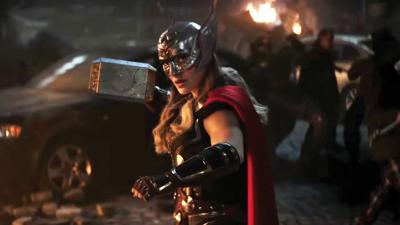
The return of Natalie Portman as Jane Foster — astrophysicist/incarnation-of-thankless-girlfriend from the first two films in the series — is a nice narrative shift, especially since she’s got her own story line, which has naturally led to her taking up the mantle of Thor in defense of the coastal community of New Asgard. Unfortunately, there’s not nearly enough Tessa Thompson in the film, which is deeply unfortunate because she’s found the exact right tone for absolutely anything that Marvel throws at her. And that includes universe-hopping to rescue a bunch of Asgardian kids who have been stolen to set up a third-act confrontation. Hemsworth, as always, is charming. He’s got a strong framework for the character, allowing for jazzier shifts in interpretation depending on what the requirements are for the film he’s in, and he understands that modern action film physiques are inherently hysterical.
If there’s an overarching issue, it’s not one borne by this film exclusively. But with something new in the Star Wars or Marvel universes deploying seemingly every week, that in-house Disney+ visual style doesn’t really feel special. There are still some interesting color choices and the occasional unexpected creature (including a pair of space goats walking a delicate tightrope between endearing and annoying), but it’s becoming more necessary that the MCU step up its visual game.
Fortunately for audiences, the God Butcher’s path of vengeance introduces the viewer to Omnipotence City, a planetoid/realm that offers Maxfield Parrish and Q*Bert vibes in abundance. Here deities from all over the cosmos hang out and have meetings, presided over by Zeus, played by Russell Crowe in a horny showboat of a performance that makes you wish he commandeered even more screen time. It is equal parts Oliver Reed and Orson Welles and steeped in a Mediterranean accent that somehow manages to start a bunch of cultural difficulties but also finish them. It is without exaggeration that I tell you a two-hour Zeus film would not suffice for connoisseurs of unexpected acting choices.
It’s been several years since a Marvel mid-credit sequence has delivered a surprise like the one that drops here. It is structured immaculately, with a not-as-dead-as-you-thought kicker followed by a guess-who’s-playing-who reveal that inspires awe, lust and that delicate drop that a grand cliffhanger can hit you with. Also, there’s a Very End Credit scene that will anger Nazis, so that’s good as well.



Post a comment as anonymous
Report
Watch this discussion.
(0) comments
Welcome to the discussion.
Log In
Welcome to the discussion.
Keep it clean. Please avoid obscene, vulgar, lewd, racist or otherwise abusive language. Comments featuring hate speech or threatening or violent content will not be tolerated.
PLEASE TURN OFF YOUR CAPS LOCK.
Be truthful. Don't knowingly lie or mislead.
Be proactive. Use the “report” link on any comment that violates our comment policy.
Share with us. We'd love to hear your feedback.