
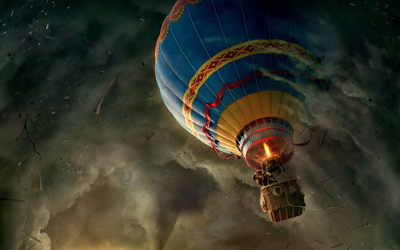

Oz the Great and Powerful wears its mantle more lightly than you'd expect from the $200 million offspring of a movie once said to have influenced every other movie that followed it. In a sense, that's entirely in keeping with the one-man niche occupied by its director, Sam Raimi, who has one of those oddball skill sets — think Méliès or Willis O'Brien — suited only to exactly what he wants to make. That means things like comic-book yarns and splatter movies, stuff that routinely gets derided as juvenilia — and so it often is, until it's given the animating force of Raimi's (yeah, I said it) artistry.
I'll put it another way: Oz the Great and Powerful is a movie that by all rights should suck but doesn't. In anybody else's hands, this post-Wicked prequel to The Wizard of Oz probably would've looked like one of those Dr. Seuss adaptations that resembles a Disneyland parade staged in a prison yard. But Raimi has imaginative gifts (empathy? fixation?) that fuse CG vistas, motion-capture creatures and extras in goofy wigs and costumes into a world. The surprise of Oz the Great and Powerful isn't its teeming large-scale action scenes or its origin-story slant on the familiar material: It's the ease with which the director musters the iconography of Emerald City.
Oz isn't a remake: Raimi did that already in his antic Army of Darkness. This telling, scripted by Mitchell Kapner and Rabbit Hole playwright David Lindsay-Abaire, opens with a clever variation on the original's sepia prologue. Kansas shrinks to the original's 1.33:1 aspect ratio as the once and future Oz (James Franco, in charming mock-heroic Bruce Campbell mode) toils in a seedy carnival, harboring illusions of destiny. Those are tested when a tornado tosses him into a Roger Dean Yes cover of an otherworld — at which point the movie explodes into color-saturated widescreen lushness worthy of Powell-Pressburger, expressed most feverishly in the matched scarlet lips and chapeau of glamourpuss witch Mila Kunis.
At first, the plot, involving a struggle between good witch Glinda and evil Evanora (Rachel Weisz, drinking Joan Crawford's milkshake), is mostly a tannenbaum Raimi can drape with ornaments, starting with Oz's arrival — the kind of travelogue-of-wonders it's assumed audiences won't tolerate anymore. (The confident, unhurried cutting of Raimi's longtime editor Bob Murawski definitely helps.) But the first-rate cast gives the warmed-over fantasy the spark of conviction. In this kind of movie, it's not a waste to cast someone as talented as Michelle Williams in the role of Glinda — not if she delivers every line with feeling enough to bring back Tinkerbell.
The difference between Raimi's Oz and The Wizard of Oz is the difference between a male escape fantasy of conquest and a moral lesson aimed at women. ("There's no place like home.") Yet Franco's wish to be the parallel-universe Thomas Edison isn't nearly as potent as Judy Garland's longing for somewhere over the rainbow. The real desire that drives the movie is the director's mandate to explore the communal dreamscape of Oz in model-railroad detail, using some of the sharpest, most spatially distinct 3D ever devised to whisk us along. Is that enough? If it would get me to a second viewing faster, I'd click my heels.
Email arts@nashvillescene.com.



