
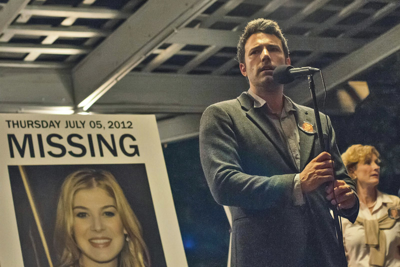

By this point, Gillian Flynn's devious literary thriller Gone Girl has become something more than a bestseller: a social phenomenon that offers a merciless vivisection of contemporary marriage. It's also a work whose impact relies almost entirely on its narrator's voice — something that makes it unusually tricky to translate to film.
And yet the movie Fight Club/The Social Network director David Fincher has fashioned from Flynn's script is a diabolically crafted (and crafty) entertainment: a vicious film that never lags or insults its audience's intelligence. In Fincher's hands, Gone Girl emerges as a physically and psychologically violent roller coaster for misanthropes — one that manages to throw in an explicit Paul Verhoeven homage (and a fierce Missi Pyle riff on Nancy Grace) while expertly deploying a superb supporting cast, including Kim Dickens and Blythe Danner as the queen of all WASPs.
The icing on this frosty cake is an eerie Trent Reznor/Atticus Ross score, a fitting accompaniment to the meticulous mise-en-scéne that is Fincher's hallmark. The night of the film's premiere at the 2014 New York Film Festival, the Scene had the chance to talk with director Fincher, screenwriter Flynn, the movie's, um, problematic lovebirds Ben Affleck and Rosamund Pike, and cast members Neil Patrick Harris and Tyler Perry.
How did you start the process of adapting this book?
Flynn: It was a very tricky proposition, and I spent the entire time when it was about to be bought [for film] saying, "It has to be me, it has to be me," and they said, "All right, it's you." And I thought, "No! No! That seems like a little too much to take on."
But once I started getting into it, I realized that the important thing was not to be slavishly devoted to every plotline, but to make sure that it ultimately felt like the book — the tone, and the dark heart of it, and not turning it into a pure "whodunit?" It was about the relationship, keeping the weird nuances intact.
(to Perry and Harris) What was it like becoming part of this project?
Perry: Well, for me, I didn't know that much about the book, but when I got a call from David, I said, "This is really interesting." And then when I read the script, I was blown away, and I thought, "What can I bring to this?" — and if he would give me this opportunity, I would want to do my absolute best for him. The character for me was just so rich, and I just thought: "ease." This was David's word to me every day.
Harris: I was just fascinated, and loved the book and the script, both in that all of the characters were relatively suspect throughout. Everyone's character demanded that you couldn't reveal too much, so you couldn't be too arch one way or the other. That was an interesting conceit. And then getting to really sit in a scene, and doing it over and over again, paring it down and distilling it, then all the tricks you have to try and play the middle ground go away. I was over the moon to be a part of it.
(to Pike and Affleck) How did you navigate the Dunnes' story? What was your interpretation of it?
Pike: We really put a marriage under a microscope, don't we? It seems to me to be a film about intimacy, and all the treachery that can come with intimacy, when you know someone so well that you can just screw every little sort of nut. ... [laughs maniacally] When we were on set, we'd go from all the early romantic scenes where we'd be having a laugh and chatting to barely speaking when we got into the more toxic stages of the movie.
Affleck: I think that's a great assessment. One of the things is that Ros is so good that it was very easy to play opposite her. The book asked really hard questions about marriage and relationships; it didn't gloss over all of the things that we don't really like to talk about. And sometimes you find out ugly things when you ask hard questions. And we wanted to give truth to Gillian's really dark look at marriage, and David's subversive take on that dark look at marriage.
It's an intense depiction, but there's at least the cat keeping things together.
Flynn: There's a screenplay book called Save the Cat, and it's all about how you should make your character likable, and he should do something in the first 10 minutes that makes the viewer like them. And I enjoy the fact that in the first 10 minutes, literally [Affleck's character] saves the cat.
Affleck: And yet you still don't really like him.
Flynn: I like him. I like that Nick is so devoted to his cat. And that cat was really hard to get, he was really hard to cast, he was very difficult on set.
(to Affleck) You've said that you wanted to work with directors that you could learn from ...
Affleck: [deadpans] Yes, and I'm about to do that. ... I'm kind of at this point in my career as an actor that at this point, it's all about the director. To get a chance to work with a director whose work you admire — it was great to work with David, and it was a pleasure to be around him, and it was a true learning experience, and I loved it and I would do it again and again and again. And despite his reputation, David is a very funny and nice guy — not just a demon, but very kind and smart and sweet.
Flynn: I knew when David signed on that he was known for dread and claustrophobia and sense of place. But he's underrated for those weird bursts of dark humor in his films, and I thought, "This would be the guy who's not afraid to keep those things in there." I think that those moments are really important. But it's a movie about storytelling; it's a movie about the stories we tell ourselves, and that we tell other people.
Fincher: I don't know if we're talking about "the media" as much as we're talking about a very narrow bandwidth of tragedy vampirism. I mean, I'm not convinced that CNN and The New York Times are in the bushes at the Dunne house.
Flynn: It's the idea that someone else's tragedy is something that we're consuming. We're consumers of tragedy when we tune into those shows.
(to Perry) As a director yourself, what was it like working with David Fincher?
Perry: For me, it was the greatest learning experience that I could have had. I could not imagine learning more in any other place from any other director. I say this a lot about his "eye." People say he does a lot of takes, and what I realized early on is that he is seeing everything at once. I don't think he sees like a normal human being; I think he sees everything at once and he's trying to create a perfect tableau, and if one thing is out of place it's got to be redone. The level of brilliance and genius that it takes to make that happen is so impressive to me. And I walked away hopeful that one day I will do better in my own films.
Harris: I love that David has a high vocabulary and demands a higher level of excellence while performing, so everyone on set is very quiet and everyone is very focused. And yet the way he communicates with people is very calm and confident, so it's not demanding excellence by ratcheting up the stress level, because I didn't feel like when we were working that it was intense, but in between takes he would give you lots of notes that were calming notes that would make you feel like you were on the right path. What I got from him was an empowering ability to work harder and the confidence that comes from knowing you were in good hands.
Pike: That is really well put. You feel like you've got the time, and you feel like somebody's really, really watching. I remember on the first week, I was walking into Desi's house, and the camera was looking at me from behind, and David just said, "You're not impressed enough." And I thought, "That's on the back of my head." I think you have pre- and post-Fincher in your work.
Email arts@nashvillescene.com.



