
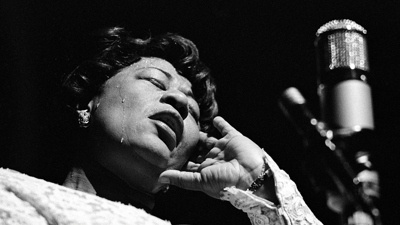


British director Leslie Woodhead’s powerful, often poignant documentary Ella Fitzgerald: Just One of Those Things provides a comprehensive portrait that doesn’t shortchange its audience in any department. The film, which the Belcourt will begin streaming Friday via its site, provides a thorough history of the singer’s evolution from teen prodigy to global icon — beginning with her 1934 appearance at the Apollo Theater at age 15. From there, the documentary follows Fitzgerald’s rise to stardom in the swing era, her embrace of bop and ability to transition into its demanding tempos and harmonies, and her final role as a sublime interpreter of the Great American Songbook and a tireless world traveler who once worked 48 weeks out of the year, touring concert halls and nightclubs around the world.
Woodhead’s analysis and examination is no less extensive and penetrating when covering Fitzgerald’s life off the bandstand. The impact of devastating losses are spotlighted, from the death of her mother at 13 to the premature passing of mentor and champion bandleader Chick Webb at 30. For a time following her mother’s death she became unruly and difficult, a phase that eventually resulted in her being arrested and spending time in a reformatory. But that fueled a determination to succeed and a desire to entertain that would remain for the rest of her life. Fitzgerald took the reins of Webb’s band upon his death, leading it for two years until the start of World War II. This came in an era when women seldom ran anything — in or outside the jazz world — and Black women even less so. That period toughened her mentally, giving her a resolve that would enable her to persevere, no matter how rough things got.
The film also addresses how the ugly twin factors of racism and sexism frequently affected Fitzgerald. At 2, her mother moved the family to New York from Virginia to escape the harshness of Jim Crow. As a teen she discovered that the North has its own version of segregation in Harlem, with The Cotton Club allowing Blacks to work there but requiring them to enter through the back door and otherwise totally ignoring them. Much later in her career, Fitzgerald was wrongly arrested by Houston cops because they observed some band members playing dice in their hotel. There’s also the lengthy struggle that manager and ardent advocate Norman Granz had getting Fitzgerald into certain nightclubs and venues — a battle aided by no less than Marilyn Monroe. Fitzgerald’s stardom didn’t insulate her from mistreatment and inequity, nor did her immense talents prevent other musicians from making callous, scathing remarks about her looks or physique, or insensitive writers from inserting snide comments about her weight into supposed concert reviews. She continually dealt with self-esteem issues, and endured a lengthy period of estrangement from her adopted son Ray Brown Jr.
Still, this is far from a morose, overly bitter presentation. Indeed, the primary focus of Ella Fitzgerald is on the joy the iconic performer felt and expressed onstage, her brilliance as a melodic interpreter and rhythmic vocal improviser, and her ferocity as an entertainer. The scope of her impact on other singers is revealed by the variety of performers interviewed, a list that includes not just jazz stalwarts like Tony Bennett, Cleo Laine and Jamie Cullum, but also mainstream pop stars like Johnny Mathis and R&B/soul legend Smokey Robinson, the latter of whom recalls that his mother’s favorite song was Fitzgerald’s first mega hit, “A Tisket, a Tasket.” Such writers as Pulitzer Prize winner Margo Jefferson and Will Friedwald, arguably the nation’s most astute critic of jazz vocalists, add ample historical and cultural context. Friedwald marvels at Fitzgerald’s ability to turn her voice into an instrument, and Jefferson provides ideal insight and wisdom regarding her musical and social accomplishments.
No one — not even the great Louis Armstrong, whom she loved and admired — surpassed Ella Fitzgerald as the consummate vocal performer of the pre-rock canon. But Ella Fitzgerald: Just One of Those Things goes deeper than just spotlighting her artistry — it reveals the toll it took, while cementing the fact that the journey was still well worth it.



