
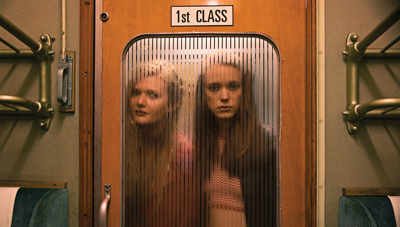

The opening of Nymphomaniac — languid shots of roofs and doorways defining the space where we meet our heroine — is breathtaking. It's almost purely constructivist; we're left to assemble in our heads the specifics of this alleyway, this world just beyond our view. And then the snow begins to fall, and with it comes a pulverizing dose of Rammstein. Yes, it's a Lars von Trier film.
Yet even compared to previous von Trier ice baths such as Breaking the Waves and Antichrist, Nymphomaniac is intense, stylized, upsetting and schematic as hell. The Danish director has always been a perceptive chronicler of behavioral extremes that people rarely feel free to discuss, as well as a filmmaker of underestimated technical prowess. But this two-part, four-hour assault on sexual politics, gender theory and conventional morality does so many cinematic cartwheels it could be his Amélie, scars and sores and all. It's definitely his Grand Budapest Hotel — an overstuffed movie that encapsulates its maker's obsessions, and whose insanity is boundless and exhilarating.
Found bloodied in an alley, Joe (Charlotte Gainsbourg) describes herself as a nymphomaniac, and a bad person. Her middle-aged monastic rescuer, Seligman (Stellan Skarsgård), refuses to condemn her. She proceeds to tell him stories from her life of compulsive fleshly pursuit, hoping to draw his disgust, or better yet, his wrath. He in turn uses his exhaustive knowledge of countless subjects — a short list includes fly-fishing, numerology, music theory, polyphony, biology and religious art — to thwart her self-loathing and raise other options. Fortified in Seligman's apartment, each confronts the person who essentially poses a rebuke to her or his design for living.
Joe and Seligman represent warring ideologies — a sensualist in denial of spiritual debasement, and an ascetic in denial of carnal desire — and they swat confessions and challenges back and forth in an unhinged verbal ping-pong game. The combatants are evenly matched, and the madness that unfolds between them provokes a silly awe, as if the director were debating himself in a mirror. Joe believes in her own exceptionalism, and although the film is explicitly European, there is something American about her can-do incarnation of all that is sexual.
But where the movie unfolds is in the erotic dream spaces of its characters. As Gainsbourg relates her encyclopedic sexual history chapter by chapter — early flashbacks star a younger Joe (Stacy Martin) and special guest fornicators — Skarsgård plays the audience surrogate figuratively and literally. That is, von Trier doesn't soften the particulars any more for Seligman than he does for us. There are a few scenes which are not part of Joe's story, but rather Seligman's perception of her story — an important distinction that shows the disconnect between the way she's putting the details forth and the way they're being received. (Joe knows how to tell a story, but she's not a liar.) The director expects us, like Seligman, to sit there squirming as we suppress either our prudery or our prurient interest, until our heads or laps explode. In a way, Seligman's response to the hardcore Scheherezade he's hearing resembles the movie's marketing campaign, which promises a classy actor pile-on with no stone unboned.
That's not what it is, naughty shots or not. The currency of Nymphomaniac is human loneliness, and trying to find a way to exist that doesn't ache. Or a way not to exist that doesn't hurt either. There is a lot of sex in the film, but never quite how you expect. Von Trier's Zentropa Entertainments made headlines in 1997 when it launched Puzzy Power, a line of high-end adult films made with female customers in mind, eschewing degradation and exploitative signifiers for more sophisticated plots and langorous scenes. Many scenes in Nymphomaniac seem designed to thwart the visual syntax of pornography, placing a narrative context around action that is usually the end in itself.
And yet Nymphomaniac amounts to a directorial survey of the sex movies of decades past — themselves a challenge that left audiences unsettled whether free love was an agent of liberation or a different kind of confinement. Some of the chapters could be direct responses to '70s European sexploitation: By using hardcore inserts, von Trier honors a tradition going back to the Emanuelle Nera series — though one can only imagine the joy that sleaze auteur Aristide "Joe D'Amato" Massacessi would have taken in the digital effects here that let you merge your topline talent and their sex double. Joe's protegé in Chapter 8, P (Mia Goth), suggests the spirit of Radley Metzger's arty softcore fantasias physically coalesced into a woman's form, while the games that Young Joe and B play seem very much in keeping with French coming-of-age films of the late '70s and early '80s.
In the midst of all this erotic adventure, surprise guest stars show up: Connie Nielsen's nearly ephemeral turn as Joe's mother, Swedish treasure Shanti Roney (from Lukas Moodysson's Together) as a sex interpreter, Willem Dafoe continuing the global tour of evil incarnate he began in The Grand Budapest Hotel. Von Trier good-luck charm Udo Kier has a one-scene wonder as a waiter confronting a dining situation not even Prince at the height of his freakitude could have written a song about. Remarkably, the ones that seem most like stunt casting often prove revelatory — like Christian Slater's distant and devastating turn as Joe's father, easily the best work he's done in years. As for Shia LaBoeuf, whose plagiarism/meltdown/performance-art phase began during the publicity phase of Nymphomaniac's European release, his accent leaps around the continent, but his work here as Joe's seducer boss has a louche consistency that is highly effective. (He seems to be playing Europe — that is, he's from all of it.) During a Christmas fracas that tops even the one in John Waters' Female Trouble, he just for a moment lets us inside his character, and it's stunning. Perhaps in working with von Trier, he realized the value of the purgative.
It's always nice to see von Trier favorites mix with whatever new bunch he welcomes into his repertory family, but there has never been anything in his filmography like Uma Thurman's Mrs. H. The titular character of Chapter 3, Mrs. H even gets her own aspect ratio: The very image condenses inward from 'Scope to 1.85:1 for the scenes where Joe is confronted by the wife of a lover, come to wreak vengeance, find closure and burn all bridges. Unlike the other guest stars, Thurman takes over the movie completely, delivering the kind of performance that usually only Pedro Almodóvar can get out of someone — nervy and intuitive as jazz, while consciously plumbing the deepest reservoirs of emotion.
It takes some time to recover after Mrs. H's exit, but von Trier has greater provocations to come. In Chapter 6, we reach the point where the fainthearted will be checking out. When Joe starts visiting K (Jamie Bell, Billy Elliott himself), she begins to explore a yearning for ritual abasement that movies rarely address intelligently. Secretary gets a lot of love from the mainstream for being forthright about bondage and discipline, and Michael Haneke's The Piano Teacher examines sadomasochism in a way that pulls no punches but is much more concerned with what it represents than what it actually is. But neither of those films had a couch winch. The sessions that Joe has with K are shockingly intimate because they truly understand and convey the value of flesh. There is no internalized abstraction going on here, merely transference — from thought to action to skin. It is incredibly hard to take, but it provides catharsis on par with the grand finale of von Trier's greatest film, 1998's The Idiots.
The movie, too, has something of the air of a grand finale — a summation of von Trier's profligate obsessions and eccentricities. Some of these are nods to other filmmakers: A few shots (the Chapter 1 title card, a magnificent distant gaze down a hospital corridor) offer explicit homages to or pastiches of Tarkovsky, while the early carnal adventures of Joe play off the "Waltz for Variety Orchestra" that Kubrick immortalized in the opening of Eyes Wide Shut. (Perhaps the opening Rammstein track is meant as an expression of solidarity with Moodysson and David Lynch.)
But the visual rhythms, the brazen collision of the sexual and spiritual, and the indistinguishable mix of earnestness and prankish extremity are no one else's. There's a spectrum of tone here, from deadpan comedy to insolent taboo-busting, that would be daunting to any filmmaker working besides Paul Verhoeven (specifically Kaetje Tippel, Wat zien ik? and Spetters) or Lee Daniels (pick a film). Moments of sheer ridiculousness butt up against emotional realism so painfully accurate that the contrast seems a challenge.
Yet von Trier has developed a fragmented editing style that fits all these jagged shards into an overwhelming whole. He maintains emotional throughlines across several takes and setups, jumpcutting as is necessary to let the feeling flow. He senses with uncanny precision when a cut will most rattle nerves, or when the camera needs room to breathe. One of the persistent conundrums regarding von Trier is never precisely knowing whether he is beckoning you closer or setting you up for a trapdoor plunge into a roomful of nails. But the beauty (and madness) of his films is that there need be no distinction — either response triggers the same endorphins, or kicks the hypothalamus into gear.
As a final note, Nymphomaniac was split in half by its producers/distributors. The director doesn't like it, and I don't like it either. The first half is more light and accessible, but I would not recommend seeing half the film to anyone. Watching either of the volumes by itself gives a misleading impression, and it's as a whole that the film should be seen and judged. Nymphomaniac may be working on a more expansive palette than much of Lars von Trier's previous work, but it is defiantly, triumphantly, unmistakably its master's mindfuck.
Email arts@nashvillescene.com.



