
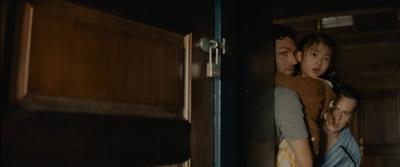

It should be a nice little getaway, with dads Andrew (Ben Aldridge, from Fleabag) and Eric (Jonathan Groff, always Patrick Murray, spending a significant amount of the film’s runtime concussed and going on an internal psychological journey) and their adorable daughter Wen (Kristin Cui) spending the weekend in a lovely rustic cabin near the lake, in the woods. We’re not certain what the dads’ objectives are other than getting away from the orchestrated series of microaggressions that is being alive at this moment in time, but Wen is working on a project involving grasshoppers — the ceaseless eye of God, dispassionately recording sincere but intermittently misspelled observations.
We’re already on edge when Leonard (Dave Bautista) enters the scene, embodying contradictions like a walking Mendel experiment. Leonard is a second-grade teacher who is built like a mountain, which makes for a certain incongruity, compounded by the fact that he’s talking to a 7-year-old in the middle of the woods. This unease sets the tone for the fraught and intense situation that follows, as three compatriots of Leonard’s enter the picture and invade the cabin, taking Andrew, Eric and Wen hostage to deliver the message that the family has been chosen to avert The Apocalypse by sacrificing one of their own. From there, things just get more and more emotionally and ideologically complicated.
It isn’t Knock at the Cabin’s fault that it landed in the zeitgeist the same week as "Long Long Time," the staggering third episode of HBO’s The Last of Us, or the same week that legislatures across the country (especially in Tennessee) have decided to come up with evil plans for the various factions of the queer community. (Literally, between when I started this review and when I finished things ramped up to a horrifying extent.) But here we are, and we’re going to have a cultural moment at which internet trolls and malicious parasites with government jobs quake and quiver with rage because queer people exist. Because in the one aspect of Knock at the Cabin that is 100 percent rooted in reality, just being alive as a queer person is a fucking battle.
The film makes a point and then emphasizes it repeatedly that none of this armed quartet was particularly religious to begin with, and also that they aren’t homophobic and that they think Eric and Andrew and little Wen are just adorable together. Which feels like it could be a leavening choice by director M. Night Shyamalan and the other writers, or it could be studio notes. I am grateful, however, to Shyamalan for not having a big, shocking twist. Part of that is the debt the film owes to its source material, but as Knock continues its inexorable journey to where it goes, I could feel within me a sense that if there was a twist that didn’t work, something was gonna burn. Shyamalan's last film, Old, was kind of amazing until an unnecessary codicil that gave us something approximating a happy ending. And it’s no secret that there have been some changes to the book on its way to the screen; I don’t envy anyone trying to do a literal adaptation of Paul Tremblay’s resolution (except for Michael Tolkin, who kinda did so 30-some-odd years ago in a more allegorical context) for his novel The Cabin at the End of the World. But Shyamalan approaches the material with an uncharacteristically delicate and restrained touch. Also, maximum respect for cleft-palate representation.
The film at least has the guts to give voice to what is currently unspeakable in mainstream American cinema — for the sin of acknowledging and validating the rage queer people feel at The Way Things Are, Bros was abandoned at the box office and condemned to be an object lesson in think-pieces that delight in the punishment of brashness. (For all the hateful and grotesque stereotypes that get bandied about against gay men, no homophobe ever tries to weaponize being picky, which is a 100 percent correct stereotype.) So when Andrew says to these four religious fundamentalists (and they have been made such by whatever power is in play) who have taken his family hostage and who now insist that someone in that family must kill another member in order to save society, he rightfully tells them to fuck off. After having watched Aldridge nobly suffer through Spoiler Alert, it’s nice to see him be very proactive. And there’s a lot to be said for art that acknowledges (and here comes the shadow of that The Last of Us episode again) that it falls upon members of the queer community to defend ourselves. To put it another way, if humanity manages to survive, expect a lot of survivalist gays popping up in films and TV.
This film is a Kobayashi Maru exercise that, as a viewer, you must follow to its end — you must examine and confront your own responses to it. At heart, this is a big, cosmic “What Would You Do?” But I certainly don’t see the vast majority of people being capable of extending that kind of empathy. The film's big weakness, though, is that everything is left very cosmologically sweaty. Something like this, you can’t come right out and say that a god of some sort is doing this, but it feels so restrained in what is supposed to be a grand finale for the planet, especially considering how tied to a lot of the iconography of Abrahamic apocalyptic tradition Knock incorporates. Paul Tremblay’s work is pretty great. His breakthrough novel A Headful of Ghosts is superb, and his short-story collection Growing Things is just essential for any fans of imaginative terror. And Knock (the film) preserves how he’s so good at finding unexpected facets of humanity in unconventional crisis.
I cannot remember the last time a film has left me this conflicted, angry, impressed and exhausted. Maybe Lars Von Trier’s Manderlay? The Painted Bird from back in 2020, possibly? Part of me wants to say Sick, from a few weeks ago, but that’s more notable because of how completely, glibly irresponsible its script is. But Knock at the Cabin is a perfect storm of conflicting emotions, such to the point that I’m actually glad the press screening was the night of the ice storm; my friend bowed out because of the weather, leaving me to knock this movie around the whole storm-struck drive home. Which is probably for the best. Who knew that KC and the Sunshine Band’s “Boogie Shoes” (or Trick Daddy’s “Take It To Da House,” for the somewhat younger) could be a requiem?



Post a comment as anonymous
Report
Watch this discussion.
(0) comments
Welcome to the discussion.
Log In
Welcome to the discussion.
Keep it clean. Please avoid obscene, vulgar, lewd, racist or otherwise abusive language. Comments featuring hate speech or threatening or violent content will not be tolerated.
PLEASE TURN OFF YOUR CAPS LOCK.
Be truthful. Don't knowingly lie or mislead.
Be proactive. Use the “report” link on any comment that violates our comment policy.
Share with us. We'd love to hear your feedback.