
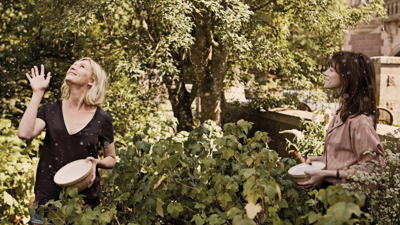

Before Kirsten Dunst won the Best Actress award for Melancholia at this year's Cannes Film Festival, before the magnificent trainwreck of the film's press conference (it's all on YouTube and essential background for the film), no one knew what to expect when writer/director/provocateur Lars von Trier cast her as his leading lady. For Dunst, who had lain low after taking some time off for depression, this would be new ground. And considering the baroque sufferings he'd wrung from Charlotte Gainsbourg in 2009's Antichrist, with its gore and genital mutilation, who knew what to expect this time around?
Surprisingly, what endures from Antichrist, in von Trier's latest creation, is the openhearted way his characters open themselves up to depression — and the way that affects their loved ones. For all the earlier film's garish atrocities, the scene that lingers most is Willem Dafoe talking Charlotte Gainsbourg through a horrifying panic attack. Melancholia is that scene in macrocosm, as overwhelming, incapacitating depression pulls everything around it closer.
Justine (Dunst) is the fixed point around which this world revolves — both in the film's first part, detailing her wedding to the puppy-dog passive Michael (Alexander Skarsgard, helpless and adorable), and in its second, where Earth must deal with the approach of another planet. This planet, naturally called Melancholia, has been hidden by the sun, so its emergence takes people off guard. But Justine, her deepest unease given life by the very cosmos, begins to emerge from her stasis.
As everything around her begins to fall apart, and her previously micro-managing alpha sister Claire (Charlotte Gainsbourg) collapses inward, it falls to Justine to make sense of the world around her. Dunst and Gainsbourg are quite good together; theirs is a remarkable duet, one where their silences say just as much as their words.
A good apocalypse film requires two things: hierarchies and chaos. Hierarchies, because we need to see beloved institutions fragment and authority become meaningless; and chaos, because we secretly love to see order turned on its end. Melancholia is a spectacular apocalypse film, but not in the way we're used to seeing. Its joys are internal, its mayhem is cosmic, and madness in the film lies not in the imminent catastrophe but in the wedding sequence, which is a nice inversion.
Cinematographer Manuel Alberto Claro is a new addition to the von Trier production family, and his work is stellar (especially as the planet Melancholia becomes another light source in the sky). After watching von Trier redefine the visual aesthetics of independent cinema in the '90s with the Dogme 95 manifesto, it is rapturous and reassuring to see him return to crafting ravishing images in the vein of 1991's Europa/Zentropa, with a Maxfield Parrish chaser.
It doesn't make sense that a film as fixated on the end of all things as Melancholia should feel so uplifting, but it does. The film's ending is the most beautiful of catharses. For his musical score, von Trier uses Wagner's Tristan und Isolde, which perfectly fits the movie: a deeply romantic, lush experience that carries an inescapable note of horror, as it approaches the end promised by its maker's strangely soothing teleology.
Email arts@nashvillescene.com.



