

There's something funny about visibility. In the '90s, LGBT people had fewer rights, but mainstream Hollywood releases like Philadelphia, In and Out and The Birdcage featured gay men as heroes. These films weren't aesthetic or political successes, but they existed on a large scale.
Now gay men and lesbians can get married in 19 states, but no Hollywood studio would make Steven Soderbergh's Liberace biopic Behind the Candelabra. Can you imagine a contemporary Hollywood film featuring a rainbow coalition of lesbian, bi and trans characters like Orange Is the New Black? The New Queer Cinema of the early '90s opened a door for directors like Todd Haynes and Gus van Sant to queer "straight" indie cinema in films like Safe and Gerry, but it also led to a complacent niche of micro-budget gay indies never likely to be seen outside the LGBT festival circuit. Who would've thought TV would look more progressive in terms of gay representation than American cinema?
That makes the arthouse success of Ira Sachs' Love Is Strange all the more heartening. The Memphis-born director has cast aside the explicit sex, drug use and openly gay actors of his previous film, Keep the Lights On, for a much more straight-friendly tale of late-life marriage. I keep expecting queer radicals to attack the film as an assimilationist tract, although so far, I don't believe any have. Yet in subtle ways, Love Is Strange keeps pointing out the traces of homophobia that exist in large and small degrees in our supposedly "post-gay" culture.
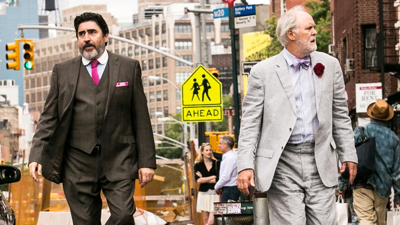
At the beginning of Love Is Strange, Ben (John Lithgow) and George (Alfred Molina) exchange vows. Ben's a painter, while George teaches music at a Catholic school. Although everyone at work knows about George's sexuality, he's fired for going public with it. After the loss of his income, the couple can no longer afford to live together. George stays with a couple of gay cops. Ben moves in with his nephew Elliot (Darren Burrows), Elliot's writer wife Kate (Marisa Tomei) and their teenage son Joey (Charlie Tahan). Although nothing terrible happens, everyone involved is uncomfortable with this arrangement.
It's easy for Love Is Strange to attack the homophobia of the Catholic church: 99 percent of the audience that would go see a film about a gay married couple would disagree that George should be fired. But it's one thing to say "homophobia is wrong" and another to show how it directly affects the lives of George and Ben. Forced to live apart, they wind up in situations that are awkward in very different but equally unpleasant ways. The scenes at Kate's apartment are a bit on-the-nose — her frustration about Ben hanging around all day is somewhat predictable. The cops with whom George lives are less stereotypical — rather than being brainless gun nuts, they're D&D-playing geeks.
The friendship of Joey and an older boy has something homoerotic to it, which the film never resolves. His friend winds up banished from the household. But his presence also brings Ben back to life in ways that disturb Kate. Love Is Strange shows how prejudices about gay men corrupting youth stubbornly cling to life. Ben finds a life force in painting a teenage boy, which Kate reads as borderline pedophilia.
Love Is Strange makes a lot of its narrative decisions elliptically, including the most important one of all. In this, Sachs may be influenced by the French director Maurice Pialat, whose films radically screwed around with time and forward motion. But it's all the more heartbreaking because it withholds sentimentality and retains a relatively gentle, muted tone. As I write this review, it has grossed about $1.2 million in the U.S. By the end of its American run, I hope that figure's a lot higher. The mainstream could stand to be much queerer.
Email arts@nashvillescene.com.



