
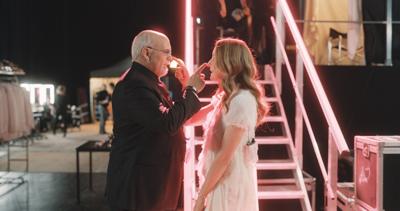

Aline Dieu is not Céline Dion. There’s a pre-film disclaimer and everything to make sure that any potential viewer is aware of that. But in that way the movies have of shaping our perceptions, Aline the film is going to exult in muddying some waters.
This isn’t like one of those somewhat-interesting-but-slapdash films you see on the Reelz network, though cursory glances might lead some to that conclusion. What writer/director/star Valérie Lemercier (best known in the U.S. for Claire Denis’ 2002 feature Friday Night) has crafted is a meditation on the life and legacy of Dion that will rightfully prove fascinating for Dion fans who know her story and songs and want to see what happens when a modern icon gets refracted through a different kind of lens. We all know the benevolent tyranny of “the authorized story,” wherein rougher edges get sanded down in a tradeoff for access to the songs, the outfits and the estate. But there’s never been a biopic exactly like this one before.
Lemercier plays Aline from childhood to the present, with her face and performance digitally meshed on the body of a child actor for the early years. This has broken some members of the critic community, and while it is quite a choice, it ultimately works because of the way the film structures itself: Everything before the Las Vegas residency and critical and commercial triumph is presented as Aline’s memory, summoned as she lounges in an oppressively tasteful bedroom, at a moment in life when one might need to reflect (which will be revealed in suitably dramatic fashion sometime around the third act). It’s a subtle choice, but it makes sense that even in her own memory, our Aline must perform — and Lemercier has studied the mannerisms and physicality of 21st-century Dion.
“It’s hard to believe this voice is yours,” Aline’s future manager/lover/husband says upon their first meeting, which is very funny and indicative of the bite that lurks within the funhouse mirrors and Erté reflections that comprise the film — it’s not Céline’s voice, nor is it Lemercier’s when she sings. (Dion impersonator Victoria Sio handles this aspect of the performance, and she does an incredible job.) We know the building blocks of the Céline legend — battling for attention with 13 siblings, having to be the clown/performer to break through. And it’s Lemercier’s face, stitched onto the child actor, who can’t help but use every gesture and thought as a means to connect. The distance of memory won’t allow the seasoned performer to see herself as the child she was, and even if she’s living in a world where dignity is signified by a limo and dipping a croissant in Champagne is a major flex, she’s still that country youngster with her eyes on the stage.
There’s a Gallic/kétaine take on Walk Hard lurking just out of frame for a lot of Aline, and it makes the film much more endearingly weird than one might expect. Certainly there’s a great deal of local interest because it demonstrates the power that songwriters hold over the licensing of their tracks — as well as the way hit songs become the text of performing artists’ lives. We may be watching the story of “Aline Dieu,” but her discography has fortuitous overlap with Céline Dion, making differentiation beyond real/fictional a much muddier (or in this case, glossier) comparison.
Camp is very much the air that we breathe in this film, but not always. In fact, the most impressive thing about Aline is how Lemercier keeps the film nimbly shifting between high camp and perceptive drama. For each of the sections that positively soak in the clichés of stardom, there’s something as razor-sharp and haunting as the last 10 minutes of the film — which manages to recall Last Days, Last Year at Marienbad and Stroszek. Not something I expected from an off-brand Céline biopic.
Healed by a Jimmy Somerville cover of Sylvester, nurtured by a sympathetic makeup artist (Jean-Noël Brouté), with a concluding summation courtesy of a Rufus Wainwright ballad and a peerless wig game, this film understands the symbiosis between “Céline” and the gay community. It serves us every key change, every aerobicized trauma, every dental drama like a queen in Céline drag lip-synching all the moments that make up a life.
Lemercier plays the long game as regards Aline’s agency, especially her long-term relationship with René Angélil equivalent Guy-Claude Kamar (Sylvain Marcel). The film is very French in the way it dances around the edges of appropriateness with the Aline/Guy-Claude relationship. “Delicate, but squicky” as my Dion-aficionado buddy Tiffany Minton says. We’re fortunate that Sylvette Dieu (Danielle Fichaud) is serving as the audience surrogate regarding this relationship. She’s a marvel, a supportive mom of iron will and devastating comic timing.
The songs do a very good job filling in the background of the Aline/Guy-Claude relationship, with “Nature Boy” doing a lot of lifting as Guy-Claude’s leitmotif. The fact that Luc Plamondon’s “Ziggy” is used as an emotional catchall is the kind of delicious moment that only really works if you’ve done your homework: It allows Aline to express her love for an untouchable man (in this case Guy-Claude) through the use of a ballad about a teenage girl swooning over the gay boy on the soccer team (please do check out the jejune NSFW video here), and it encapsulates what we love about Céline Dion — she inhabits rickety, treacherous emotional situations without hesitation. And even when working outside of the Dion songbook, Lemercier knows the right devastating needle-drop can hit like a hammer, answering several questions and raising heaps more, like when a Glenn Medeiros jam drops and hits like an atom bomb of pent-up emotion. That is the key to both Céline Dion and Aline Dieu — the pop song and chanson as catharsis.
There’s a moment when a concert is going wrong, and the day is saved by a singalong of “Pour Que Tu M’Aimes Encore,” and it’s one of the greatest cinematic moments of 2022. Easily up there with “Naatu” in RRR or the gator in X or even the misremembered Pixar skein of Everything Everywhere All At Once — unforgettable in its wild ambition, and taking big, messy swings for the stands. It’s the kind of weird emotional triumph that Dion and Dieu both excel at.



