

Though its full potential is not explored often enough, animation has the ability to bring worlds to life like few other creative mediums. Even with advanced special effects and fine editing, live-action filmmaking is usually bound to some kind of reality, with human bodies always ruled by physics. But animated filmmaking allows artists and audiences alike to truly explode any rules or expectations — the only limits are what you can dream up, and what you can put down on paper, the image governed not by gravity but by an internal artistic inertia.
Japanese filmmaker and animator Masaaki Yuasa is responsible for some of the most psychedelic and mind-boggling images of the 21st century, and his latest creation Inu-oh is no different. Though Yuasa’s palette is colorful and his canvas is broad, what makes his work so distinct is how he renders intimate and internal emotions as endless galaxies of shape-shifting color. Films like Mind Game and The Night Is Short, Walk on Girl are about primal and universal experiences of infatuation and unrequited desire, but their visual style is truly out of this world, breathing animated life into emotions that are so often difficult to express literally.
Though the look of Inu-oh will be unmistakable to fans of Yuasa’s previous work, its sense of scale and setting is remarkably different from his most beloved work. While past films were often set in a contemporary milieu, Inu-oh sojurns deep into the past, immersing itself in legendary mythos and historic pageantry. Adapted from a recent historical-fiction novel, Inu-oh is set at the height of feudal Japan, a land ravaged by endless conflict between warring clans. The film begins with this history, as we see and hear of the ruthless destruction of the Heike clan, whose ghosts now haunt the countryside.
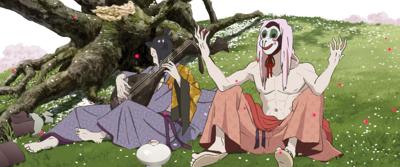
Despite the political turmoil of the era, it was also a cradle for new forms of art, particularly the distinctive Noh style of drama, a theatrical hybrid of dance and storytelling. The film’s two central characters are outsiders who eventually become verified superstars in the competitive world of Noh performance. Title character Inu-oh has an unusual form that he hides under a mask, but is blessed with an incredible knack for captivating choreography. His partner, Tomona, is a gifted musician trained in the biwa, a traditional stringed instrument — he’s blind, and though the movie never exactly names it, is something approaching genderqueer. The world of Noh performance is recognized as a vital means for controlling the populace, which means how it is performed is ruthlessly governed by the shogunate. Needless to say, Tomona and Inu-Oh’s new style transgresses all kinds of boundaries.
Whereas the old-school biwa players keep to a fairly traditional folk-music style, Inu-oh truly becomes a musical with the breakout duo’s captivating performances, which are given a sound somewhere between psychedelic blues and prog rock. Not only is Inu-oh deeply in touch with fallen spirits who inspire his songs — to the degree that it threatens the establishment — but Tomona’s stage presence becomes something like a medieval prince as he begins wearing bold makeup, grows his hair out, and adopts a scandalous sense of fashion.
It’s in these stretches of musical performance that Inu-oh truly begins to sing (pun intended). While the dense history and larger narrative can at times become overwhelming, Tomona and Inu-oh’s extended jam sessions allow for Yuasa to truly put his imagination to work, as spirits intertwine with the band, the paralyzed begin to breakdance, and the dead are brought back to life. The transformative and liberatory power of music isn’t easy to express through visual form, but watching Yuasa’s living murals is at times a synesthetic experience, as senses bleed into each other.
Though the film is mostly in a 2D hand-drawn style, Yuasa at times incorporates CGI landscapes to offer an ever-shifting vantage point, with a perspective that’s constantly evolving. A film like Inu-oh is at its best when it leaves words and stories behind and treats the animated image as something almost like music, a fully flowing medium for expression that changes like the air.



