

There is wisdom in the old cliche: Sometimes truth really is stranger than fiction. And at other times, the two get so deeply entwined that you can barely tell where one ends and the other begins. Such was the life of John Wojtowicz, the bisexual bank robber who became the model for Al Pacino's character in Dog Day Afternoon. Thanks to The Dog, Allison Berg and Frank Keraudren's documentary on Wojtowicz, one learns that he was the equal of the young Pacino in looks and charisma. If anything, Dog Day Afternoon toned down its subject's exuberance.
A city symphony for honking horns, Dog Day Afternoon is less about the robber and more about the sweltering turmoil of 1970s New York — or more precisely, the flashpoint at which the inept crooks, stymied cops, tetchy hostages, surly Fun City onlookers and sensation-starved media reached mutual combustion. At the same time, Sidney Lumet's 1975 caper-gone-awry classic remains one of the first relatively sympathetic treatments of an LGBT character in post-Stonewall Hollywood — certainly superior to Richard Rush's Freebie and the Bean or William Friedkin's notorious Cruising. It focuses on the unfolding robbery, but as it turns out, the story the movie didn't tell is equally compelling. The Dog mythologizes Wojtowicz, up to a point, but it also shows the emptiness of the fame Dog Day Afternoon brought him.
Wojtowicz came of age in '60s New York. As a teenager, he supported Barry Goldwater and responded enthusiastically when drafted. He was sent to Vietnam, and his experiences there — especially a raid in which 90 percent of his platoon was killed — changed his politics. When he returned home, he married Carmen Bifulco in 1969. He also wanted to explore his sexual interest in men, however, and joined the Gay Activists Alliance in 1971. In 1972, he committed the bank robbery that inspired Dog Day Afternoon, in order to pay for gender reassignment surgery for his partner (then known as Ernest Aron, later changing her name to Liz Eden). Ironically, the proceeds from the film, not his crime, actually paid for her surgery.
Up to the robbery, The Dog integrates his story into the gay scene of early '70s New York. Wojtowicz's gender preferences remained ambiguous his whole life. He had four "wives" (to use his preferred term regardless of their gender), one of them unambivalently male. If they'd wanted to, Berg and Kerudren could have made a fascinating film on the gay liberation movement, which Wojtowicz says he joined mainly to get laid. The Dog includes footage of some of the very first protests for same-sex marriage at the New York city clerk's office. (Wojtowicz and Aron held a wedding at a West Village bar, complete with drag-queen bridesmaids.) After the robbery, few people from the Gay Activists Alliance other than activist/videographer Randy Wacker stood by Wojtowicz's side — but who can blame them? Robbing a bank to pay for your lover's gender reassignment isn't exactly offering a positive role model for gay youth, and Wojtowicz did so at a time when gay visibility was minimal.
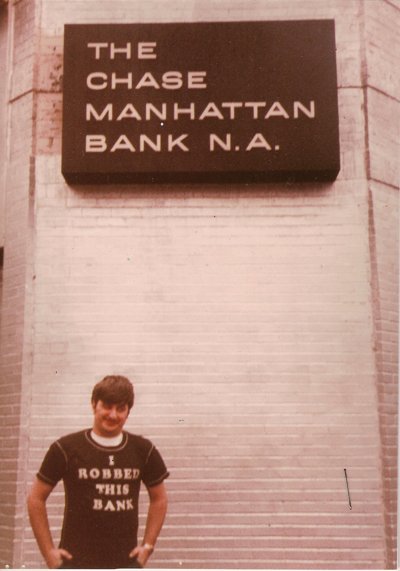
Wojtowicz remained a handsome charmer well into his 50s, in footage shot by Berg and Keraudren between 2002 and 2006. But his charm had its limits. The bank robbery defined his life. Once he got out of prison — where he was raped and abused by inmates until he found protection from his "wife" George Heath — he couldn't find a job, so he resorted to hanging out in front of the bank he robbed and signing autographs, to the disgust of his hostages. After all, his robbery had real consequences: One accomplice was shot and killed by the FBI. He and Liz appeared on talk shows together; on commercial TV, they put up a happy facade, but on a sleazy public-access program they openly bickered. She had to turn to sex work to earn a living and died of AIDS-related pneumonia in 1987.
Formally, The Dog is a relatively conventional documentary, relying on archival footage, interviews and still photos. (Its glimpses of Dog Day Afternoon are inevitable but relatively brief.) No one is going to confuse it with the immersive avant-garde nonfiction coming out of Harvard's Sensory Ethnography Lab. But its interviews are hypnotic, its archival footage revelatory. It has some structural problems and lapses in covering Wojtowicz's life — it never mentions his 1986 arrest for visiting Heath, a parole violation, or explains how he made a living in the last decade of his life. Nevertheless, The Dog introduces us to a man whose brief moment in the spotlight shows the dangers of fame. Cautionary tales are rarely this exhilarating.
Email arts@nashvillescene.com.



