
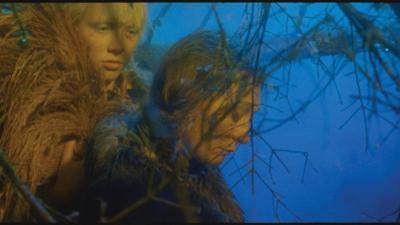

The kind of late-night soak that imprints itself directly into the kaleidoscopic surface of memory rather than as a direct experience, After Blue (Dirty Paradise) is a sensual wallow. It represents a perfectly cohesive world that is nonetheless so alien to our own that the friendly disconnect it creates in the brain threatens to destabilize the entire experience.
You can think of this film as a grenade of the most velvety cushions, as pitiless a sci-fi realm as Żulawski’s On the Silver Globe but simultaneously a bad-girl manifesto on par with Russ Meyer’s Faster, Pussycat! Kill! Kill! It even comes with its own built-in drinking game, one that could lay waste to viewers as easily as the weaponry wielded by the women who populate the world (literally and figuratively) of After Blue. Just know that no matter how many times you’ve encountered the pride of Bexleyheath in articles about Stranger Things, you will encounter Kate Bush many, many more times herein.
But this Kate Bush, full name Katarzyna Buszowska (played by Agata Buzek), is a Polish assassin and force of mystic power who threatens to destabilize the post-apocalyptic community that Earth’s surviving population has established on the planet After Blue. After the death of all men, the vibe has become something equal parts nurturing and chaotic. And though Zora (the legendary Elina Löwensohn) has kept the peace as community hairdresser, her daughter Roxy (occasionally called Toxic) has a kind nature that has freed the renegade Kate Bush and set the community into a firestorm of rage. So Roxy/Toxic and Zora must head into the sensual wilds of After Blue in pursuit of Kate Bush, reshaping archetypes even as they explore the frontier tropes of the past century of cinema.
Sprung from Jodorowsky’s weirdo Westerns, the hermetic fantasias of James Bidgood and the sensually violent charge of Metal Hurlant magazine, After Blue is a slippery and elusive experience that refuses to allow deep or analytical engagement, keeping the viewer adrift in a swamp of vibrant decadence. This can be a problem if you’re looking for a reinforced nucleus to dig into and engage. But After Blue (Dirty Paradise) — like writer-director Bertrand Mandico’s previous film, the gender-blending pirate fantasy The Wild Boys — is so much that it requires at least two viewings before one can even attempt to experience it like a regular kind of movie. That’s not mescaline on your popcorn, but it may very well feel like it.



