
MST3K's Michael J. Nelson joked in a recent tweet, "Instead of going to see Transformers 4 I had the crazy guy who lives at the dump throw lawnmower parts and scream at me for three hours." But let's be serious: Michael Bay understands that cinema is dead. Videogames are the thing. Explosions, tits and crunching metal: These are the tools with which he plies his trade. It has been noted by many that the Transformers films veer into avant-garde territory, a claim I reject and resent. But yes, on a superficial level, zero narrative structure (Surrealism!), 4-D chassis twists (John Chamberlain!), color-saturated micro-edits (Brakhage!), and a poetry of wanton destruction (the Futurists!) can all add up to an assault on traditional values of meaning, coherence and humanity, of one thing logically following another.
Too often, classicism — or just an application of recognizable forms — bears the stigma of a rearguard action. Is Bong Joon-ho's latest film, the quite remarkable Snowpiercer, an old-fashioned, backwards-looking film? I would say no. If we compare it to Bay's Transformers films (which commercial considerations ask us to do — one was released as counter-programming to the other), Bong's art is undoubtedly more radical, and not just because it was made for a fraction of the cost, or because it hails from South Korea rather than the Evil Empire. Snowpiercer is a model of narrative simplicity: It practically appears to have been assembled from a model. But this is a key part of its allegorical operation. Form and narrative are one and the same in Bong's film, until they become catastrophically uncoupled.
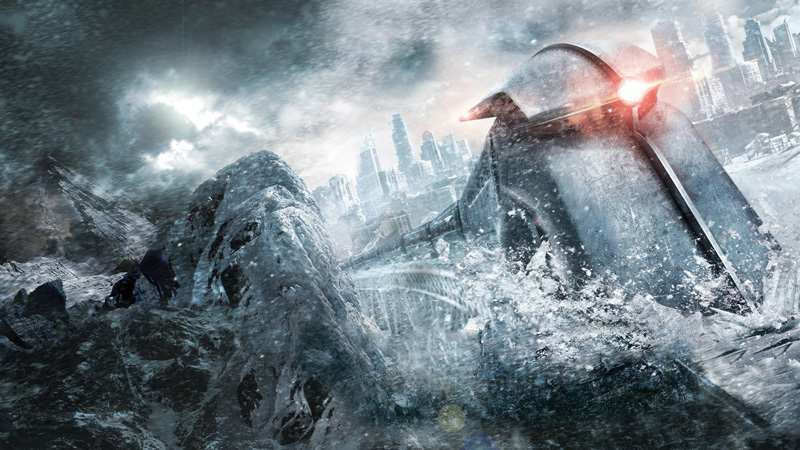
The planet has frozen over due to a failed experiment to control global warming. All life on earth is dead, except for those lucky enough to have gotten a place on the Snowpiercer, a nonstop supertrain that circumnavigates the globe and was built (for its pre-disaster luxury patrons) to withstand extreme heat and cold. In light of the impending doom, its owner-inventor, Wilford, sold steerage positions in the last cars of the train. The filthy back cars have evolved into a replica of the worst conditions of the Global South; the wealthy enjoy every privilege at the front of the train. Security, food services and water treatment reside in the middle. So Bong has given us a Marxist replica of class-divided society at its most stratified, depicted with visual flourish and compact mise-en-scene, to allow for a film-as-revolution that proceeds car by car.
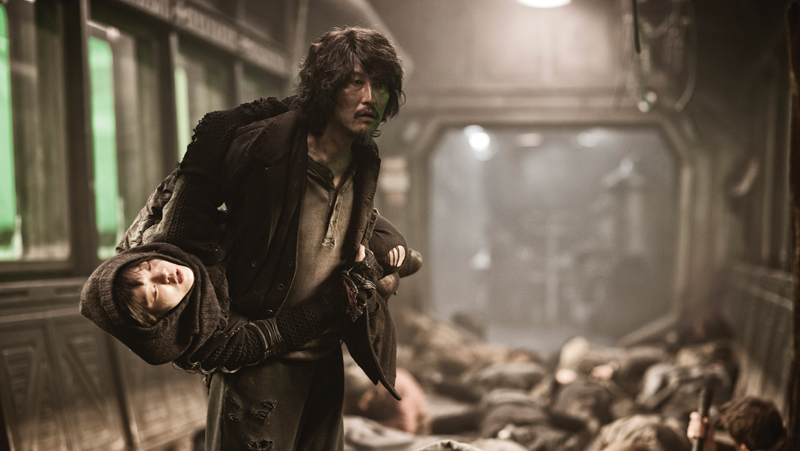
Granted, our "characters" are stock types. But we could say the same thing about the characters in many films by Ford or Hawks, and the general ambiance in Snowpiercer is much the same. Curtis (Chris Evans) is the reluctant hero and leader of the revolt. His confidant Gilliam (John Hurt) is the aged keeper of the revolutionary flame; his last name (as in "Terry") is hardly coincidental here. Korean superstar Song Kang-ho (Thirst, Secret Sunshine, Bong's own The Host) plays Nam, the baleful designer of the train's security passages; his only investment in helping the ragtag group is saving his daughter (Ko Ah-sung). Tilda Swinton is Mason, Wilford's smug, unctuous factotum, a kind of cartoon Thatcher. Finally, in the last car is Ed Harris as Wilford, a weary industrialist of equal parts Willy Wonka and Ayn Rand.
Jamie Bell, Octavia Spencer, Ewen Bremner, Alison Pill and even Romanian stalwart Vlad Ivanov (4 Months, 3 Weeks and 2 Days) round out the international cast. Aside from learning more about them as the film progresses, there is not much more than the arduous fight to move forward. (Imagine the hammer fight in Park Chan-wook's Oldboy but as a collective clamor.) The train plows ahead through the wasteland, and the rabble drives the plot by plowing ahead inside the train. They and Wilford's creation are both of a piece, Snowpiercer's narrative engine.
In other words, Snowpiercer makes a virtue of its transparency, turning allegories into structural homologies. As I implied above, there is an eventual breakdown of said structures — there really is no such thing as a perpetual motion machine, and Bong is too smart to have made a timeless, bottomless bad movie. Even as you watch Snowpiercer, you are aware of its singular trajectory. But this is never to its detriment. Rather, inside the overall clarity and cognitive openness of the film, we are able to engage anew with philosophical questions about social protest, the feasibility of proletarian uprising and, well, the problem of whether we can (or should) remain neutral on a moving train of runaway consumption. You may call such a fusion of legible filmmaking and progressive politics outmoded or mired in old-media thinking. I call it transformative.
Email arts@nashvillescene.com.



