
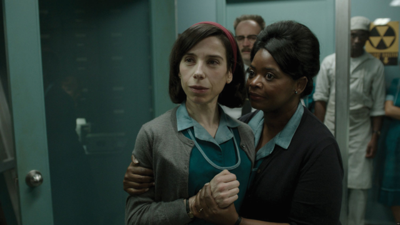


In Guillermo del Toro’s The Shape of Water, protagonist Elisa Esposito’s life is one of habit and routine. Every morning, she boils eggs for her lunch, setting an egg timer on the bathroom sink. Then she disrobes, gets in the tub and vigorously masturbates. She visits her neighbor, a closeted gay artist named Giles — played lovingly by Richard Jenkins — tap dances down the hall, and heads out into the night for her graveyard-shift gig cleaning a secret government lab. It’s the early 1960s, as we’re shown through TV news footage about the Vietnam War, the front lines of the civil rights movement and escalating Cold War tensions.
To anyone working at the lab, Elisa (Sally Hawkins) is the diminutive mute sidekick to her gabby friend Zelda (Octavia Spencer, who is capable of far more than this small role). She happens to be in the room when straitlaced Richard Strickland (Michael Shannon) arrives with a tank in tow. He describes what’s inside as “the asset,” which he “hauled up from the Amazon.” Elisa peeks through the tank’s window when no one’s looking, locking eyes with an amphibious half-man, half-creature. Elisa doesn’t see a monster, but rather a person capable of love and pain.
But make no mistake: The Shape of Water is damn sexy. When Elisa first sets a hard-boiled egg on the ledge of the pool where the creature is confined, he rises like a revelation — some artifact, long left to languish beneath the surface of South American rivers. This creature is cut, chiseled, virile; you’d be forgiven if you find yourself a little turned on. Elisa perks up on her midnight bus rides, excited to bring him lunch and play him records — the old-timey score is romantic as all get-out.The depiction of their developing bond might’ve benefited from some slower pacing, but Strickland is hot to put his asset down before the Russians get to him — or have they already?
Strickland doesn’t even go to the bathroom without the cattle prod he uses to torture the creature, whom he compares to the Russians and Vietnamese — none of them human in his eyes. In less capable hands, Strickland might read as one-dimensional, but Shannon summons a disquieting sense of compassion for his character in a way that only he could. The character is motivated by a precise self-loathing, a disgust with the world that men like himself have created. When his sadism earns him a couple of missing fingers, we see him rot from the inside out. But Elisa’s moral purity and heroism make her a formidable opponent.
Despite the film’s erotic undertones and Hawkins’ nudity, Elisa is not objectified. Instead of rendering her as a shy, disabled girl with no agency, del Toro and his co-writer Vanessa Taylor paint Elisa with vitality — in contrast with her treatment by a society that devalues her because of her disability and her gender. She owns her sexuality and isn’t defined by her otherness. In fact, she doesn’t reveal her sense of isolation until late in the film as she makes the case to Giles for her illicit affair. “When he looks at me,” she signs, “he doesn’t know how I am incomplete. He sees me as I am.”
The film isn’t officially affiliated with Universal Studios’ classic The Creature From the Black Lagoon trilogy, but it’s impossible to separate the two. Del Toro recently retweeted a photo of Milicent Patrick, who created the iconic Black Lagoon mask and suit. The Shape of Water’s creature suit — worn by Doug Jones, who expresses more with his body than many actors can with their faces and voices — is green, sinewy and blue-veined, with webbed fingers ending in sharp claws. His huge blue eyes blink from the bottom up, and his gills! They flutter when he’s agitated, threatened or sexually aroused.
For some classic horror fans, the Black Lagoon character, sometimes referred to as Gill-Man, has always been a hard sell. He’s misunderstood and lonely — yadda yadda, a classic monster-film trope — but he reliably goes after the nearest woman trying to make a dent in the STEM field. But the threat of rape by the Other, the misunderstood outsider, is at the heart of white supremacy and patriarchy. With The Shape of Water, del Toro turns this conceit on its head by, realistically enough, assigning the rapey tendencies to the white guy with most of the power: Strickland. The parallel to the current slate of predators in Hollywood and elsewhere has bite.
It’s clear who the real monster is, and the film lays its cards on the table pretty quickly. But it’s too dazzling to be predictable, thanks to gorgeous art direction and a palette handpicked by del Toro and production designer Paul D. Austerberry — they reportedly sorted through 3,500 paint swatches. Regardless of how it fares this awards season, The Shape of Water is a winner. By blending suspense, science fiction and romance, del Toro has created a film that’s as much dreamy as it is grotesque.
Email arts@nashvillescene.com



