
A central figure in the American folk revival of the early 1960s, an influential political activist and a creator of timeless music, Joan Baez has undoubtedly left her mark on American culture. Her legacy is explored in the documentary Joan Baez: I Am a Noise, which opens at the Belcourt Oct. 20 and follows the folk icon as she looks back on her life and career during her 2018-19 Fare Thee Well Tour.
Filming the documentary took an unexpected turn when Baez gave filmmakers Miri Navasky, Maeve O’Boyle and Karen O’Connor the keys to a storage unit. Inside the unit was archival footage, letters, drawings and cassette recordings that Baez had sent to her parents — some dating back to her childhood. Handing over the keys was a huge leap of faith, but, says Baez, “I wanted it to be an honest legacy — I have nothing to lose.”
The documentary became not only a celebration of Baez’s career but also a deeply honest exploration of the “darkness” and struggles that have plagued her from a young age. One letter found in the storage unit dates back to when Joan was 13 years old. “I am a very moody person,” reads the letter. “I sit sometimes and just think about life, death and religion.”
This darkness in part informed Baez’s evolution as a powerful musician.
“The struggles early on produced part of the strength of the music and then the combination of music and politics,” Baez tells the Scene. “At the same time, the stage fright, the nerves and the panic attacks were exacerbated by being onstage, so I was stuck there, but I just kept going.”
Baez began her career at age 18, performing in spaces like Harvard Square’s Club 47 in Cambridge, Mass. She quickly rose to fame as one of the central figures of the budding folk revival.
“I had nothing to compare it with,” says Baez of achieving fame at such a young age. “People say, ‘Did you ever imagine that this would happen?’ You don’t imagine that when you’re 18. You don’t see past the following Wednesday, or at least I didn’t.”
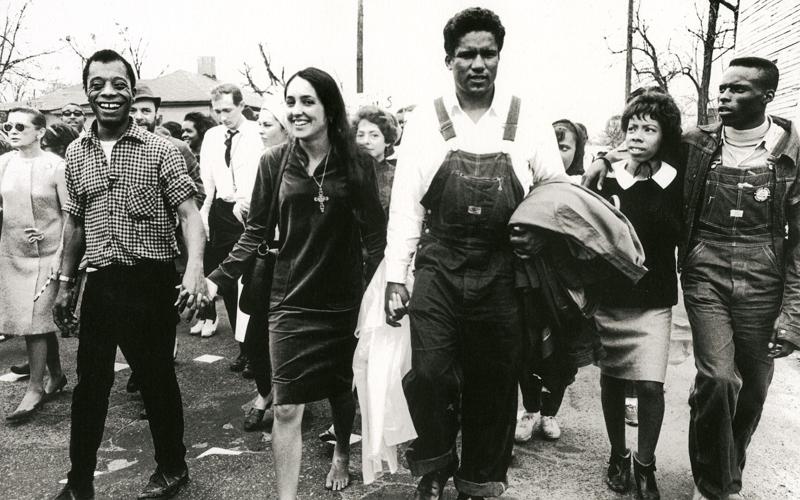
During the height of her fame, Baez used her status to make a positive impact. In 1966, the singer joined Martin Luther King Jr. in Grenada, Miss., to lead African American students to a newly integrated public school. Only a week before, a white mob had attacked students and those escorting them.
Baez was also present for King’s “I Have a Dream” speech during the 1963 March on Washington for Jobs and Freedom.

“We all knew something pretty grandiose was going on,” says Baez. “This made a difference to me as I realized that this was really happening. Something about that day, 350,000 people, nonviolence and Dr. King’s speech — the thought of it makes me weep.”
“Those days were so real,” she says. “At the moment the world is spiraling toward the abyss and fascism, what we did and those brave children did back then has karmically still got to be around — you can’t do that and then have it vanish from the earth. It dictates somebody else’s decent behavior, but right now we are in such terrible, bullying, hateful and fascist times.”
During the ’80s, Baez realized the culture had shifted — she wasn’t quite as famous as she once was. She admits in the documentary that she “was enticed by being hip and groovy and having [her] name better known.”
“I didn’t have direction,” she says. “When you start off at 18, the houses are all filled, [you’re on the cover of] Time magazine, it never dawns on you that at some point it’s just not going to be that way. I was for a long time stuck in thinking that everybody else was wrong. Music was passing me by, and it took a long time for me to realize that and then deal with it.”
Baez has inspired a wide array of artists, from Lana Del Rey and Led Zeppelin to even Judas Priest. Her music has resonated with millions, some unexpected. And even some unwelcome.
“Throughout my career, the strangest people would come up to me and say how much my music has meant to them,” she says. “I was at a party with Allen Ginsberg, Bob Dylan and a bunch of Hells Angels. This Hells Angel came up to me with a bunch of swastikas and shit hanging off him, and he said, ‘I just want you to know your music has always meant so much to me.’ I just thought, ‘Where did I go wrong?’”