
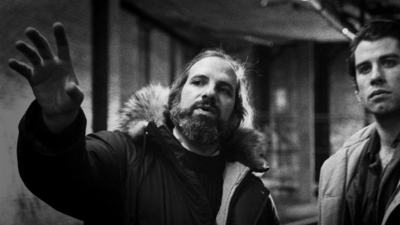


Noah Baumbach and Jake Paltrow’s De Palma is less a documentary on filmmaker Brian De Palma’s life and more a master class from the auteur himself — 100 minutes and change of De Palma walking the audience through his entire career, start to finish. And using the phrase “Holy mackerel!” a lot.
Throughout the course of the interview, which is shot and presented an awful lot like an interview in one of Errol Morris’ documentaries, the man behind everything from Carrie and The Untouchables to Scarface and Carlito’s Way takes us through his entire filmography. De Palma is indeed an iconic filmmaker — an overwhelmingly prolific one at that — and it’s a lot of ground to cover. But his matter-of-fact delivery and deep knowledge of the industry and process don’t allow for lulls.
De Palma’s process is fascinating: He’s part craftsman, part voyeur, part film buff, part anti-establishment rabble-rouser and part deal-maker. Throughout De Palma, Baumbach and Paltrow — the former the brain behind The Squid and the Whale and Frances Ha, the latter Gwyneth’s little bro, who has experience as a television director — present clips from De Palma’s films as he’s describing the process of making them. Some of it is wonky: his formula for setting up shots, his obsession with Hitchcock. Other parts are juicy: anecdotes about Orson Welles (he had to use cue cards in Get to Know Your Rabbit) and Hitchcock’s composer Bernard Hermann (“He was scary”), not to mention occasional flashes of the director’s fully exposed psyche (an anecdote about a childhood inspiration for a Dressed to Kill plot development is particularly intriguing).
“Most of my movies are about megalomania,” says De Palma at one point. And that speaks volumes. He’s from a fraternity of directors that includes Spielberg, Lucas, Scorsese and Coppola — more than just contemporaries, most of these giants of cinema are friends and advisers to one another. And of that bunch, De Palma is something of the lurid weirdo — the lone creep in the bushes filming cross-dressers and sex parties while the rest of the bunch make movies about gangsters and space aliens. And as such, De Palma is somewhat misunderstood and sometimes bitter about it, and through it all is clearly more obsessed by credits and on-set egos and box-office returns than you might expect.
Even just as a refresher course on an abundant catalog (Oh right, he did Mission Impossible! Wait, he put a young Melanie Griffith in Body Double?), De Palma serves its purpose. But past that, as the dissection of a complicated and singular mind, it’s almost as entertaining as the man’s films.
De Palma, the son of a surgeon who doesn’t bat an eye at the sight of blood, who cast Robert De Niro in some of his first roles, who talks about his marriages dissolving with the same degree of concern most of us might use to describe dealing with a summer cold — he’s almost fascinating enough to be one of his own characters.
Email arts@nashvillescene.com



