


There’s a school of thought that many of the differences in American politics are manufactured or at the very least manipulated. With the exception of issues that have two very obvious sides with very little gray area — capital punishment comes to mind — politicians and their complicit talking-haircut handmaidens in the media emphasize that on every single issue that comes down the pike, there’s a right way to think and a wrong one.
In large part, this is a product of the hard two-party system that has defined the political landscape for the overwhelming majority of our country’s existence. It’s also a fairly grim view of things, and an overly simplistic one. It cynically makes Americans automatonic pawns in a game being played by the already powerful, and it casts away any chance of individual agency among voters, ignoring the fact that many people genuinely hold beliefs and aren’t puppets of the political class.
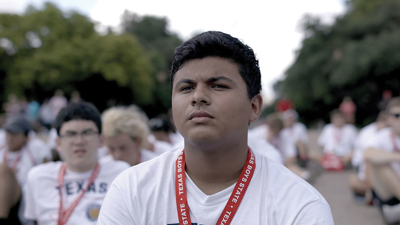
Boys State, a new documentary from the husband-and-wife directing team of Jesse Moss and Amanda McBane, presents a view of what a wholly manufactured political system would actually look like. Boys State is an 83-year-old program run by the American Legion. (There’s a Girls State as well.) Essentially, 16- and 17-year-old boys from across a state, selected by local Legion posts, come together and re-create state government for one week every summer. The emphasis is, by and large, on process rather than policy, with elections for a state’s highest offices as the week’s climax. The film spends a week at Texas’ Boys State in Austin, as 1,100 teenage boys play-act — rather convincingly so — the political process. Rather than letting the boys choose their political parties based on belief, the group is split in half, each boy randomly assigned to one of two parties — the Federalists or the Nationalists — that come together to nominate their candidates and construct a platform.
It is a bit disconcerting to see boys on the verge of manhood so accurately parallel what alleged grown-ups do to seize power, but it’s hard to say if it’s more disturbing to see kids mimic the pros or to realize the pros act like teenage boys. It being Texas, the true political beliefs of the “Statesmen,” as they are called, are by and large fairly predictable, fairly boring bog-standard Fox News conservatism: pro-gun, pro-life, pro-immigration-control. Those stances bleed into the party platforms, meaning there’s very little light between the Feds and Nats.
It also means that those who hold views outside the mainstream, like Rob — a gladhanding, ebullient, straight-out-of-central-casting teenage Texan who made a remarkable amount of money after he forgot he owned a Bitcoin and used the proceeds to, naturally, buy new boots — have to make bargains with themselves if they want to win an election. Bargains like downplaying — or even downright lying about — their personal beliefs to try to win votes.
“That’s politics — I think,” Rob says in a moment of bildungsroman-level clarity.
We also meet Rene, a transplant from Chicago with the natural gift of gab honed at the pulpit of what must be a very engaging church, and his nemesis Ben, a Reagan fanboy who looks a bit like Rahm Emanuel and has an unsettlingly innate gift for the greasier side of politics.
The protagonist, though, is Steven. Where far too many of the characters exemplify the division and rancor and dirty tricks of American politics in 2020 — hey, it works! — the soft-spoken son of Mexican immigrants hops on the bus to Austin in a Beto O’Rourke T-shirt and with a vision of Americans united … or at least not constantly at one another’s throats.
Boys State offers a glimpse of the future, of course. The Boys State program counts among its alumni Bill Clinton, Samuel Alito and Dick Cheney, plus countless lawmakers at the state and federal level. There’s no doubt that at least one prominent future leader is in the bunch. Featuring kids all born after the turn of the 21st century, it also portends a political future in which every candidate has a lifelong social media presence. The long-ago threats from the cliché vice principal about every mistake made growing up showing up on a “permanent record” is reality to this generation. It’s hard to contemplate such a burden — not just for those with a desire to enter professional politics, but for any child.
No, Boys State is not an entirely hopeful movie. Many of the Statesmen were inspired, at least tactically, by Donald Trump and his imitators. And as one might expect, there’s some frivolousness. No one can expect 1,100 teenage boys away from home not to make mischief (proposing “laws” that would exile Prius owners to Oklahoma, for example). If you’ve always wanted to hear Darude’s “Sandstorm” played on a French horn, there’s a teen boy in Texas happy to oblige you.
There are also moments of real education, as the Statesmen talk out (and sometimes talk themselves out of) their political views. As Rene says, noting the overwhelmingly rightist views held by the group, “This is literally something every liberal needs.” But there is, as Steven says, a sense that the kids are all right. For every absurd piece of performative toxic masculinity and speech that borders on fascism, there’s genuine humanity and emotion. It’s easy as one ages to forget the rapidity with which teenagers form real connections with one another. But after all, a lifelong friendship can’t be built unless you start early.
For those worried that the American political experiment will decay into demagoguery, Boys State offers plenty of support. For those with a sunnier view of the future, it presents evidence of better days as well. It’s compelling from the start to its heart-wrenching finish — an examination of young manhood and citizenship, and a reminder that ultimately, we will choose what our democracy becomes, for good or ill.



