
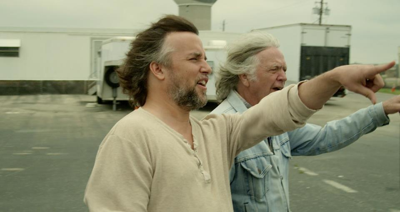
Double Play, Gabe Klinger’s new documentary about directors Richard Linklater and James Benning, is not a conventional portrait of filmmakers at work, or the sort of glowing career-retrospective clip show that serves as a glorified DVD extra. As it happens, both of Klinger’s subjects have been profiled in just such films before: Benning was filmed, by German TV documentarian Reinhard Wulf in 2003 while making his wonderful 13 Lakes, while Linklater was recently profiled in a rather hagiographic documentary entitled 21 Years, released last year to relative indifference. Klinger, who is a film critic, was clearly after something else. His film is a critical intervention, a biographical essay of sorts that aims to provide a new way to consider these very different filmmakers.
One of the ways Double Play accomplishes this critical task, of course, is by comparison, and Klinger recognizes that in placing Linklater alongside Benning, he is making a kind of argument. Disclosure: I have known Klinger for years, and as a critic, he is interested in treating “cinema” as a single universe, regardless of whether it comes from Hollywood or the DIY margins. He knows that Linklater is well known (although he could not have predicted that the Austin-based maverick would be on track for an Oscar this year — all hail serendipity); and by and large, Benning is not.
But the two men have been friends for decades, going back to when Linklater ran the Austin Film Society and invited Benning to screen there. Klinger is interested in their relationship, of course, but beyond this, Double Play implicitly sets the stage for a clear but tacit argument: Benning and Linklater are artists of equal magnitude, regardless of the fact that one enjoys more mainstream success than the other. So the film asks us to consider the usual metrics for success in filmmaking, and to expand our notions of both cinema and experimentation.
Linklater is currently enjoying the greatest success of his career with films that represent a refinement, possibly a perfection, of his authorial approach. The trifecta of Bernie (2011), Before Midnight (2013) and Boyhood (2014) clearly shows an artist at the height of his powers. The same could be said of Benning, who has been a major figure in the avant-garde film world since the early 1970s but in the last 15 years has become one of its two or three most prominent practitioners.
Benning is mostly known for landscape films shot with long, still takes. Unlike many experimentalists, Benning works almost exclusively at feature length, relies on the straightforward realism of the film image and is concerned with the social and political ramifications of the events and landscapes he frames. This makes his films more accessible than many experimental films, but still somehow not quite populist enough for the mainstream.
The title, Double Play, is a pun on the fact that Klinger is profiling two artists who share a passion for baseball. While Linklater’s remake of The Bad News Bears is often considered one of his weakest efforts, it’s an outgrowth of this interest. Likewise, Benning’s 1984 film American Dreams is about, among other things, Hank Aaron’s struggle to beat Babe Ruth’s all-time home run record.
We see Rick and James playing ball, naturally. But a great deal of Double Play consists of the two men talking with each other about their work and aesthetics, how they tend to see the function and promise of cinema in highly similar ways. Both men came to filmmaking from other careers (Linklater from working on an oil rig; Benning from studying mathematics and working odd jobs), and were largely self-taught cineastes.
And both understand that film is a process of organizing time. Baseball takes a certain kind of temperament — the ability to appreciate a relaxed, loping rhythm, occasionally punctuated by some burst of agitated activity. This mindset is not altogether different from that which Linklater and Benning bring to their filmmaking. Boyhood and the Before movies are all about the long game, and Benning’s work — his 270-minute “California Trilogy” or the two-shots-in-two-hours Ruhr — ask us to observe small changes within a relative field of sameness. Double Play is an essay-doc about a similar relativity: how two men use cinema to reshape time, adjusting our focus in divergent but related ways.



