
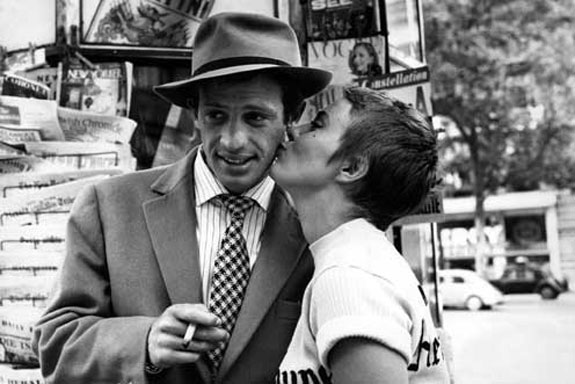
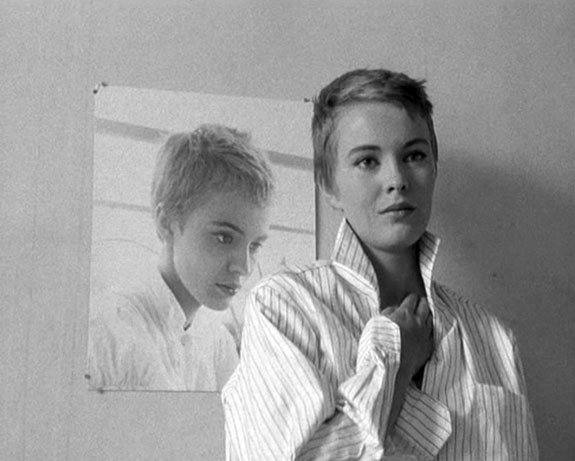
Watching Breathless again after all these years, in the 50th anniversary restoration Rialto Pictures is currently touring across America, one wonders if Jean-Luc Godard had any idea what the hell he was doing at the time. The director himself once said that he thought he was making Scarface only to discover he had made Alice in Wonderland. That's not to say that Godard's 1960 cause célèbre — the film that, along with Truffaut's The 400 Blows one year earlier, effectively launched the French New Wave — is not one of the most important works of any art form in the 20th century. But whereas other films — even other films by the notoriously flighty Godard — are content to merely use and explore and sometimes even expand cinematic language, Breathless virtually invents one before our very eyes. Nothing would ever be the same again.
On paper, it starts off as pretty standard stuff: Michel Poiccard (Jean-Paul Belmondo), a Bogart-obsessed car thief, shoots a motorcycle cop, then joins up with beautiful American student Patricia Franchini (Jean Seberg), whom he had met a couple of weeks earlier. The two proceed to spend as much time lounging around lobbing oblique questions and declarations at each other as they do fleeing the authorities. Along the way there are quotations, various riffs on movie iconography, a hilarious cameo by gangster film maestro Jean-Pierre Melville, but little in the way of tension.
Almost as an afterthought, the fuzz does eventually catch up with Michel, and Patricia betrays him. In one of the most iconic finales in all of cinema, our fatally wounded anti-hero staggers through traffic and finally topples in the middle of the street, uttering his final, immortal line: "C'est vraiment dégueulasse" — variously translated as "That's really disgusting," and, in this new translation, "Makes me want to puke." Is he saying it to Patricia? We'll never really know. Should we even care?
Godard would perfect this devil-may-care approach to narrative in subsequent pictures. But in Breathless, we can actually sense him discovering it — throwing away the old and groping his way around for the new. Perhaps by necessity: The opening scenes, of the glances that pass between Michel and one of his molls as he prepares to lift a vehicle, feel like a bad film student's painful attempt at Hitchcockian suspense. Several other times in the film we can sense Godard experimenting with (and essentially tossing out) conventional narrative devices and techniques. Insert shots, close-ups, cut-aways, editing for suspense — he tries out the full menu of Griffithian tactics, and pretty much discards them all.
His mind, it turns out, just doesn't function that way. Proper dramatic structure requires conflict, catharsis. Proper Godardian structure undercuts such things, with jump cuts, bizarre non sequiturs, and long passages in which practically nothing happens. He's content to just watch Belmondo walk through a room, without really making it clear what the guy is looking for; if we knew what he was doing, then we might not pay as much attention to the reality of him doing it. (Is it any wonder that Breathless came just 15 years after Sartre introduced the term "existentialism?")
So why then does the damn thing work so well? The real secret of Godard's cinema, especially in these early years, is that he was one of the great shooters in the history of cinema. No disrespect to cinematographer Raoul Coutard, who would go on to shoot some of the most seminal works of this era (including more than a dozen other Godard films), but Godard had — and, some might argue, still has, when he bothers with it — an uncommon ability to train a lens on something worth watching, divorced of any context. Breathless, the wild catastrophe that somehow became a near-masterpiece, is the proof. Something happens between this director and his frame that is as close to alchemy as the cinema is ever likely to get.
Email arts@nashvillescene.com.



