
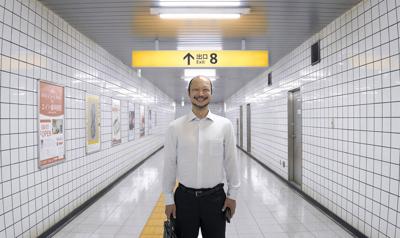


Exit 8
“It’s what the game ‘I Spy’ has been preparing you for,” my friend Kishan told me, talking about the indie video game The Exit 8. That game has, as unspeakable liminal horrors can do, revealed its next form with Genki Kawamura’s film Exit 8, a prizewinner at Cannes 2025 now making its way into international theaters. “I’ve never been more scared to turn a corner in a bright hallway in my life.”
The setting here is a subway station, an ongoing tunnel with a few 90-degree turns here and there. There are posters for upcoming events, public health messaging, safety notices. M.C. Escher’s art gets a shoutout. Nothing here looks all that different from any other metro station you might find in the world. But this isn’t a typical place at all. There are rules, compelling you (the participant as well as the viewer) to keep a sharp eye out for anomalies in the tunnels, and to immediately turn back if encountering any such variances. Your phone will not save you. You can take photos of the walls to your heart’s content, but what you retain in your phone is garbled yellow slop.
Liminal horror (see also Skinamarink or Noclip or the upcoming Backrooms) is about indistinct spaces, rooted in the fear that our own faculties are betraying us, and that the breakdowns of synapses are deforming the physical space around us. It is simultaneously giving husk, haunted house, futuristic yet outdated ennui and the ruins of What Came Before. It’s a genre devoted to the unspeakable things operating just below the threshold of panic-based response. At first. And we see these spaces evolve, as joints crack and elongate and new, ghoulish senses of purpose arise.
There’s a subtle horror inherent in public transit, though it’s not rooted in the racism that defines the history of that kind of infrastructure — rather, this horror is about what happens when spaces designed for hundreds and thousands are wide-open and empty. It’s an internal unease that gathers strength the longer it is experienced, kicking the reptilian brain into lower gear. Exit 8 specifically demonstrates how blank spaces become sounding boards for whatever we bring into them. You can feel things coalescing, slowly and surely, like fingers slowly clenching into a fist. The way that we notice things — or don’t. It’s a constant war of attrition between your eyes and your fear, which is a great concept for unsettling art, and this film is remarkable in the way it wrecks your soul in its brisk run time. Exit 8 is a process-oriented creepypasta brought to life.
But there’s never a peek under the hood. The intelligence, or instinct, running this scenario is deeply and impenetrably alien, and will remain so. Something that just taps into our infrastructure and lets the mice loose in the maze of our own making. Whether you take it as allegory or challenge or nightmare, the cosmology operating here is fascinating and deeply upsetting.
If you’ve been waiting for there to be a new vision in horror that comes along and Cubes things up, this one is totally for you. (If you’re a fan of the podcast Magnus Archives, this is a collaboration between The Spiral, The Vast, The Buried and The Lonely.) And the time is right for this after the unprecedented success of Markiplier’s adaptation of the indie game Iron Lung back at the end of January. Like that film, Exit 8 benefits from a strong lead performance (which is the essential ingredient in any high-concept, low-budget minimal approach). This is absolutely the moment for the indie-game-to-big-deal-film pipeline to dazzle a marketplace that wants new vistas.
As part of the current J-horror renaissance (see also Ryota Kondo’s Missing Child Videotape and Kôji Shiraishi’s About A Place in the Kinki Region, hopefully coming to domestic screens sometime soon), Exit 8 does a razor-sharp vivisection of what all is going on and how it’s affecting us, as well as pinning contemporary masculine unease to a surgical table and digging deep.
No horror film this mean could ever truly be respectable. There’s no foul language and no graphic violence, but watch out for those adult themes, because they will get you every time. The closest thing I can compare it to is The Durutti Column’s “Otis,” with soothing and neutral loops and whirls of some of the starkest, most troubling extracts and sources. And the scars that this film leaves don’t heal. It’s not a film that watches you back, but it is a work of art that opens an outpost in the back of your skull — a Gerry, a Twin Peaks, a Shining, a Desert of the Tartars. It will remain there long after you’ve left the theater.
Or have you?



