
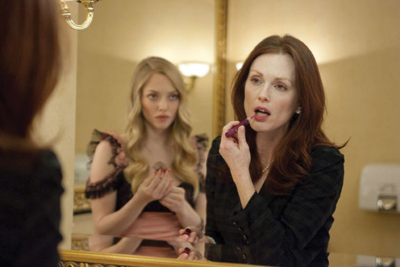

Taking the skeleton of the 2003 French film Nathalie... and building a designer house's worth of insecurities and needs on its bones, Chloe is a portrait of a family in crisis and the perniciousness of jealousy as it erodes outward. Director Atom Egoyan (here working on a script he sadly had no input on) has made remarkable films about obsession and emotional frustration: his 1991 masterpiece The Adjuster gets at the heart of the multifaceted labyrinths of desire in a way that very few films have even tried. For much of its first half hour, Chloe promises to be a film about real women's issues — and in Egoyan's steady hands, what could almost be a feminist take on David Lynch's Lost Highway.
But then, through uncertainty and privilege (always a dangerous combination), we find ourselves in an upscale variant of the Cinema of the Erotic Wager. Usually, it's a teen flick or ostensible romantic comedy where characters jump through hoops in order to prove (or rule out) their own future fleshy compatibility. Here, though, we have an intelligent woman paying a high-dollar sex worker to test the limits of her husband's loyalty. And once again, a movie's worth of complication could have been cleared up with one moment of heartfelt honesty — a scene which always ends up happening anyway.
Amanda Seyfried plays the titular immaculate object of desire as both a walking wound of womanhood and a blood-red-nailed, unblinking instrument of emotional trauma. The opening and closing scenes of the film would posit her as something out of Pasolini's Teorema — a family-wide sexual jumpstart — but Seyfried's Chloe is just a cipher for whatever the script requires at any given moment. She's at her best when left as an enigma — as when she and Catherine (Julianne Moore) first meet, setting up the importance of an ornate hair barrette as signifier and war trophy.
Moore, as always, is superb. There is nothing she can't do, and her commitment to the material makes you wish the material earned that trust. Her Catherine is a successful gynecologist dealing with a vast, unnamable something at the heart of her marriage; a resentful and alienated son (an Egoyan specialty); a husband with a wandering and expansive sense of desire (Liam Neeson, quite good in a problematic role — the script demanded rewrites because of his wife Natasha Richardson's tragic death); and a house that lays out the film's subtext in its production design. The house is a masterpiece of false intimacy and intimidation, offering exceptional visibility and sacrificing closeness at every step of the way — it's a remarkable embodiment of the boxed narratives Egoyan has been perfecting throughout his career. And in the midst of this we watch a family torn apart.
Both Moore and Seyfried give it all they've got as far as the sex scenes go, playing out decades' worth of gender issues in a couple of tastefully appointed hotel suites. This is very much the Toronto of David Cronenberg's Crash, where the act of living is a glacially creepy-sexy travelogue where everyone speaks of their desires in the most clinical of terms, leaving nothing unspoken. It's a shame, though, the way things turn so trashily predictable; it seems we may never escape an instinctive cinematic fear of assertive female sexuality. It's like starting a film on Sundance or IFC, and then before you know it you're right in the middle of a circa-1991 Cinemax After Dark presentation.
Email arts@nashvillescene.com.



